Best Dutch Ovens
Roundup · Enameled Cast Iron Under $100

The Best Dutch Ovens Under $100

The iron inside a $50 Dutch oven and a $300 one is the same iron, cast the same way. What changes under a hundred dollars is the enamel, the knob, and how much handle you get to hold onto. We compared published specifications and current prices for three enameled cast-iron pots that all land under $100, to find out exactly what that budget buys and what it quietly takes away.

By Ilane Tall · Updated October 12, 2026 · Research-based.

Affiliate disclosure: we may earn a commission if you buy through the Amazon links on this page, at no extra cost to you.

Enameled cast iron Dutch ovens under one hundred dollars arranged on a kitchen counter
Where the money goes

Same metal, different enamel

Cast iron is a commodity. It is melted, poured into a mold shaped like a pot, cooled, and it holds heat the way cast iron has always held heat — slowly, evenly, and for a long time after you turn the burner off. Nothing about that process changes because a pot costs $300 instead of $50. The three pots in this guide, the Amazon Basics 6-Quart, the Overmont 7QT and the Lodge Essential Enamel 6 Quart, all do the fundamental job of a Dutch oven: they hold a steady, even heat for a braise, a stew or a loaf of bread, because they are all cast iron.

What separates a $50 pot from a $300 one is almost entirely the enamel — the glass coating fused onto the iron at high heat so you never have to season it, worry about rust, or avoid a tomato sauce. Enamel quality is not a marketing word; it is a real, measurable thing: how evenly the coating is applied, how well it resists a metal spoon scraping the bottom, how it holds up after a few hundred trips through a dishwasher, and whether the interior is light enough that you can actually see a sauce reducing or a fond browning. None of the three pots here publish a lab figure for chip resistance, because none of their manufacturers do — this is true of nearly every enameled Dutch oven on the market, premium or budget. What we can tell you honestly is where the published specifications differ, and that is mostly in capacity, color options, and the few included extras.

Our top pick across every price tier is also the cheapest way into genuinely durable enamel: the Lodge Essential, at $69.99, comes from a foundry that has cast iron in Tennessee since 1896 and sits comfortably under $100 while behaving, day to day, almost exactly like the cookware that costs four times as much. The Amazon Basics and Overmont pots below it are not worse at holding heat. They are simply less certain, on paper, about how their enamel will look in five years — because nobody publishes that number, at any price.
Read the label

What a published oven-safe temperature actually tells you

Of the three pots here, only the Amazon Basics 6-Quart publishes a specific number: oven safe to 500°F. That single figure covers every braise, roast, and bread recipe a home cook is likely to run, and it is worth noticing precisely because the manufacturer bothered to state it. The Overmont 7QT and the Lodge Essential 6 Quart do not give us a temperature figure in the specifications we have on file for them, which is not unusual — it simply means you should check the current listing yourself before you push a pot past 450°F for a long roast, rather than assume a number nobody has published.

Here is the detail that gets missed: the iron and the enamel on almost any Dutch oven can take oven heat far beyond what most home ovens ever reach. The actual limiting part is usually the lid knob. Dutch ovens that ship with a plastic or phenolic knob are rated lower than the pot body itself, which is why some brands sell a stainless steel replacement knob specifically to raise that ceiling. If a listing is silent on oven-safe temperature, that silence is itself a piece of information — it means you are trusting the knob, not just the pot, and you should find out what the knob is made of before you put it under a broiler.

None of this is a mark against the two pots that don’t publish a number. It is a reason to open the current Amazon listing before buying and read what the manufacturer specifically says about oven temperature, rather than extrapolate from a sibling product or a review that may be describing a different lid.

The spec nobody photographs well

Handle size, and why it matters more than the brand

A full six-quart Dutch oven is heavy before you add stew to it, and you will be lifting it out of a 400°F oven wearing thick mitts, not bare hands with fine motor control. Handle geometry decides how safe that lift is far more than which company's name is stamped on the lid. The Amazon Basics 6-Quart specifically advertises dual handles on a round body, which is the configuration that lets both hands grip symmetrically rather than one hand doing more work than the other — a meaningful detail at this price point, where it would be easy to cut a corner on exactly this.

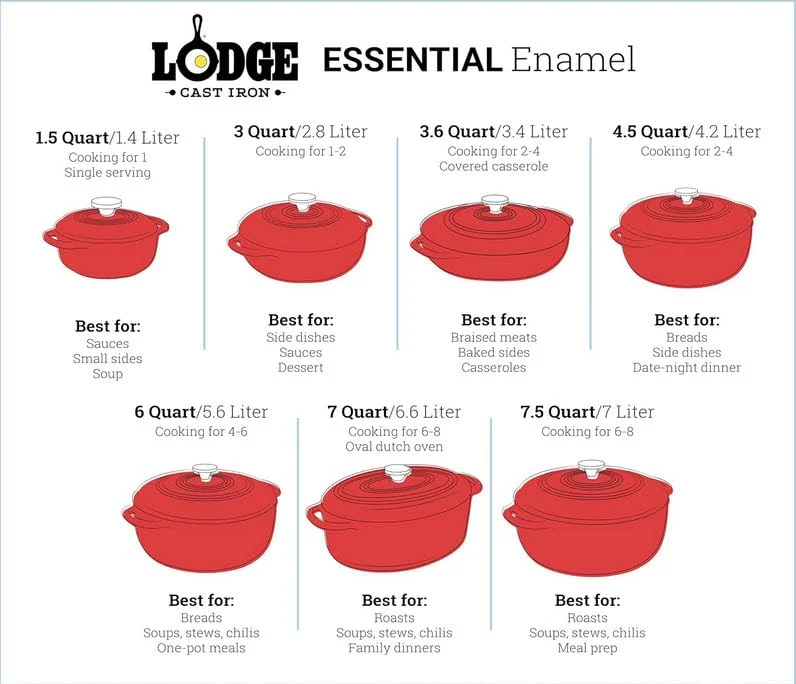
The Overmont 7QT is a larger, heavier pot at seven quarts, built with thick walls specifically to even out hot spots across a wide base; a bigger pot asks more of its handles by definition, since there is simply more mass hanging off them when it's full. The Lodge Essential, at six quarts, is sized to the capacity most households actually use week to week, which indirectly helps here too — a pot you are not routinely filling to its absolute limit is a pot that is easier to carry safely regardless of exactly how its handles are shaped.

None of these three listings give us a handle measurement in inches, so we will not invent one. What we can tell you is to treat handle size as a question to answer before buying, not after: look at the product photos for how far the handle stands away from the body, and recognize that a pot described as compact or space-saving is very often making that trade at the handle.

Side by side

The three, compared

PotBest forCapacityMade byNotablePriceGet it
Lodge Essential Enamel 6 Quart Most kitchens 6 qt Lodge No seasoning needed, casting iron since 1896 $69.99 Get it
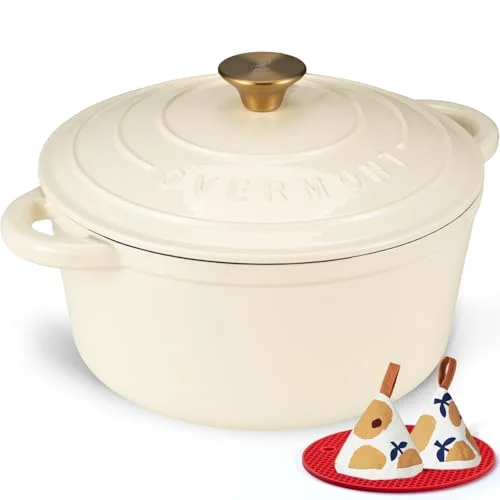
Overmont 7QT Enameled Feeding a crowd 7 qt Overmont Ships with cookbook and cotton potholders $59.99 Get it
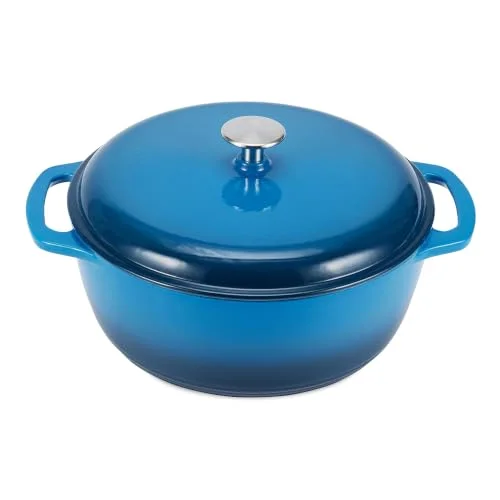
Amazon Basics 6-Quart A first pot, tightest budget 6 qt Amazon Basics Oven safe to 500°F, dual handles $49.99 Get it
The picks

Our picks, and who each one is for

01Best overall

Lodge Essential Enamel Cast Iron Dutch Oven, 6 Quart, Oyster White

Best for most kitchens, under $100 or over it

6 quarts·Oyster white enamel·No seasoning·Made by Lodge

At $69.99, this is the pot in this roundup with the clearest provenance: Lodge has cast iron in South Pittsburg, Tennessee, since 1896, and the Essential Enamel line is their answer to needing cast-iron heat retention without the seasoning ritual or the rust risk of bare iron. Six quarts is the size that actually gets used week to week — a whole chicken, a loaf, a stew for six — rather than a size bought for the one holiday dinner a year. It is also the only pot here that sits comfortably in the same conversation as the $300 French brands on the rest of this site, at a fraction of the price.

If you are deciding whether you will actually use a Dutch oven, this is the one to find out with.

Lodge Essential Enamel cast iron Dutch oven, 6 quart, oyster white
Price
$69.99
Check price →
02Best value

Amazon Basics Enameled Cast Iron Dutch Oven, 6-Quart, Blue

Best for the tightest budget

6 quarts·Dual handles·Oven safe to 500°F·Round, blue

Forty-nine dollars and ninety-nine cents is the floor of what a competent enameled cast-iron pot costs, and this is that pot. Dual handles on a round six-quart body, heavy-duty construction, and a plainly published 500°F oven-safe rating that covers every stew, roast and baking job you are likely to ask of it. There is no foundry heritage story and no included cookbook — it is cast iron with enamel on it, priced close to as low as that combination goes while still naming an oven-safe figure outright.

The specification that matters most here is the one they actually printed: 500 degrees, in writing.

Amazon Basics enameled cast iron Dutch oven, 6-quart, blue
Price
$49.99
Check price →
03Best for a crowd

Overmont Enameled Cast Iron Dutch Oven, 7QT, Cream White

Best for feeding five to eight people

7 quarts·Thick-walled cast iron·Cookbook included·Cotton potholders included

Seven quarts for $59.99 is the most capacity per dollar of the three pots on this page by a wide margin. Overmont builds this one with thick walls specifically to even out hot spots across a wider base, and bundles a cookbook with cotton potholders — not a gimmick once you have felt how much a full seven-quart pot weighs coming out of the oven. If your household regularly cooks for more than four, the extra quart is the real reason to choose this over the two six-quart pots above.

More pot for less money, as long as you have the cupboard space and the counter room for it.

Overmont enameled cast iron Dutch oven, 7 quart, cream white
Price
$59.99
Check price →
The long view

What changes after two or three years

We don’t have verified review data tied to these specific three listings, and we won’t invent sentiment to fill that gap — no paraphrased "owners say," no manufactured star rating, nothing attributed to a reviewer we can’t point to. What we can describe honestly is how enameled cast iron behaves as a category over a few years of ordinary use, because the physics and the chemistry of enamel-over-iron don’t change by brand.

Enamel is glass fused to iron, and glass is harder than it is flexible. The most common failure point across the category is chipping at the rim or the interior base, usually from a metal spoon scraping against the enamel, a pot banged against a faucet while being washed, or sudden temperature shock — a hot pot plunged into cold water. A lighter interior enamel, where the manufacturer uses it, tends to show staining and discoloration sooner than a dark one, simply because stains are visible against a pale background; that is a cosmetic trade-off, not a functional one, since a stained enamel surface still cooks exactly the same as a pristine one. Dishwasher use accelerates all of this gradually, even on pots marketed as dishwasher-safe, which is why hand-washing is the standard care advice across the entire enameled cast-iron category, not a brand-specific quirk.

None of that is specific to the Amazon Basics, the Overmont or the Lodge. It is simply what enamel does, on any Dutch oven, if you use metal utensils and a dishwasher for several years. The way to extend any of these three pots is the same regardless of price: wood or silicone utensils, no cold water on a hot pot, and a hand wash when you can manage it.

The real question

When to spend more, and when it is vanity

There are three honest reasons to spend past $100 on a Dutch oven, and none of them are "it cooks better." First, enamel quality and the manufacturer's own confidence in it — brands like Le Creuset and Staub, both compared elsewhere on this site, publish specific claims about chip and stain resistance and back them with long warranties, which is a real signal even though nobody publishes an independent lab figure. Second, handle and lid engineering tuned for a specific use — a spiked, self-basting lid built for long braises is a genuine design choice, not a flourish, and it only shows up once you've picked a premium line that bothers to engineer it. Third, color and finish options, which is pure preference and has nothing to do with performance.

Everything else that premium pricing implies — that the pot will hold heat better, cook a braise more evenly, or last fundamentally longer in normal use — is largely vanity, because the iron underneath is the same iron. A six-quart Lodge at $69.99 run through the same recipe as a six-quart Le Creuset at $300 will produce a nearly identical result on day one. The gap opens slowly, over years, in how the enamel ages, and only if you are rough with metal utensils and a dishwasher in the first place.

Our honest recommendation: buy under $100 if you are finding out whether you will actually use a Dutch oven, if your budget is genuinely tight, or if you are careful with cookware regardless of what it cost. Spend more only once you already know you use one constantly and want the warranty and the enamel confidence that comes with a brand that stakes its reputation on exactly that.

Our method

How we compared

What we did

Specs and current prices, cross-checked

We compared the published specifications and current Amazon prices for the Amazon Basics 6-Quart, the Overmont 7QT and the Lodge Essential 6 Quart, limiting every claim in this article to what each manufacturer actually states — capacity, included accessories, oven-safe temperature where it is published, and the materials used. Where a specification such as a handle measurement or an oven-safe figure is not published for a given pot, we say so plainly rather than estimate it from a similar-looking product.

What we didn’t

We don’t run a testing lab

We do not physically test these pots, we do not own them, and we have no star ratings or review counts for these specific listings to report, so we don’t publish any. The questions that actually matter over years of use — how the enamel chips, how the lid fits after a hundred washes — cannot be answered honestly from a fortnight with a pot, by us or by anyone else claiming to have tested it. We can read the categorical, well-established facts about how enameled cast iron ages, and we do, rather than invent product-specific sentiment we don’t have. See more about our approach on the About page.

FAQ

Common questions

Is a Dutch oven under $100 as good as one that costs $300?

For cooking, yes, on day one. Both are enameled cast iron, and the iron holds heat the same way regardless of price — a stew braised in the Lodge Essential at $69.99 and one braised in a $300 French pot will come out nearly identical. The premium buys enamel confidence, warranty, and handle or lid engineering tuned for specific techniques, not better cooking from the iron itself.

Which of these three Dutch ovens should I buy?

The Lodge Essential Enamel 6 Quart at $69.99 is the safest default for most kitchens: a known foundry since 1896, no seasoning required, and a size that fits most households. Choose the Amazon Basics 6-Quart at $49.99 if budget is the deciding factor and you want a published 500°F oven-safe rating in writing. Choose the Overmont 7QT at $59.99 if you regularly cook for five or more people and want the extra capacity.

Do budget enameled Dutch ovens need to be seasoned?

No. Seasoning is a bare cast-iron requirement, not an enameled one. All three pots in this guide are enameled, which means they are ready to use out of the box, will not rust, and can handle acidic sauces like tomato without issue. What enamel needs instead is gentler handling than bare iron: wood or silicone utensils and care around sudden temperature changes, regardless of what the pot cost.

What oven temperature can a budget Dutch oven handle?

Check the specific listing rather than assume. The Amazon Basics 6-Quart publishes 500°F outright, which is enough for virtually any home recipe. The Overmont and Lodge pots in this guide do not list a specific figure in the specifications available to us, and on most Dutch ovens the actual limiting part is the lid knob rather than the pot itself — a plastic or phenolic knob is usually rated lower than the cast iron body underneath it.

Keep reading

More from Best Dutch Ovens