Best Dutch Ovens
Honest Take · Amortized Cost

The Real Cost Per Year: Is a $300 Dutch Oven Actually Cheaper Than Five Budget Pots?

A CAROTE 5QT costs $35.99. A Le Creuset 5.5 qt. costs $349.99 — eight times as much for roughly the same capacity. Compared purely on sticker price, that is not a close call. Compared on cost per year of actual ownership, it gets a lot closer, and sometimes the premium pot wins outright. We ran the amortized math using the published prices and warranty terms for four enameled cast-iron pots, stated our assumptions about how long each one realistically lasts, and show exactly where the arithmetic tips each way.

By Ilane Tall · Updated November 11, 2026 · Research-based.

Affiliate disclosure: we may earn a commission if you buy through the Amazon links on this page, at no extra cost to you.

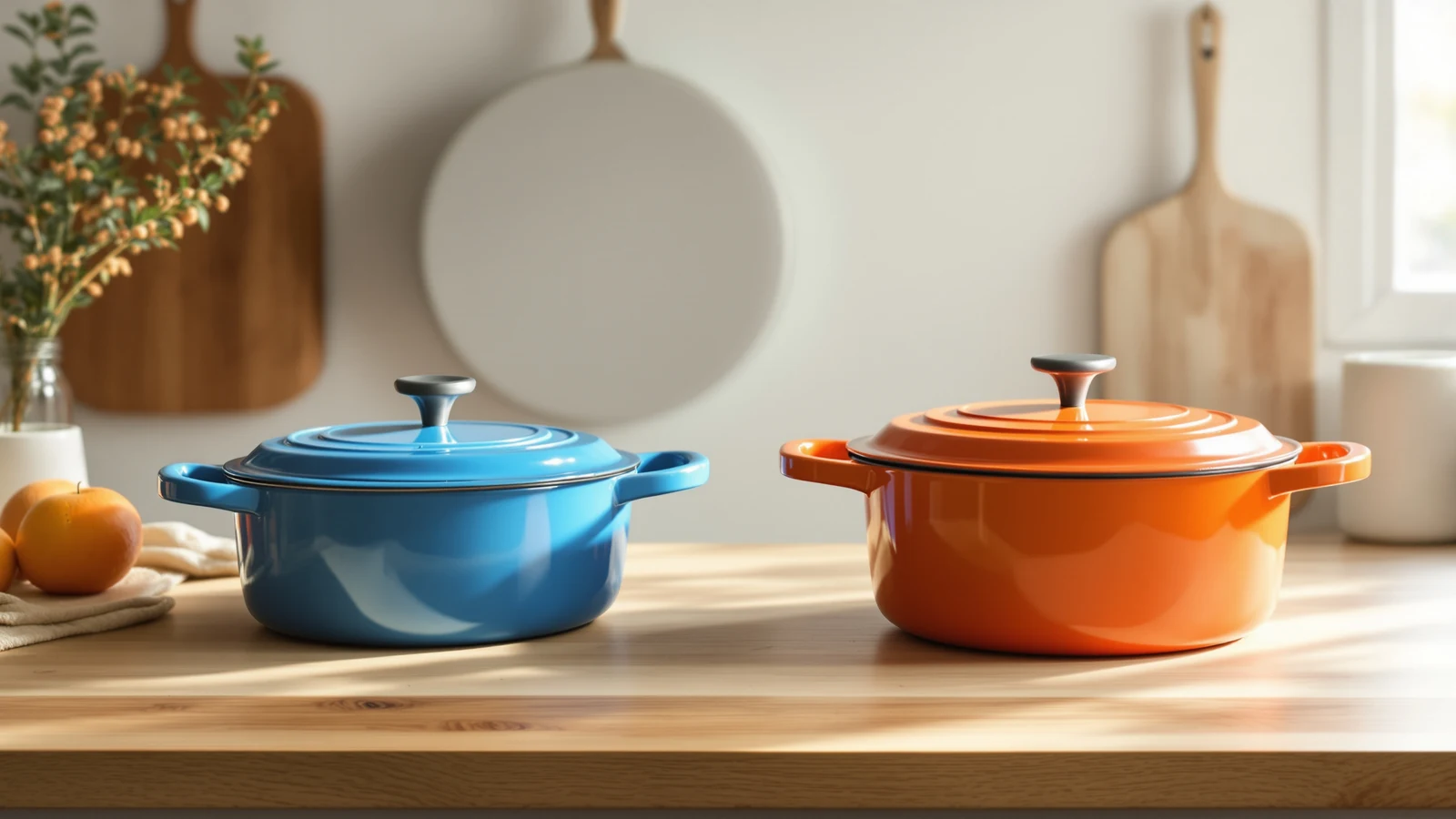
A premium enameled cast iron Dutch oven and a budget enameled Dutch oven side by side on a kitchen counter, illustrating a cost-per-year comparison
The number that lies

What a sticker price hides: cost divided by years owned

A sticker price is a single number for a purchase that actually plays out over years, and that mismatch is where most Dutch oven buying advice goes wrong in one direction or the other. Tell someone to "buy cheap and replace it" and you are ignoring that a pot bought five times costs more in total than a pot bought once. Tell them to "buy the best and it pays for itself" and you are ignoring that the payoff only arrives if the ownership period is long enough for the division to work in the premium pot's favor. Neither slogan does the arithmetic; both skip straight to a conclusion.

The actual comparison is simple to state and easy to get wrong in practice: take the price, divide by the number of years you genuinely expect to own and use the pot, and you get a cost-per-year figure that can be compared directly across price tiers — something a sticker price alone cannot do. A $35.99 CAROTE owned for four years costs about $9.50 a year. A $349.99 Le Creuset owned for thirty years costs about $10.16 a year. Stated that way, the two numbers are almost identical, even though one pot costs roughly eight times as much as the other up front. The sticker price makes them look like entirely different purchases. The cost-per-year number says they are close enough that the real decision comes down to how long you actually intend to own the thing, not which number is bigger today.

That single reframing — price divided by years, not price alone — is the entire argument of this article. Every section below is really just filling in the two variables: a defensible estimate of how long each tier of pot lasts, and what the number looks like once you divide. We are not claiming to know how long any specific pot in your kitchen will last; nobody can know that in advance. What we can do is lay out the assumptions plainly, show the math behind them, and let you swap in your own estimate of your own cooking habits.

The honest downside

How long a $40 enameled pot realistically lasts with weekly use

Neither the CAROTE 5QT nor the Amazon Basics 6-Quart publishes a stated lifespan, and no enameled cookware brand at any price does — that number simply does not appear on a listing, premium or budget. What we can describe honestly is how enamel fails as a category, because the chemistry is the same regardless of price: enamel is glass fused to iron, glass is hard but not flexible, and the common failure point is chipping at the rim or the interior base from a metal spoon, a knock against a faucet while washing, or thermal shock from a hot pot hitting cold water. None of that is brand-specific. It is what enamel does, on any pot, under ordinary kitchen handling.

For the purpose of this math, we are assuming a budget enameled pot used roughly once a week, hand-washed most of the time, occasionally run through a dishwasher, realistically lasts somewhere in the range of three to five years before enough chipping or wear accumulates that most owners would replace it — call it four years as a working midpoint. That is an assumption, not a manufacturer claim, and we are stating it as one. If you are gentler with utensils and never let it near a dishwasher, you will likely beat that number; if you cook daily and run it through the dishwasher every time, you may fall short of it. The CAROTE and the Amazon Basics are each built to the same basic recipe — enameled cast iron, no seasoning required, a lid that fits — and neither publishes anything suggesting a materially different enamel grade from the other, a gap we cover directly in our CAROTE vs Amazon Basics comparison.

At $35.99 and a four-year assumed life, the CAROTE runs about $9.50 a year. At $44.99 over the same four years, the Amazon Basics runs about $10.75 a year. Those numbers are close enough that the eighty-cent price gap between the two listings barely moves the annual figure. The honest downside of either pot is not that it cooks worse on day one — it is that the clock on replacing it starts running the moment you buy it, in a way the clock on a premium pot, treated the same way, mostly does not.

What the premium actually buys

What the Le Creuset and Staub warranties are actually worth in this math

Le Creuset backs its enameled cast iron with a limited lifetime warranty, and Staub backs its enameled cast iron with a limited warranty measured in decades rather than years — both brands publish these terms as part of owning the product, not as marketing copy we are paraphrasing from a review. A warranty does not pay you back the purchase price or guarantee the pot will look new forever; it covers manufacturing defects, not chips from a metal spoon or a drop on tile. But it is a real signal with real weight in this math, because a company does not attach a decades-long warranty to a product it expects to fail in five years. We compare the two brands' actual design and warranty differences in more depth in Staub vs Le Creuset: The Two French Names, Compared.

For this article's math, we are assuming that a Le Creuset or Staub pot, hand-washed and used with non-metal utensils as both brands recommend, realistically stays in daily rotation for twenty to thirty years before an owner replaces it for reasons other than defect — a kitchen downsize, a change in taste, cosmetic wear they are simply done living with. That is a long ownership window by appliance standards, and it is the entire reason the premium tier's cost-per-year number looks as reasonable as it does. Take the Le Creuset at $349.99 over thirty years and you land at about $10.16 a year. Take the Staub at $299.95 over the same thirty years and you land at about $10.00 a year. Shorten that window to twenty years instead and the figures rise to about $15.25 and $15.00 a year respectively — still a defensible number, but a meaningfully different one, which is exactly why the assumed ownership length matters more than the sticker price in this entire exercise.

The warranty, in other words, is not a refund mechanism. It is evidence supporting the twenty-to-thirty-year assumption that makes the rest of the math work. Without that evidence, dividing a $300 pot's price by thirty years would just be optimism; with it, it is a reasonably grounded estimate.

Doing the division

The break-even point: how many budget pots equal one premium one

Set the two assumed lifespans side by side and a cleaner question appears: how many budget pots, bought back-to-back as each one wears out, would it take to match what one premium pot costs up front — and how does that compare to how many years the premium pot is likely to last? Dividing the Le Creuset's $349.99 by the CAROTE's $35.99 gives just over eight. Dividing the Staub's $299.95 by the Amazon Basics' $44.99 gives just under seven. The headline of this article rounds that down to "five" for a punchier question; the honest tally, run on the actual published prices, lands closer to seven or eight budget pots per premium one, not five. We would rather correct our own headline here than let a rounded number stand in for the real arithmetic.

Here is where that number becomes meaningful rather than just a ratio: at an assumed four years of life per budget pot, seven to eight of them back-to-back cover roughly twenty-eight to thirty-two years of ownership — which lines up almost exactly with the twenty-to-thirty-year assumption we used for the premium pot's warranty-backed lifespan. That alignment is the actual answer to this article's title. Over a multi-decade ownership horizon, buying the premium pot once and buying budget pots repeatedly cost roughly the same amount of money, assuming both assumptions hold. The premium pot does not clearly win on price. It wins, when it wins, on everything the repeated-replacement path does not give you: no searching for a near-identical replacement every few years, no risk of the exact color or size being discontinued, and a pot that looks the same at year twenty as it did at year two if you treat it the way the warranty terms ask.

If you would rather split the difference than go all-in on either tier, the same logic applies to any mid-priced bundled line — we run a similar break-even exercise in Overmont vs Umite Chef: Two Bundled Budget Lines, Compared, where neither pot is trying to last thirty years and the price reflects that honestly.

Where the logic breaks

Where the math falls apart if you only cook with it twice a year

Every number above assumes something specific: roughly weekly use, enough to put real wear on an enamel surface over a handful of years. Twice-a-year use breaks that assumption completely, and in a direction most people do not expect — it does not make the premium pot look better. It makes the entire comparison nearly meaningless, because a budget pot used twice a year is not wearing out from chipping or dishwasher cycles in any four-year window; it may well outlast its owner's interest in cooking long before the enamel ever shows real damage. At that usage rate, the CAROTE's realistic lifespan is not four years. It could easily be fifteen or twenty, simply because nothing is happening to the enamel often enough to degrade it on any predictable schedule.

Once the budget pot's assumed lifespan stretches that far, its cost-per-year number collapses toward almost nothing — a $35.99 pot divided by fifteen years of occasional use is about $2.53 a year, which no premium pot's amortized math can beat regardless of how generous the warranty is. At the same time, the premium pot's cost-per-year number does not improve from infrequent use the way the budget pot's does; it was already being divided by a multi-decade assumption, so sitting mostly unused in a cabinet does not meaningfully extend a number that was already long. The honest conclusion for an infrequent cook is the opposite of the headline's premise: at low usage, cost per year stops being the deciding factor at all, because both pots become cheap on that basis, and the decision should shift to cost per occasion, storage space, and whether the extras some budget bundles include — see our look at Dutch Ovens That Ship With Potholders — are worth more to you than four hundred dollars sitting in a cupboard twice a year.

This is the honest asterisk on everything above: the entire amortization argument assumes frequent, sustained use that actually stresses the enamel. If that assumption doesn't describe your kitchen, the math doesn't fail gracefully — it simply stops being the right tool for the decision.

The four, by ownership horizon

The picks, by how long you plan to own one

01Finding out

CAROTE 5QT Cream White Enameled Cast Iron Dutch Oven Pot with Lid

Best if your honest ownership horizon is a few years

5 quarts·Enameled cast iron·Cream white·No seasoning required

At $35.99, this is the cheapest entry point in this comparison, and on the cost-per-year math it is also one of the most defensible purchases on this page — provided you are honest that a few years of weekly use is really what you're signing up for, not a decades-long commitment you're hoping to avoid admitting to. Five quarts suits a household of two to four. There is no warranty story to lean on here, which is exactly the point: the price already assumes a shorter life, so you are not overpaying relative to how long it is actually built to last.

Buy this one if you are still finding out whether you will use a Dutch oven at all.
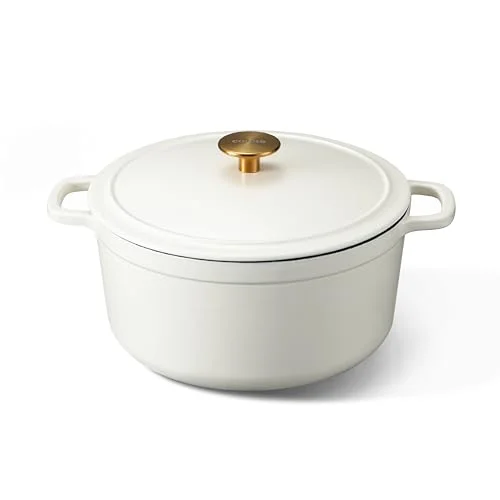
CAROTE 5QT cream white enameled cast iron Dutch oven pot with lid
Price
$35.99
Check price →
02Tightest budget

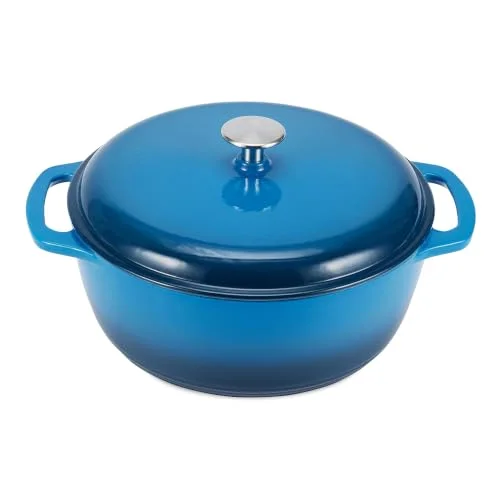
Amazon Basics Enameled Cast Iron Dutch Oven Pot With Lid, 6-Quart, Blue

Best if price per year matters more than price today

6 quarts·Dual handles·Heavy-duty·Round

At $44.99 for six quarts against the CAROTE's $35.99 for five, the per-year math barely separates the two — roughly a dollar a year apart under our four-year assumption. The extra quart of capacity is the real reason to pick this one over the CAROTE rather than any difference in how long either is likely to last; neither manufacturer publishes a figure that would let us claim one outlasts the other. Dual handles on a round body matter here, since a full six-quart pot is genuinely heavy to lift from a hot oven.

The quart you gain costs about a dollar a year. For most households that is an easy trade.

Amazon Basics enameled cast iron Dutch oven pot with lid, 6-quart, blue
Price
$44.99
Check price →
03Decades, braising

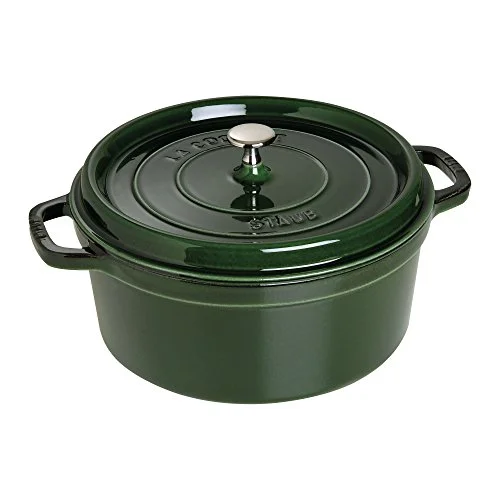
Staub Cast Iron 7-qt Round Cocotte, Basil, Made in France

Best if you know you braise often and plan to keep it for decades

7 quarts·Made in France·Spiked self-basting lid·Basil

At $299.95, the Staub only clears the break-even math laid out above if the twenty-to-thirty-year ownership assumption actually holds for you — which means hand-washing, non-metal utensils, and genuinely wanting a seven-quart pot for the long haul rather than buying it on momentum. If that describes your kitchen, the published warranty terms behind that long-ownership assumption, and the spiked lid built specifically for long braises, are real reasons to spend here rather than replace a budget pot seven or eight times over the same span.

This pot's math only works if you actually keep it that long. Be honest with yourself before you buy it.

Staub cast iron 7-quart round cocotte, basil, made in France
Price
$299.95
Check price →
04Decades, everything

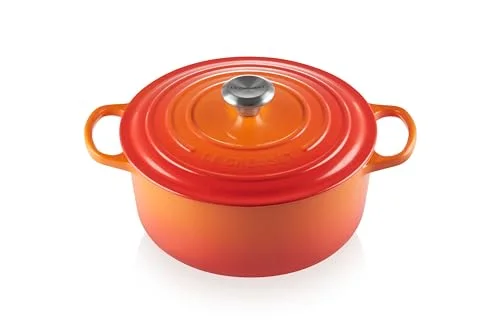
Le Creuset Enameled Cast Iron Round Dutch Oven, 5.5 qt., Flame

Best if you want one pot you never have to think about replacing

5.5 quarts·Flame·Round·Limited lifetime warranty

At $349.99, this is the most expensive pot in the comparison and, on the thirty-year assumption, lands at almost exactly the same cost per year as the Staub and barely above the two budget pots. Five and a half quarts suits two to four people, which is the size most households actually use week to week rather than the size bought for one holiday a year. The limited lifetime warranty is the single piece of evidence in this entire article that makes a multi-decade ownership assumption reasonable rather than wishful.

The price looks like a different category of purchase. Divided by the years, it mostly isn't.

Le Creuset enameled cast iron round Dutch oven, 5.5 quart, flame
Price
$349.99
Check price →
Side by side

The four, compared on cost per year

PotPriceAssumed yearsCost / yearCapacityGet it
CAROTE 5QT $35.99 ~4 (weekly use) ~$9.50 5 qt Get it
Amazon Basics 6-Quart $44.99 ~4 (weekly use) ~$10.75 6 qt Get it
Staub 7-qt Round Cocotte $299.95 ~30 (warranty-backed) ~$10.00 7 qt Get it
Le Creuset 5.5 qt. $349.99 ~30 (warranty-backed) ~$10.16 5.5 qt Get it

Assumed-years figures are our stated estimates, not manufacturer claims. Prices change — confirm the current price on Amazon before buying.

Our method

How we compared

What we did

Published prices, published warranty terms, stated assumptions

We compared the current Amazon prices and each brand's published warranty terms for the CAROTE 5QT, the Amazon Basics 6-Quart, the Staub 7-qt Round Cocotte and the Le Creuset 5.5 qt. Every dollar figure divided by a year in this article uses an assumption we state outright — roughly four years for weekly-use budget enamel, twenty to thirty years for warranty-backed premium enamel — rather than a number any manufacturer actually published for lifespan, because no manufacturer at any price publishes one.

What we didn’t

We don’t run a testing lab, and we don’t pretend our assumptions are facts

We do not physically test these pots, we do not own them, and we have no star ratings or review counts for these specific listings to report, so we don’t publish any. The lifespan assumptions in this article are reasoned estimates based on how enamel behaves as a material and on each brand's published warranty terms — we have labeled them as assumptions throughout rather than dressing them up as verified figures. See more about our approach on the About page.

FAQ

Common questions

Is a $300 Dutch oven actually cheaper per year than a $40 one?

Often close, sometimes yes, depending entirely on how long you keep each one. Using our stated assumptions — about four years for a budget pot under weekly use, twenty to thirty years for a warranty-backed premium pot — the cost-per-year gap narrows to within about a dollar. The premium pot only wins the math if the long-ownership assumption actually holds for your kitchen.

How many budget Dutch ovens equal the price of one premium one?

Roughly seven to eight, based on the published prices in this comparison — $349.99 divided by $35.99 is just over eight, and $299.95 divided by $44.99 is just under seven. That is higher than the "five" in this article's headline, which we rounded for readability; the honest number from the actual prices is closer to seven or eight.

Do Le Creuset and Staub warranties cover normal wear like chipping?

No. Published warranty terms for enameled cast iron typically cover manufacturing defects, not chips from metal utensils, drops, or cosmetic wear from years of use. The warranty matters in this math as evidence that the brand expects the product to last for decades under normal care, not as a replacement guarantee for damage you cause yourself.

When does the cost-per-year math not apply?

When you use a Dutch oven only a few times a year. At that usage rate, a budget pot's enamel barely wears, so its realistic lifespan stretches well past our four-year weekly-use assumption and its cost per year drops close to nothing — at which point cost per year stops being the deciding factor for either price tier, and storage space or included extras matter more.

Keep reading

More from Best Dutch Ovens