Best Dutch Ovens
Comparison · Staub vs Le Creuset

Staub vs Le Creuset: The Two French Names, Compared

A Le Creuset Signature Deep Round Oven, 6.5 qt., in Marseille, costs $289.95. A Staub Round Cocotte, 7 qt., in Basil, costs $299.95 — about $10 apart, and a Le Creuset Round Dutch Oven at 5.5 qt. in Flame runs $349.99. Both brands are French, both are enameled cast iron, and both have spent decades deciding, differently, what a lid should do. We compared the published specifications and current prices for all three listings to find out exactly where Staub and Le Creuset diverge, and whether the gap between the two French names means anything at all.

By Ilane Tall · Updated November 3, 2026 · Research-based.

Affiliate disclosure: we may earn a commission if you buy through the Amazon links on this page, at no extra cost to you.

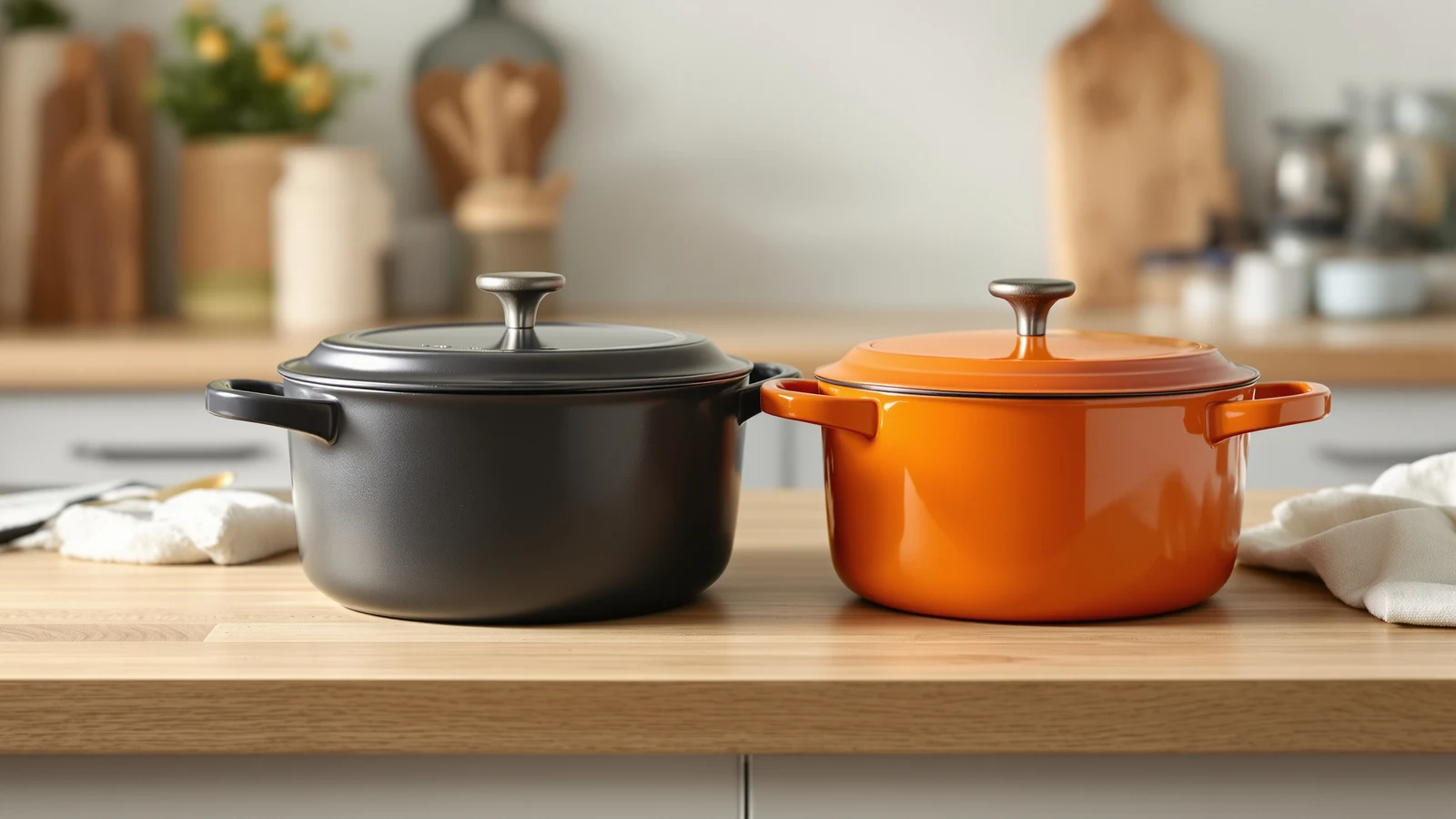
A black Staub round cocotte and a colorful Le Creuset Dutch oven side by side on a kitchen counter
The one real engineering difference

The spiked lid versus the smooth one

Staub casts a grid of small spikes into the underside of its lid, on every round cocotte the brand makes, including the 7-qt Basil compared here. Steam rising off a braise hits that spiked surface, condenses, and drips straight back down onto the food in dozens of small points rather than running off a single smooth curve to the rim. Staub calls this a self-basting lid, and the engineering logic is specific: more contact points for condensation to form means more moisture returned to the pot instead of lost to the inside of the lid or to the seal. For a four-hour short rib braise, that is the difference between a dish that bastes itself unattended and one you have to check and top up.

Le Creuset's lids, across the Signature Deep Round Oven and the Round Dutch Oven compared here, are smooth on the underside. That is not a cheaper or lesser design — it is a different answer to the same physics. A smooth lid still traps steam and still returns condensation to the pot; it simply doesn't engineer extra nucleation points to accelerate the drip-back. Le Creuset's own engineering emphasis sits elsewhere, in a heavy, close-fitting lid that seals tightly against the rim so less moisture escapes in the first place, rather than in shaping how the moisture that does condense falls back down.

Neither listing gives us a lab figure for moisture retention, so we won't invent one. What both companies have done, consistently, for decades, is commit to one solution over the other: Staub engineers the underside of the lid, Le Creuset engineers the seal. If you braise constantly, the spiked lid is a real, specific advantage; for a weeknight stew that's rarely uncovered for long, the practical gap closes considerably. For how lid weight and fit affect ordinary cooking across the category, our guide to Dutch oven lid design covers the mechanics in more depth.

The detail that changes how you cook

Matte black interior versus a light enamel

Staub finishes the inside of its cast iron pots, including the 7-qt Basil cocotte here, in a matte black enamel. That finish is formulated to be especially tough against metal utensils and high-heat searing, which is also why Staub markets this line toward browning meat directly in the pot before a braise. The trade-off is visual: against matte black, the usual cues that tell you a sauce is reducing or a fond is building — a shift from pale to deep brown, a thin crust forming at the edge — are far harder to read than they would be against a lighter surface, simply because there isn't enough contrast to see the change happening.

Le Creuset, across both the Signature Deep Round Oven and the Round Dutch Oven compared here, uses a light-colored, nearly cream interior enamel. The reason is the same physics in reverse: a light interior makes it easy to watch a sauce darken in real time and to catch a fond just as it turns, which matters if you are building a pan sauce or reducing something by eye rather than by the clock. It does mean the interior will show staining from tomato-heavy or deeply pigmented braises sooner than Staub's dark finish would, which is a cosmetic cost, not a functional one — a stained light interior still cooks exactly the same as a pristine one.

Neither finish is more durable in any sense either company states outright; they are simply solving for different things at the stove. If you sear and judge sauces by color, the light interior is doing real work every time you cook. If you braise and don't need to watch the bottom closely, Staub's matte black will simply show less wear over the years.

Round, but not the same round

Classic round versus Le Creuset's Signature profile

The Staub 7-qt Round Cocotte in Basil keeps the brand's traditional round profile: tall, slightly curved sidewalls that taper in gently toward the base, a shape built around braising a whole piece of meat upright with liquid partway up its sides. The Le Creuset Round Dutch Oven, 5.5 qt., in Flame, is built on Le Creuset's own long-standing round silhouette, a slightly wider stance that gives a larger searing surface relative to its depth.

The Le Creuset Signature Deep Round Oven, 6.5 qt., in Marseille, is Le Creuset's own variation on that shape: the Signature line is built with a slightly deeper wall and a wider base than the brand's standard round profile, specifically to hold more liquid and more volume without the pot feeling unwieldy to lift. That makes the Signature Deep Round the better match for the Staub's 7-qt capacity in this comparison — both are the larger, deeper option in their respective lineups, where the 5.5 qt. Flame is a smaller, more everyday size from the standard Le Creuset range.

None of these three listings publish exact base-diameter measurements, so we are describing the documented difference in profile rather than a number either brand states. Comparing the Staub 7-qt against the 5.5 qt. Le Creuset is comparing two different jobs as much as two different brands; the Staub against the Signature Deep Round 6.5 qt. is the fairer size-for-size match. For a broader look at how round and oval profiles diverge across the category, our round versus oval guide covers that ground separately from brand.

The part that limits both pots

Phenolic knob limits, on both brands

Neither brand escapes this: a phenolic knob, the hard black plastic resin used on lids across the mid-tier of both lineups, carries a lower oven-safe ceiling than the cast iron and enamel underneath it. Phenolic resin is genuinely heat-resistant compared to ordinary plastic, which is why both Staub and Le Creuset use it, but it is still the limiting component on a Dutch oven whose iron body could otherwise take oven heat with room to spare. Where a listing in this comparison specifies a knob material, we report it; where it does not, we are not going to guess what temperature the knob on your specific pot tops out at.

This is the detail that gets missed because it sits on top of the lid rather than inside the pot: the iron doesn't limit how hot your oven can run a braise, and in most cases neither does the enamel. The knob does. Both French brands sell versions of their lines with stainless steel knobs rated for higher heat specifically because phenolic knobs cap out lower, and both brands' broiler-adjacent instructions exist because of the knob, not the pot. Before you push either of these three pots past a standard 450°F roast, check the current listing's stated oven-safe temperature for the knob specifically, rather than assume the cast-iron body's tolerance applies to the whole lid assembly.

Our honest note: this is one place where the two French names aren't different from each other. A Staub phenolic knob and a Le Creuset phenolic knob fail the same way, at roughly the same ceiling, for the same chemical reason. The brand name tells you nothing extra here that the knob material doesn't already tell you.

The spec nobody photographs well

Weight and handle shape, side by side

Weight follows capacity before it follows brand. The Staub 7-qt Round Cocotte is the largest pot in this comparison and will be the heaviest for exactly that reason — more capacity means more iron and more food, not a heavier-handed casting process. The fairer size-for-size comparison sits between the Staub 7-qt and the Le Creuset Signature Deep Round 6.5 qt., which are close enough in capacity that neither has a built-in weight advantage from size alone; the 5.5 qt. Le Creuset Round Dutch Oven is the smallest and lightest of the three simply because it holds the least.

None of the three listings compared here publish a handle measurement in inches, so we won't invent one. What we can tell you is what to check before buying either brand: look at how far the handle stands away from the pot's body in the product photography, since that gap decides whether a gloved hand fits underneath it. A full seven-quart cocotte coming out of a 400-degree oven is heavy, and you'll be lifting it in thick mitts rather than bare hands with fine motor control — a handle that looks generous bare-handed in a product photo can be genuinely tight once a mitt is added.

Staub's traditional cocotte handles are typically small and integrated closely into the body's silhouette, in keeping with the brand's compact profile. Le Creuset's handles, on both lines compared here, tend to stand out further from the body for a mitted grip. Neither listing states this in inches, so confirm it against the current product photos before buying either pot. For the fuller picture of how weight scales across the category regardless of brand, our guide to how much a Dutch oven actually weighs has the broader numbers.

Side by side

The three, compared

PotBest forCapacityMade byNotablePriceGet it
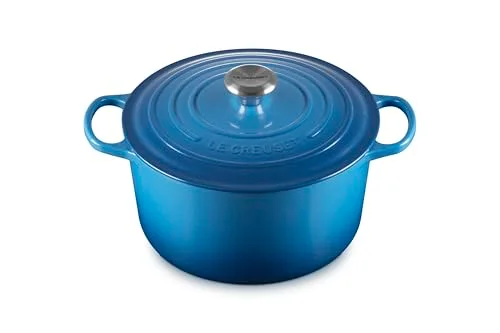
Le Creuset Signature Deep Round Oven, 6.5 qt., Marseille Matching the Staub's capacity 6.5 qt Le Creuset Light interior enamel, deep Signature profile $289.95 Get it
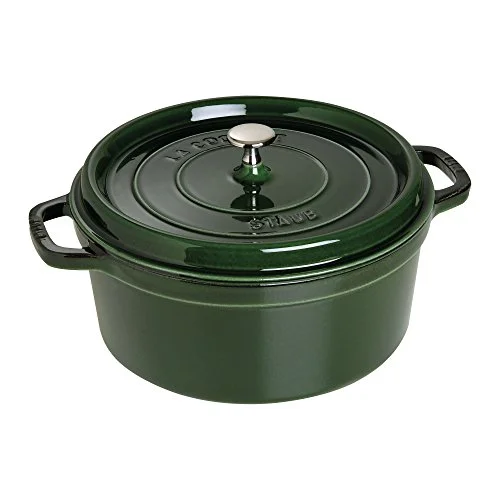
Staub Round Cocotte, 7 qt., Basil Long, unattended braises 7 qt Staub, France Spiked self-basting lid, matte black interior $299.95 Get it
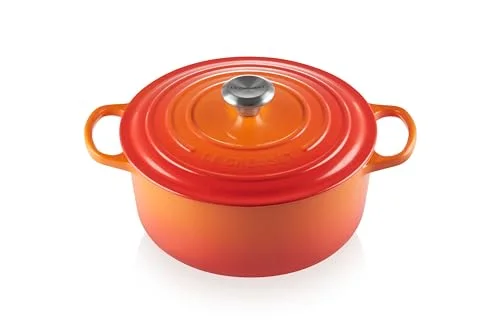
Le Creuset Round Dutch Oven, 5.5 qt., Flame Everyday cooking, smaller households 5.5 qt Le Creuset Light interior enamel, standard round profile $349.99 Get it
Who buys which

Our picks, and who each one is for

01Closest match to the Staub

Le Creuset Enameled Cast Iron Signature Deep Round Oven, 6.5 qt., Marseille

Best if you want Le Creuset at the Staub's own size

6.5 quarts·Light interior enamel·Deep Signature profile·$289.95

At 6.5 quarts, this is the Le Creuset in this comparison that sits closest to the Staub's 7-qt capacity, built on the brand's deeper Signature profile specifically to hold more without feeling unwieldy. You get Le Creuset's light interior for watching a sauce reduce by eye, a smooth lid that relies on a tight seal rather than spikes, and a price that actually lands ten dollars under the Staub it's being compared against here.

If the decision is really Staub-or-Le-Creuset rather than big-pot-or-small-pot, this is the Le Creuset that plays fair on size.

Le Creuset Signature Deep Round Oven, 6.5 quart, Marseille
Price
$289.95
Check price →
02Best for braising

Staub Cast Iron 7-qt Round Cocotte, Basil, Made in France

Best for long braises you don't want to babysit

7 quarts·Spiked self-basting lid·Matte black interior·$299.95

The spiked underside of this lid is the one genuine engineering difference between the two French brands, built specifically to return condensation to a long braise instead of losing it to the inside of the lid. Pair that with a matte black interior tough enough for hard searing before the braise even starts, and this is the pot built for a short rib or a pot roast left alone for four hours, not for a delicate pan sauce you need to watch by eye.

Buy it if you braise and don't want to check the pot every half hour. For sauces you're reducing by color, the dark interior works against you.

Staub cast iron 7-qt round cocotte, Basil
Price
$299.95
Check price →
03Best everyday size

Le Creuset Enameled Cast Iron Round Dutch Oven, 5.5 qt., Flame

Best for everyday cooking in a smaller household

5.5 quarts·Light interior enamel·Standard round profile·$349.99

The smallest and lightest of the three pots here, sized for two to four people rather than a crowd, and priced at the top of this comparison despite the smaller capacity — a reminder that color and size options move the price on Le Creuset's lineup as much as any engineering difference does. The same light interior and smooth, tightly sealing lid as the Signature Deep Round, in the size most households actually reach for on a Tuesday.

The right pick if the Staub's size was always more than you needed, and you just wanted the brand's everyday pot, not its biggest one.

Le Creuset round Dutch oven, 5.5 quart, Flame
Price
$349.99
Check price →
The real question

The verdict: does $30 between two French names mean anything?

Between the Staub 7-qt at $299.95 and the Le Creuset Signature Deep Round 6.5 qt. at $289.95, the gap is about ten dollars in the Staub's favor for a touch more capacity. Between the Staub and the 5.5 qt. Le Creuset Round Dutch Oven at $349.99, the gap widens to roughly $18 in the Staub's favor for the same reason, in reverse: that Le Creuset holds a quart and a half less. None of that spread tracks quality in either direction. It tracks size, color option, and which specific listing you land on, which is exactly the trap this comparison is built to catch: at this price tier, between these two manufacturers, dollars are not a quality signal at all.

What the money is actually buying is a choice between two different engineering philosophies, not a better or worse pot. Staub decided that the lid should do more active work returning moisture to a braise, and finished the interior for hard searing. Le Creuset decided the lid should seal rather than spike, and finished the interior to let you watch the pot while you cook. Both companies have been making enameled cast iron in France for generations, both back their cookware with serious warranties, and both put real engineering thought into the part of the pot that actually touches your food.

Our honest read: buy the Staub if you braise often and want a pot that works a little on its own while it's in the oven. Buy the Le Creuset if you sear, reduce sauces, and want to see what's happening in the pot while you're doing it. Don't buy either one because it's ten or twenty dollars cheaper than the other — at this tier, that gap is rounding error against either brand's actual engineering choice, and the choice is the only thing worth paying for.

Our method

How we compared

What we did

Specs and current prices, read closely

We compared the published specifications and current Amazon prices for the Le Creuset Signature Deep Round Oven 6.5 qt. in Marseille, the Staub 7-qt Round Cocotte in Basil, and the Le Creuset Round Dutch Oven 5.5 qt. in Flame, limiting every claim to what each manufacturer actually states about lid design, interior finish, capacity and profile. Where a specification — a handle measurement, a knob's exact temperature rating — isn't published for a given listing, we say so rather than estimate it from a similar-looking product in either lineup.

What we didn’t

We don’t run a testing lab

We do not physically test these pots, we do not own them, and we have no star ratings or review counts for these specific listings to report, so we don’t publish any. The question a reader actually wants answered — does the spiked lid noticeably change a braise, does the matte interior really hide more wear — cannot be answered honestly from a fortnight with a pot, by us or by anyone else claiming to have tested it. What we can do is read each manufacturer's own stated engineering choices carefully and compare them line by line. See more on our approach on the About page.

FAQ

Common questions

Is Staub or Le Creuset actually better?

Neither is better in a way that shows up on a spec sheet as a number; they're built around different priorities. Staub's spiked lid is engineered to return more condensation to a braise and its matte black interior favors hard searing. Le Creuset's smooth lid relies on a tight seal and its light interior is built so you can watch a sauce reduce by eye. The $10 to $20 difference between the specific listings compared here tracks size and color far more than it tracks which engineering choice is "better."

Why does Staub's lid have spikes on the underside?

The spikes create more surface area for steam to condense on as it rises off a braise, and each spike becomes a drip point that returns moisture straight down onto the food rather than letting it run off a smooth curve to the rim and collect at the seal. Staub calls this a self-basting design. It is a real, specific engineering choice built for long, slow braises rather than a cosmetic detail.

Why is Le Creuset's interior light and Staub's dark?

They're optimized for different things. Le Creuset's light interior makes it easy to watch a sauce darken or a fond build by eye, which matters for pan sauces and reductions. Staub's matte black interior is formulated to stand up to hard, high-heat searing and shows less staining over years of tomato-heavy braises, at the cost of making color-based visual cues harder to read while cooking.

Which size should I buy between these three?

Match the job, not the brand. The Staub 7-qt and the Le Creuset Signature Deep Round 6.5 qt. are the closer size-for-size match in this comparison, both suited to larger braises or bigger households. The 5.5 qt. Le Creuset Round Dutch Oven is the smaller, everyday size for two to four people, and costs the most of the three here specifically because size and color options move Le Creuset's pricing independently of the engineering differences.

Keep reading

More from Best Dutch Ovens