Best Dutch Ovens
Comparison · Le Creuset vs Lodge

Le Creuset vs Lodge: Is the Premium Real?

A Lodge Essential Enamel 6 Quart costs $69.99. A Le Creuset Round Dutch Oven, 5.5 qt., in Flame, costs $323.62 — close to five times as much. Both are enameled cast iron, cast the same way, holding heat the same way. We compared the published specifications and current prices for both lines, including Lodge's own 7.5-quart step-up, to find exactly where that gap goes and who should, and should not, pay it.

By Ilane Tall · Updated October 13, 2026 · Research-based.

Affiliate disclosure: we may earn a commission if you buy through the Amazon links on this page, at no extra cost to you.

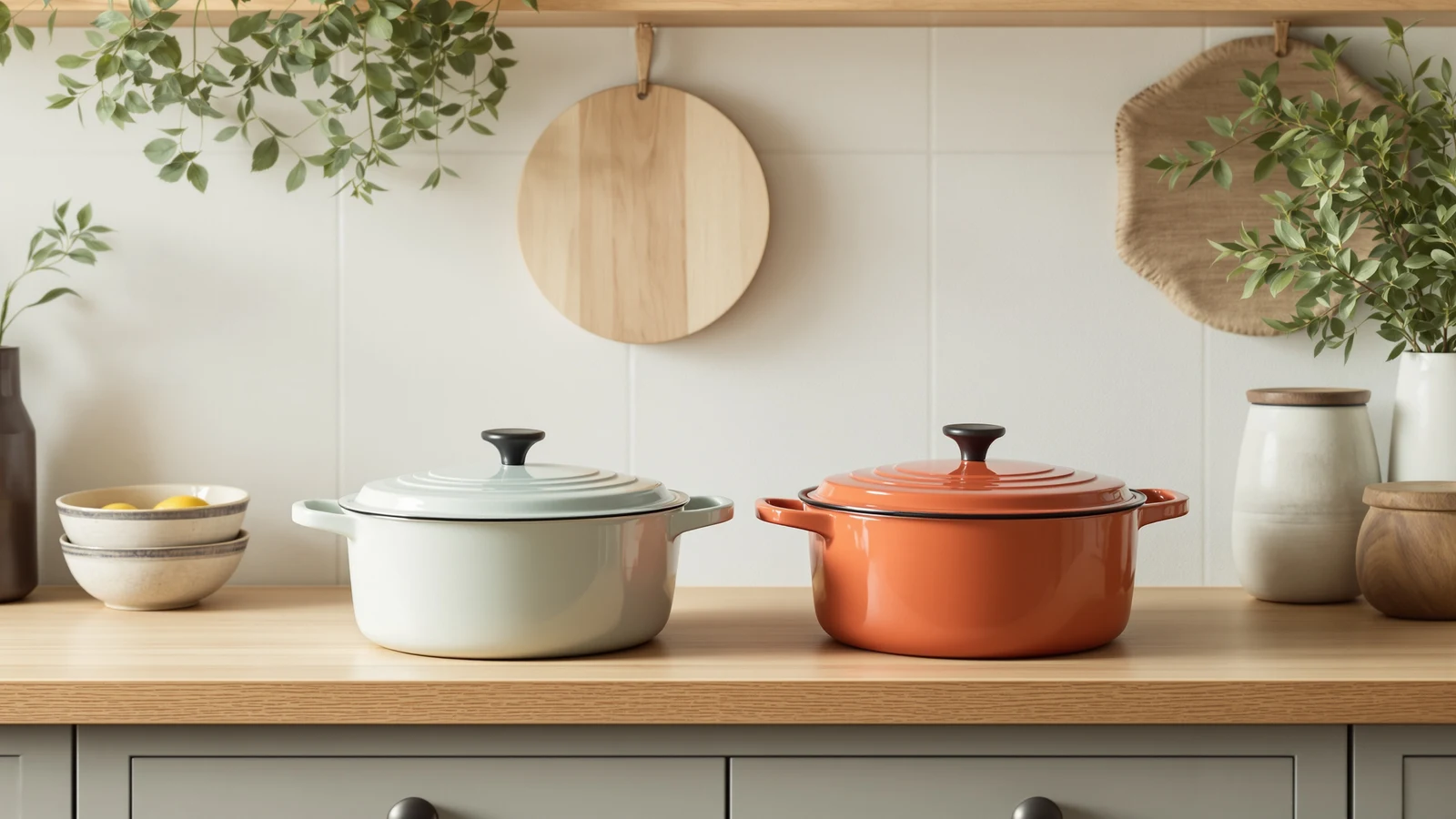
A dark Le Creuset style enameled cast iron Dutch oven and a lighter Lodge enameled Dutch oven side by side on a kitchen counter
Start here

Identical physics, different surfaces

Strip the enamel off either pot and you are left with the same material: cast iron, melted and poured into a mold, cooled into a shape that holds and radiates heat slowly and evenly. That part of a Dutch oven has not changed in a meaningful way in a century, and it does not change because a pot is stamped with a French name instead of an American one. The Lodge Essential Enamel 6 Quart, the Lodge Essential Enamel 7.5 Quart in Indigo, and the Le Creuset Round Dutch Oven in Flame all do the fundamental job the same way, because the iron inside them is doing the same job the same way.

What is not identical is the surface fused onto that iron. Enamel is glass, melted onto the metal at high temperature, and it is the one part of the pot that genuinely differs by manufacturer — in how evenly it is applied, how it is formulated to resist the wear a kitchen puts it through, and how it is finished on the inside where a spoon actually touches it. That is the premium you are weighing here: real, measurable in principle, and almost entirely invisible on day one, which is exactly why it gets confused with marketing. A chicken braised in the $69.99 pot and the same chicken braised in the $323.62 pot comes out the same on the first night. The difference, if there is one, shows up over years, not meals.

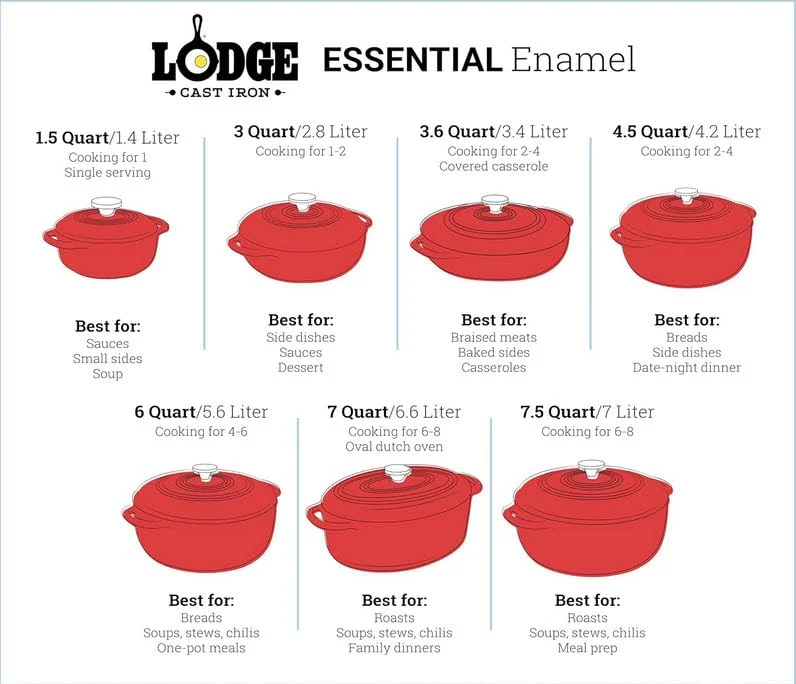
This is also why size matters more than it looks like it should here. The Lodge 6 Quart and the Le Creuset 5.5 Qt. are close enough in capacity to cook for the same household; the Lodge 7.5 Quart is a genuinely bigger pot built for bigger batches, so comparing its price to either smaller pot is comparing different jobs, not just different brands. For the full spread of capacities and prices across the category, our guide to Dutch ovens under $100 covers that ground from the budget end.

Where the premium actually lives

Enamel quality: what varies, and how it fails

Every enameled Dutch oven fails the same way, eventually: the glass coating chips, usually at the rim or around the base, from a metal spoon scraping the bottom, a pot knocked against a faucet in the sink, or a hot pot plunged into cold water. That is chemistry and physics acting on glass, not a defect specific to any one brand. What differs between manufacturers is how far they engineer against it, and how confident they are willing to be about it in writing.

Le Creuset states outright that its enamel is formulated to resist dulling, staining, chipping and cracking, and backs that claim with a long warranty — a company does not put its name behind a specific durability claim it expects to be routinely wrong. Lodge, for its Essential Enamel line that includes both the 6 Quart and the 7.5 Quart Indigo compared here, does not publish an equivalent chip- or stain-resistance claim. That is not the same as the enamel being worse in practice; it means Lodge is not making the same specific promise, and we won't manufacture one on its behalf. The pot making the explicit durability claim, and backing it with a warranty, simply gives you more to hold it to if the enamel fails early.

The price gap between $69.99 and $323.62 is almost entirely this: a formulation the manufacturer stands behind in writing, versus one not described in those terms at all. Both pots cook correctly from the day you unbox them. Whether the written confidence is worth roughly $254 is a question about how you treat cookware, not about how either pot performs on day one.

The detail that changes how you cook

The light interior, and why it matters at the stove

Le Creuset's Dutch ovens are finished inside with a light, cream-colored enamel across the line, specifically so you can watch a fond develop on the bottom of the pot or see a sauce darken as it reduces — a practical difference, not a cosmetic one, since browning and reduction are judged by eye at the stove. Lodge's Essential Enamel line, by contrast, uses a dark enamel interior. Against a dark background, the same visual cues — a sauce going from pale to deep brown, the first hint of a scorch at the edge — are genuinely harder to read, simply a function of contrast, not either enamel being lower quality.

This is a real trade, and the kind of thing a spec sheet doesn't communicate well, which is why the full roundup across all six Dutch ovens we compare keeps returning to small usability details like this rather than headline numbers. If you cook a lot of pan sauces or anything where color is the signal to pull the pot off the heat, a light interior is doing real work every time you use it. If most of what goes in the pot is a stew left alone for two hours under a lid, the interior color matters far less.

Neither listing gives us a lab measurement of interior reflectance, so we are describing this as the well-established difference between the two enamel finishes, not as a number either brand publishes. Judge it by what you actually cook, not by which pot looks more expensive in a photograph.

The spec nobody photographs well

Handles, weight and lid fit

None of the three listings compared here — the Lodge 6 Quart, the Lodge 7.5 Quart Indigo, or the Le Creuset 5.5 Qt. Flame — publish a handle measurement in inches, so we won't invent one. What we can tell you is what to check before buying: look at the product photography for how far the handle stands away from the pot's body, since that gap determines whether a gloved hand fits underneath it. A full Dutch oven coming out of a 400-degree oven is heavy and you'll be wearing thick mitts, so a handle that feels fine bare-handed in a showroom can be genuinely tight once a mitt is added.

Weight follows capacity before it follows brand. The Lodge 7.5 Quart Indigo is the largest of the three pots and will be the heaviest simply because it holds more iron and more food, not because Lodge builds heavier walls than Le Creuset. Comparing a 7.5-quart pot's weight to a 5.5-quart pot's tells you about the size difference, not about construction — the fairer comparison is the Lodge 6 Quart against the Le Creuset 5.5 Qt., close enough in capacity that neither has a built-in weight advantage.

Lid fit is where a premium brand's reputation is earned rather than assumed: a heavy, precisely machined lid that sits flush against the rim keeps the moisture from a long braise inside the pot, where a loose lid lets it escape as steam and leaves the dish drier than intended. Le Creuset is widely known for engineering its lids to seat tightly for exactly this reason. Neither listing here publishes a specific seal tolerance, so treat "precise lid fit" as a reputation each brand has built over decades, worth confirming for yourself once the pot is in your kitchen.

The part that outlasts the recipe

The warranty, and the company still being there

A warranty is only worth as much as the company standing behind it still existing when you need to use it. Le Creuset has been making enameled cast iron in France since 1925 and backs its cookware with a lifetime limited warranty against manufacturing defects. Lodge has been casting iron in South Pittsburg, Tennessee, since 1896, longer than Le Creuset, and is still family-owned and manufacturing in the same place. Longevity isn't the differentiator here — both companies clear that bar comfortably, and a warranty claim against either one in year fifteen is not a bet on a company that might not answer the phone.

Where the two differ is how specifically each one describes what the warranty covers. Le Creuset's chip-, stain- and crack-resistance language is paired directly with its warranty terms, written around the exact kind of damage enamel suffers over years of use. Lodge's Essential Enamel listings here do not pair an equivalent durability claim with the same level of warranty detail. That asymmetry, more than either company's age, is the real difference: one brand states in writing what it expects its enamel to survive; the other does not make that specific promise either way.

For the fuller picture of how we weigh claims like this across the category, our About page lays out the research-only approach behind every comparison on this site.

Side by side

The three, compared

PotBest forCapacityMade byNotablePriceGet it
Lodge Essential Enamel, 6 Quart, Oyster White Most kitchens, lowest entry price 6 qt Lodge No equivalent chip-resistance claim published $69.99 Get it
Lodge Essential Enamel, 7.5 Quart, Indigo Bigger batches, bigger households 7.5 qt Lodge Largest of the three; heaviest when full $99.90 Get it
Le Creuset Round Dutch Oven, 5.5 qt., Flame Keeping for decades 5.5 qt Le Creuset Stated chip/stain resistance, light interior enamel $323.62 Get it
Who buys which

Our picks, and who each one is for

01Lowest entry

Lodge Essential Enamel Cast Iron Dutch Oven, 6 Quart, Oyster White

Best if you are still finding out whether you'll use a Dutch oven

6 quarts·Enameled, no seasoning·Made by Lodge·$69.99

Six quarts is the size most households reach for — a whole chicken, a loaf, a stew for six — and $69.99 is low enough that buying it isn't really a commitment. It cooks a braise exactly the way the Le Creuset does on the night you make it. The honest trade is in the writing, not the cooking: Lodge doesn't publish the same chip- and stain-resistance language, and the interior enamel is dark rather than light, so you lose some visual feedback while a sauce reduces.

If you are not sure you need the premium, this is the pot to find that out with.

Lodge Essential Enamel cast iron Dutch oven, 6 quart, oyster white
Price
$69.99
Check price →
02Best for a crowd

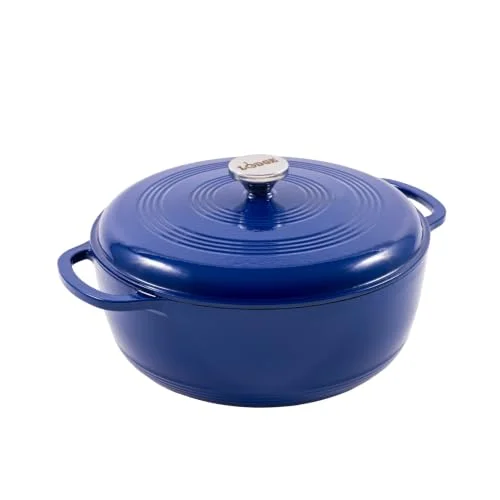
Lodge Essential Enamel Cast Iron Dutch Oven, 7.5 Quart, Indigo

Best if the problem is capacity, not enamel

7.5 quarts·Enameled, no seasoning·Made by Lodge·$99.90

At $99.90, this is still under a third of the Le Creuset's price while holding nearly two more quarts — the right answer if your constraint is feeding more people, not upgrading the enamel. It's the heaviest of the three once filled, so plan on a two-handed lift straight out of a hot oven. The enamel and interior color trade-offs are the same as the 6 Quart's: no published chip-resistance claim, dark interior, same honest trade at a still-modest price.

More pot for not much more money — as long as you have the shelf space and the counter room for it.

Lodge Essential Enamel cast iron Dutch oven, 7.5 quart, indigo
Price
$99.90
Check price →
03Best for keeping

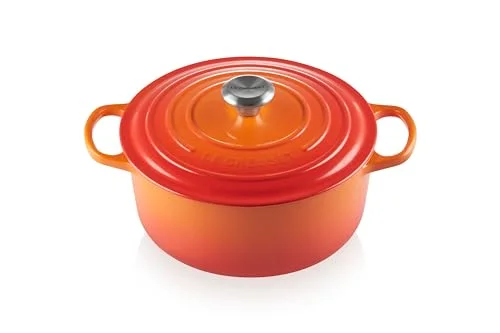
Le Creuset Enameled Cast Iron Round Dutch Oven, 5.5 qt., Flame

Best if you intend to own one pot for the next thirty years

5.5 quarts·Stated chip/stain resistance·Light interior enamel·$323.62

The pot the rest of this page is measured against. Le Creuset states that its enamel resists dulling, staining, chipping and cracking, and backs that with a lifetime limited warranty from a company making this cookware since 1925 — a specific, written promise the Lodge pots above don't make. The light interior lets you watch a sauce reduce or a fond build in a way the Lodge's dark interior does not. None of that makes the stew on night one taste different. It's a bet on year ten, paid for on day one.

You are buying the written promise, the surface, and the warranty — not better cast iron. Whether that is worth $253.63 more than the 6 Quart Lodge depends entirely on how long you plan to keep it.

Le Creuset enameled cast iron round Dutch oven, 5.5 quart, flame
Price
$323.62
Check price →
The real question

The verdict, by how long you keep cookware

Every honest difference between these pots compounds over years, not at dinner tonight. The enamel formulation Le Creuset puts in writing, the lighter interior that makes reducing a sauce easier to judge by eye, and a warranty paired with a specific, named durability claim don't change how a braise tastes the first time you make it. They change how the pot looks and seals after the five hundredth time.

That makes this almost entirely a question of how long you keep cookware, and how carefully you treat it. If you replace pots every few years, cook with metal utensils regardless of what the box says, or aren't sure yet whether a Dutch oven earns a permanent spot in your kitchen, the $253.63 gap is buying a written promise you're unlikely to ever collect on. If you already know you'll use one for the next twenty or thirty years and will hand-wash it with wood or silicone utensils, the Le Creuset's stated resistance and warranty are real value stacked over a long ownership window — spread across thirty years, the premium works out to under nine dollars a year.

The Lodge 7.5 Quart Indigo sits slightly outside this trade-off, because its case is about capacity, not enamel: at $99.90 it is still a fraction of the Le Creuset's price while holding meaningfully more food, the pick when the actual problem is feeding more people rather than keeping cookware forever.

Our honest read: buy the Lodge if you're finding out whether you'll use a Dutch oven at all, or if a bigger pot solves a real problem at a still-modest price. Buy the Le Creuset once you already know the answer is yes, and intend to hand the pot down rather than replace it.

Our method

How we compared

What we did

Specs and current prices, read closely

We compared the published specifications and current Amazon prices for the Lodge Essential Enamel 6 Quart, the Lodge Essential Enamel 7.5 Quart Indigo, and the Le Creuset Round Dutch Oven 5.5 qt. in Flame, limiting every claim to what each manufacturer actually states about capacity, enamel formulation, and warranty. Where a specification — a handle measurement, a lid-seal tolerance — isn't published, we say so rather than estimate it from a similar-looking product in either lineup.

What we didn’t

We don’t run a testing lab

We do not physically test these pots, we do not own them, and we have no star ratings or review counts for these specific listings to report, so we don’t publish any. The question that actually decides this purchase — how the enamel looks after ten years of real cooking — cannot be answered honestly from a fortnight with a pot, by us or by anyone else claiming to have tested it. What we can do is read each manufacturer's own claims carefully, compare them line by line, and tell you plainly where one brand states something the other does not.

FAQ

Common questions

Is Le Creuset actually better than Lodge, or just more expensive?

Both cook with the same cast iron, so on the stove the difference is small to none. Le Creuset is genuinely different in two written ways: it states a specific enamel formulation resistant to chipping, staining and cracking, and it uses a light interior enamel that makes watching a sauce reduce easier. Lodge does not publish the same durability claim for its Essential Enamel line. Whether that is worth roughly five times the price depends on how long you intend to keep the pot and how carefully you use it.

Will the Lodge Essential Enamel last as long as a Le Creuset?

We don't know, because Lodge does not publish the same specific chip- and stain-resistance claim that Le Creuset does for this line, and we won't invent a lifespan number for either pot. What we can say is that both companies have been manufacturing cast iron cookware for close to or over a century — Lodge since 1896, Le Creuset since 1925 — so a warranty claim against either brand in year fifteen is not a bet on a company that might not exist anymore.

Should I buy the 6-quart or the 7.5-quart Lodge?

The 6 Quart Oyster White at $69.99 fits most households' weekly cooking — a whole chicken, a loaf, a stew for six. The 7.5 Quart Indigo at $99.90 is the better choice if you regularly cook for more people or batch-cook for the week, since it holds meaningfully more without approaching Le Creuset pricing. It is also the heaviest of the three pots once full, so plan for a two-handed lift.

Does the Le Creuset need to be treated differently from the Lodge?

Not differently in kind, but more carefully in degree if you want its stated resistance to actually hold up. Both are enameled cast iron and both benefit from wood or silicone utensils, avoiding sudden temperature shock, and hand washing over a dishwasher. Because the Le Creuset's premium is partly a bet on long-term enamel condition, treating it carelessly erodes the exact advantage you paid for more than it would on the Lodge, where that specific advantage was never claimed in the first place.

Keep reading

More from Best Dutch Ovens