Best Dutch Ovens
Roundup · Nine Quarts and Up

The Best Jumbo Dutch Ovens for Feeding a Crowd

Nine quarts and up is a different category of pot. It is too big for a weeknight stew for two, too heavy to lift one-handed, and too wide for some ordinary cupboard shelves — and it is exactly the right tool for a holiday turkey, a double batch of chili for the extended family, or a pot of gumbo that needs to feed fourteen people twice. We compared the published capacities, dimensions and prices of the jumbo end of the enameled cast-iron market to work out where that category actually starts, and what it costs you beyond the sticker price.

By Ilane Tall · Updated November 18, 2026 · Research-based.

Affiliate disclosure: we may earn a commission if you buy through the Amazon links on this page, at no extra cost to you.

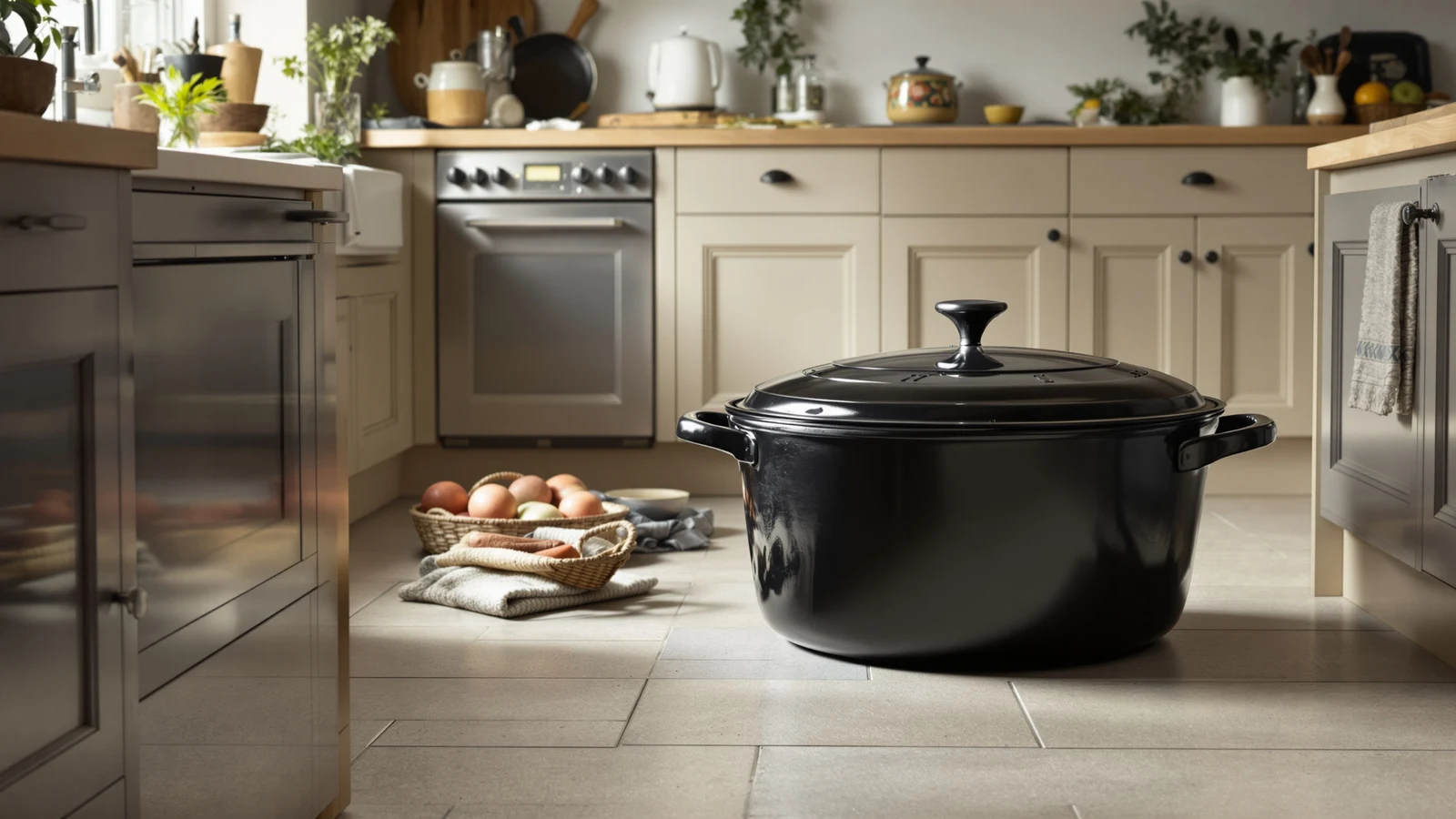
A large black enameled cast iron jumbo Dutch oven sitting on a kitchen floor beside the oven, visibly larger than a standard countertop pot
Where normal stops

When six or seven quarts genuinely runs out of room

Six quarts is the size most Dutch oven buying guides on this site point to as the sensible default, and for most weeks, it is. It holds a whole chicken, a loaf of bread, a stew for four or five with leftovers. The size does not change what the pot is made of, and six-to-seven-quart pots dominate the market because that is what most kitchens actually need on an ordinary Tuesday.

Where it runs out is volume math, not vibes. A twelve-to-fourteen-pound turkey needs clearance around the bird for a lid to seal and liquid to circulate, which a six-quart oval shape rarely has once the bird is trussed. A "double batch" of chili, soup or braised short ribs scaled up for a holiday or a freezer-stocking weekend is, by definition, more than a six-quart pot is rated to hold with the lid still closing — and a Dutch oven filled past roughly two-thirds of its stated capacity already risks simmering over onto the oven floor. The honest signal that you have outgrown a six-or-seven-quart pot is not a single big meal; it is a pattern of filling the pot to the rim, or cooking the same dish in two batches, every time you host more than six people.

That is the gap jumbo sizing fills: not a better Dutch oven than a six-quart one, but a different tool for a different volume of food, bought by households that host or batch-cook often enough that the math stops working below nine quarts.

The jumbo range

Nine quarts versus thirteen: what each actually holds

Within "jumbo," there is still a real gap between the low end and the high end. A nine-quart round cocotte, like the Staub 9-quart listed below, is built to serve nine to ten people according to its own listing — enough for a full turkey breast or a modest whole bird, a very large pot of chili, or a braise meant to feed a dinner party with planned leftovers. It is the size most households reach for first when six quarts stops being enough, because it is still a two-handed but manageable pot rather than a genuinely oversized one.

A 13.25-quart cocotte, like the Staub below, is nearly half again larger by volume. Staub sells it under its 34-centimeter sizing — the brand labels its cocottes by diameter in centimeters rather than quarts, and 34cm is the largest round size it lists for home kitchens. That extra capacity is the difference between cooking one large turkey with genuine room around the bird, or a double batch of soup versus a triple one meant for a chest freezer's worth of meal-prep containers. It earns its keep in households that cook in bulk routinely — church suppers, large extended families, or anyone running a weekly batch-cook for the freezer — not a single holiday meal a year.

The practical rule: nine quarts is "jumbo for an occasion." Thirteen quarts is "jumbo as a standing habit."

Before it goes on the stove

Burner size and base diameter at this scale

A Dutch oven heats from the base up, and the base of a jumbo pot is considerably wider than the base of a six-quart one. Staub's own sizing convention makes this concrete: the 13.25-quart cocotte below is listed at 34cm — about 13.4 inches — wider than the heating element on most home ranges. A standard electric coil or radiant glass burner runs roughly six to eight inches across; even the largest single burner on most residential ranges tops out around ten to eleven inches. Put a 34cm pot on an 8-inch element and a meaningful ring of the base sits over cool metal rather than direct heat, the textbook cause of a sauce that scorches in the center while the edges barely simmer.

This is not a defect in the pot. Cast iron spreads heat sideways reasonably well once it is up to temperature, which is part of why these pots exist, and a jumbo cocotte is typically run on the largest burner a range has, with extra preheating time built in. But check your range's largest burner diameter, or whether you have a bridge-element zone, before buying the 13.25-quart size specifically — a pot that overhangs its burner by two or three inches on every side heats less evenly, and some glass cooktops post a maximum recommended cookware diameter for this exact reason. Measuring your own stove before ordering matters more at this end of the size range than anywhere else in the category.

Side by side

The three, compared

PotBest forCapacityMade byNotablePriceGet it
Lodge Essential Enamel 7.5 Quart The edge of jumbo, not past it 7.5 qt Lodge Indigo enamel, no seasoning needed $83.99 Get it
Staub 9-Quart Round Cocotte A full turkey, nine to ten servings 9 qt Staub, France Matte black, made in France $401.55 Get it
Staub 13.25 Qt Round Cocotte The largest routine batches 13.25 qt / 34cm Staub, France Aroma Rain lid, all hob types $488.75 Get it
The picks

Our picks, and who each one is for

01Last stop before jumbo

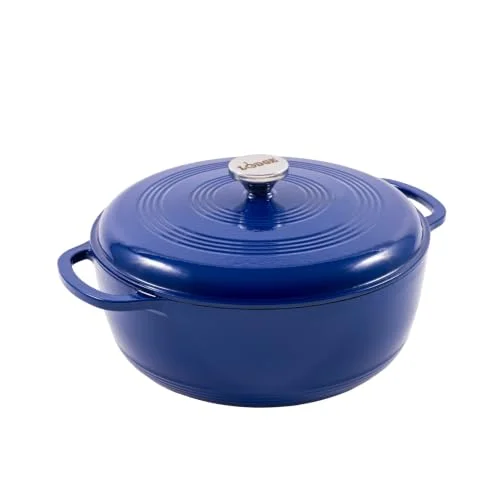
Lodge Essential Enamel Cast Iron Dutch Oven, 7.5 Quart, Indigo

Best for households who are not sure they need jumbo yet

7.5 quarts·Indigo enamel·No seasoning·Made by Lodge

At $83.99, this is the pot to buy if you suspect you are outgrowing six quarts but are not yet certain you need a genuinely jumbo one. 7.5 quarts gives real breathing room over the six-quart default — enough for a larger roast or a bigger batch of soup — without the price, weight or storage demands of a nine-or-thirteen-quart cocotte. It is also the cheapest pot in this comparison by a wide margin, which makes it the low-risk way to find out whether your actual cooking volume calls for jumbo sizing at all before spending four or five times as much.

If you host occasionally rather than constantly, this is probably as big as you need to go.

Lodge Essential Enamel cast iron Dutch oven, 7.5 quart, indigo
Price
$83.99
Check price →
02Best all-around jumbo

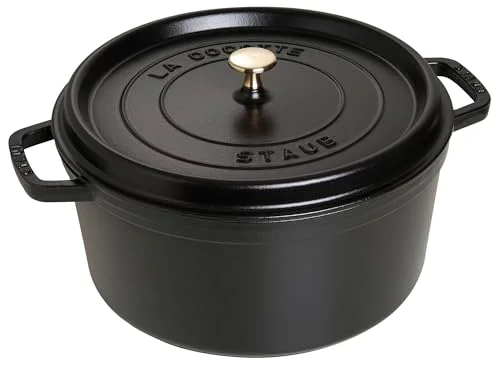
Staub Cast Iron Round Cocotte, 9-Quart, Matte Black

Best for a full turkey or feeding nine to ten people

9 quarts·Serves 9–10·Made in France·Matte black

Nine quarts is where jumbo capacity stops being a specialty purchase and starts being a holiday-and-batch-cooking workhorse. Staub's own listing states this cocotte serves nine to ten people, which lines up with what the extra three quarts over a standard seven-quart pot actually buys: enough clearance for a full turkey or a large braise, with the lid still able to seal properly. At $401.55 it is the more expensive of the two Staub pots here, despite being the smaller of the two — current pricing on these listings does not track size in a straight line, which is worth knowing before assuming the bigger pot automatically costs more.

This is the size that answers "I need to cook for a crowd" without answering "I need to cook for a crowd every week."

Staub cast iron round cocotte, 9 quart, matte black
Price
$401.55
Check price →
03Best for the largest batches

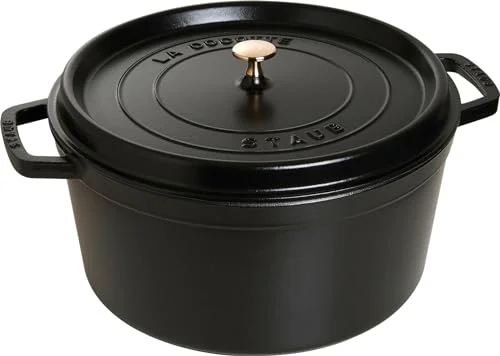
Staub 1103425 Black Cast Iron 13.25 Qt. Round Cocotte, Aroma Rain Lid

Best for households that batch-cook in real volume, not just on holidays

13.25 quarts / 34cm·Aroma Rain lid·Suitable for all hob types·Black

This is the largest pot in our comparison, and genuinely the largest size most home cooks will ever need to consider. At 34cm — Staub's own diameter sizing for this model — it outsizes a single burner on most home ranges, which makes it a pot you preheat deliberately and position on your range's largest element, not one you treat like a standard-size saucepan. The listing describes it as suitable for all hob types, which covers gas, electric and induction, but says nothing about fitting a specific burner, oven shelf or cupboard — that measuring is on you before you order. At $488.75 it is, as of this writing, actually priced below the smaller 9-quart cocotte above, which is the kind of pricing quirk worth checking for yourself rather than assuming the larger size always costs more.

Buy this size because you cook in genuine bulk routinely, not because it looked impressive in the listing photos.

Staub cast iron round cocotte, 13.25 quart, 34cm, Aroma Rain lid
Price
$488.75
Check price →
Physically handling it

Lifting a full jumbo pot safely, and who should not try alone

Cast iron is dense before anything goes into it, and a nine-to-thirteen-quart enameled cocotte, empty, typically weighs somewhere in the range of 15 to 20-plus pounds — roughly a large stand mixer, in a shape that is awkward to grip and often hot on every surface. Fill it with a double batch of chili or a 14-to-18-pound turkey and its juices, and the total coming out of a 400-degree oven can easily clear 30 pounds, carried at arm's length in oven mitts with both hands committed to the handles and none free to brace or catch a slip. That is a genuinely different physical task than lifting a six-quart pot one-handed off a stovetop.

The lid adds its own risk: lifted straight up and off, it can tip hot condensation back toward your wrists if it is not angled away from your body first — and the knob itself is often rated for lower heat than the pot, so grabbing it without checking the lid's own oven-safe rating is its own small risk at this scale.

If you have any shoulder, wrist, lower-back or grip-strength limitation, or you are lifting from a low oven rack where you cannot get your forearms under the pot, do not attempt a full jumbo cocotte alone. Clear a landing spot on the counter before opening the oven door, use two full oven mitts, and if a second person is available, have them clear the path rather than share the lift itself — two sets of hands on handles built for one tends to create exactly the uneven load that causes a drop. This is general safe-handling guidance, not a rating specific to any one pot above; none of their listings publish a filled weight, and we are not inventing one.

After the meal

Storage: the cupboard problem nobody mentions

Buying guides for jumbo Dutch ovens talk about the cooking and almost never about where the pot lives the other 364 days of the year. A 34cm cocotte, lid included, does not fit on a standard 12-to-15-inch-deep cabinet shelf without the lid overhanging the edge or the whole assembly sitting sideways, and most kitchens are not built with a 13-to-14-inch-tall, 13-to-14-inch-wide clearance free on a single shelf. The practical result is that the jumbo pot often ends up on the floor of a lower cabinet, on top of the stove when idle, or on open shelving as a semi-permanent display piece — none of which is a flaw in the pot, just a consequence of a kitchen designed around six-quart-and-smaller cookware.

Lifting a 20-to-30-pound-plus pot out of a low, deep cupboard is its own version of the lifting problem above: bending, reaching and lifting in a less controlled position than pulling a six-quart pot off an eye-level shelf. If that awkward retrieval angle is a real concern, that is a legitimate reason to handle the pot carefully during every transfer, not just while cooking — enamel chips from a knock against a shelf edge as easily as from a dropped lid.

Before buying at the 13-quart end specifically, measure the tallest clear shelf space you actually have, with the lid included in the height, and decide whether that space exists before the pot arrives rather than after.

The alternative

Whether two mid-size pots beat one jumbo one

For a lot of households, the honest answer is yes. Two Lodge Essential Enamel 7.5-quart pots at $83.99 each come to $167.98 — still less than half the price of the 9-quart Staub below. Run on two burners, they heat faster than one jumbo pot on a single element, neither overhangs its burner the way the 34cm cocotte can, and each is light enough to store the way a normal Dutch oven is stored, without the cupboard problem above. For soups, chilis and braises simply being scaled up in volume, rather than needing to hold one large item, splitting the batch across two mid-size pots is often more practical than owning one oversized pot that sits unused most of the year. The cost math tends to favor two cheaper pots over one expensive jumbo one when the use case is volume rather than a single large object.

Where two mid-size pots do not work is a single large item that has to fit in one vessel: a whole turkey, a large prime rib, a single enormous braise that cannot be split and still cook evenly. That is the one job a jumbo cocotte does that no combination of smaller pots can replicate, and it is the real justification for the 9-to-13-quart category — not simply "more food," which two pots handle fine, but "one object too big to split."

The practical test: if what you are scaling up is a liquid or semi-liquid dish — soup, chili, stock, a shreddable braise — two mid-size pots are very often the better buy. If what you need room for is one whole, indivisible item that has to come out of the oven in one piece, jumbo is the only size that solves it.

Our method

How we compared

What we did

Specs, listed dimensions and current prices

We compared the published capacities, sizing conventions and current Amazon prices for the Lodge Essential Enamel 7.5 Quart and the two Staub cocottes above, limiting every specific claim about a given pot to what its own listing states — capacity, serving estimate, diameter where given, and enamel color. Where a listing gives a size only in centimeters rather than quarts, as Staub does for the 13.25-quart model, we report it exactly as published rather than convert it into a figure the manufacturer itself does not use on the product.

What we didn’t

We don’t run a testing lab

We do not physically test these pots, we do not own them, and we have no star ratings or review counts for these specific listings to report, so we don’t publish any. General guidance in this article — about typical cast-iron weight, burner sizing, cupboard clearance or safe lifting — reflects well-established, categorical facts about cookware of this scale, not a specific claim about any one of the three products above beyond what each listing actually states. See more about our approach on the About page.

FAQ

Common questions

What size counts as a "jumbo" Dutch oven?

In this guide, nine quarts and up. Six to seven quarts is the mainstream household range; nine quarts is where a pot starts to serve nine to ten people and genuinely accommodate a full turkey or a double batch of a liquid dish; 13.25 quarts, sold by Staub under its 34cm sizing, is close to the largest round size most home cooks will ever need. Anything marketed as "jumbo" below about nine quarts is usually just a large pot in the standard range, not a different category.

Will a 13-quart Dutch oven fit on my stovetop?

Check your largest burner before ordering. The 13.25-quart Staub cocotte is listed at 34cm — about 13.4 inches — which is wider than the largest single burner on most home ranges, typically around 10 to 11 inches at most. The pot will still work on a smaller burner, since cast iron spreads heat sideways once it is up to temperature, but it will heat less evenly than on an appropriately sized element, and some glass cooktops post a maximum recommended cookware diameter worth checking against this size specifically.

How much does a jumbo Dutch oven weigh, and is it safe to lift alone?

Empty, a nine-to-thirteen-quart enameled cast-iron cocotte typically weighs somewhere in the 15-to-20-plus-pound range; filled with a large braise or a turkey, the total coming out of a hot oven can easily clear 30 pounds. Anyone with shoulder, wrist, grip or lower-back limitations, or lifting from a low oven rack, should not attempt this alone — use two oven mitts, clear a landing spot on the counter before opening the oven, and have a second person clear the path rather than share the physical lift.

Should I buy one jumbo pot or two mid-size ones?

It depends on what you are scaling up. For soups, chili, stock or any dish that can be split, two 7.5-quart pots like the Lodge Essential below cost less combined than one jumbo cocotte, heat faster on two burners, and avoid the storage and lifting issues that come with a single oversized pot. For a single large item that cannot be split — a whole turkey, a large prime rib — only a genuinely jumbo pot, nine quarts or above, has the room.

Keep reading

More from Best Dutch Ovens