The Knob Cracked or Melted: What to Do With a Damaged Dutch Oven Lid
A phenolic knob left in a 450°F oven too long, or dropped once on a tile floor, is the single most common Dutch oven failure that has nothing to do with the iron underneath it. The cast iron and the enamel are almost certainly fine. What to check first, whether the fix is a five-dollar part or a new pot, and what is actually safe to do tonight if dinner isn’t finished yet.
By Ilane Tall · Updated November 15, 2026 · Research-based.
Affiliate disclosure: we may earn a commission if you buy through the Amazon links on this page, at no extra cost to you.
Start here
Phenolic, plastic or stainless: the knob is not the pot
The knob on top of a Dutch oven lid is not cast from the same material as the rest of the pot. It is a separate part, almost always fixed through a hole in the lid with a bolt threaded up from underneath, and manufacturers buy it from whichever supplier molds or machines that specific component — often a different factory entirely from the one that cast the iron. That separation is the entire reason a knob can fail while the enamel and iron around it look untouched: the two parts are held to different heat tolerances, and when something goes wrong, it is almost always the part with the lower ceiling that gives first. We cover the mechanics of that ceiling in more depth in our guide to oven-safe temperature ratings, but the short version matters here on its own.
Three knob materials dominate the category, and they do not fail the same way. Phenolic resin — a hard, dark, thermoset material used on cookware knobs and handles for decades specifically because it tolerates more heat than an ordinary plastic — does not melt in the way a milk-jug lid would. Pushed past its rated ceiling, usually somewhere in the 400–450°F range depending on the brand, it is more likely to crack, char, or discolor at the edges than to droop or run. Cheaper nylon or ABS knobs, found on the least expensive end of the category, are the ones that genuinely melt: they soften, warp, and lose their crisp shape under sustained high heat, sometimes slumping visibly to one side while still technically attached to the bolt underneath. Stainless steel knobs do neither. Metal shares the cast iron's own practical heat ceiling rather than imposing a separate, lower one, which is exactly why higher-end lids default to a metal knob and why a stainless replacement knob is sold as an upgrade on pots that ship with something cheaper.
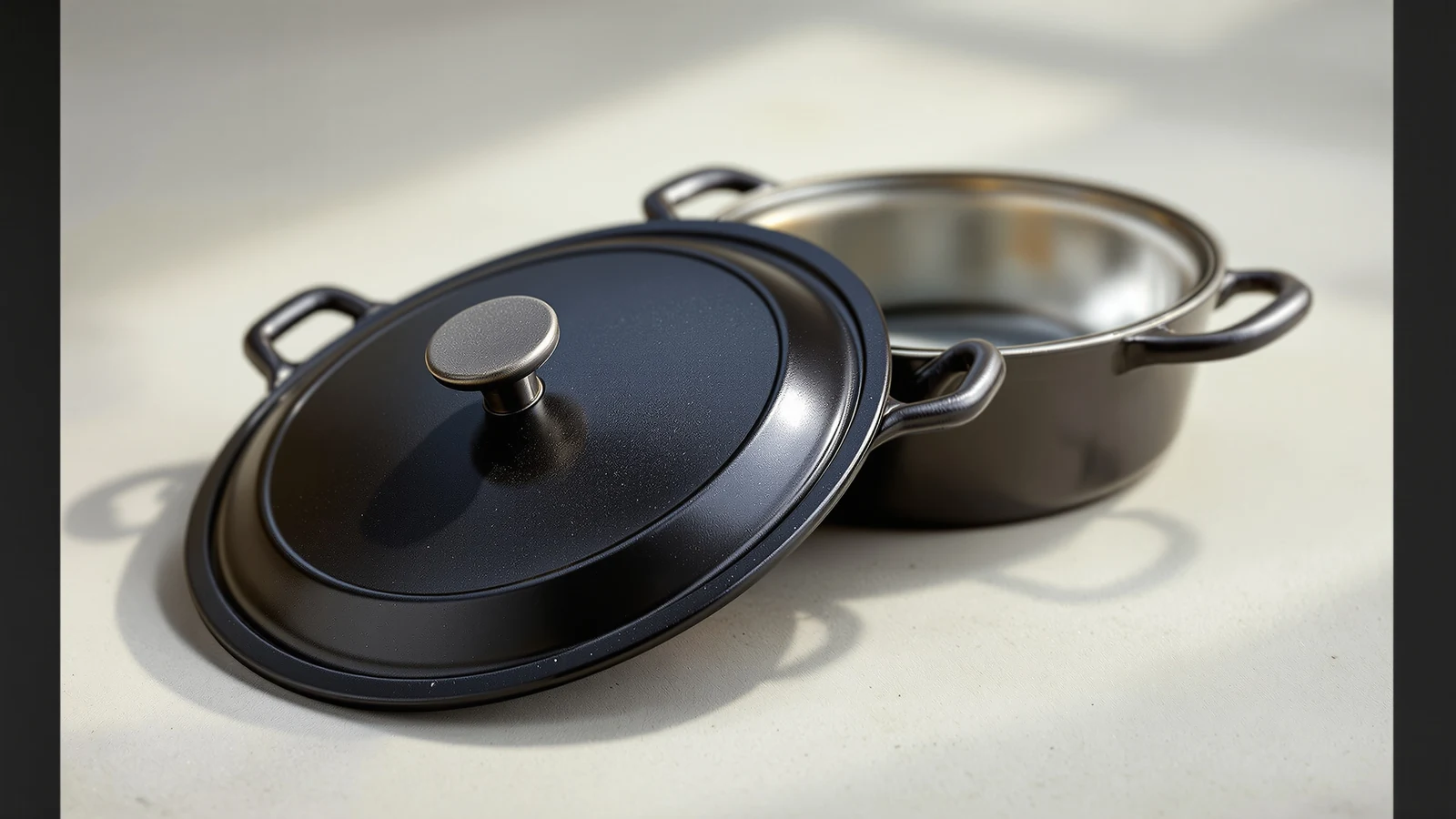
Telling the three apart at a glance is usually straightforward once the pot has cooled enough to touch safely. A metal knob reads as a bright or brushed-silver disc, cool to the touch well before the rest of the lid, with a visible seam where a screw or hex bolt meets its underside. Phenolic and the cheaper plastics are almost always dark — black or deep brown — and stay noticeably warm for longer after coming out of the oven. If what used to be a crisp, rounded knob now looks slumped, slightly glossy, or has a visibly rounded edge where a sharp one used to be, that is a plastic knob that has reached and passed its ceiling, not a defect in the pot it sits on.
What's actually underneath
The bolt underneath, and why it strips before the knob cracks
Nearly every enameled Dutch oven lid in this category uses the same basic fastening idea, even though no two brands share the exact bolt length or thread: a single bolt passes up through a hole in the center of the lid and threads into a fitting molded or cast into the base of the knob, tightened from underneath by hand or with a small wrench. Our guide to how Dutch oven lids are actually built covers this mechanism in the context of basting and venting; here, it is the point of failure that matters.
The threaded fitting inside a phenolic or plastic knob is softer than the stainless bolt it accepts, and that mismatch is exactly what wears out first. Every trip through a hot oven and back out expands and contracts the resin around those threads by a small amount, and every time someone notices a slight wobble and responds by cranking the bolt a little tighter, the threads inside the knob round off a little more. Eventually the bolt spins freely no matter how far it is turned, because there is nothing left inside the knob for it to bite into. The knob itself, at that point, can look completely intact — no crack, no discoloration, no visible damage at all — while the fastening underneath it has already failed.
That distinction decides what actually needs replacing. A knob that spins loose no matter how tight you turn it, but shows no crack or melt on the dome itself, has a stripped-thread problem: buying a new knob alone usually will not fix it unless the replacement kit also includes a new bolt, since the old bolt is very likely fine and the old threaded fitting is not. A knob that is visibly cracked across the top or clearly slumped and deformed, on the other hand, usually still has a sound bolt underneath it, and the original hardware can typically be reused with a new knob on top. Check which failure you actually have before ordering a part, because the two problems need different fixes.
Buying the part
Universal replacement knobs, and which ones actually fit
A replacement knob sold as “universal” is not a claim that it fits every Dutch oven on the market. It means the knob uses a single central through-hole and an adjustable or trimmable bolt, built to seat on a range of lid thicknesses rather than one specific brand's exact lid profile. That design covers a large share of the category, because the single-bolt mechanism described above really is close to standard across most mid-market and budget enameled cast iron — but “most” is not “all,” and the gap between those two words is where a wrong order comes from.
Three measurements settle most fit questions before you buy. First, the diameter of the existing knob's base plate, so the new one sits flush against the lid rather than leaving a visible gap or overhang in either direction. Second, the lid's hole diameter at the mounting point, which has to match the new knob's bolt rather than the knob's overall width. Third, and most often overlooked, the thickness of the lid itself at that spot — most universal kits publish a compatible thickness range, commonly somewhere around one-eighth to three-eighths of an inch, because the bolt has to pass all the way through and still have enough thread left to grip securely on the far side. A knob rated for a thin lid can simply fail to reach, and one rated for a thick lid can leave the bolt sticking out past the knob's base with nothing to tighten against.
The exception worth knowing about before you order: a handful of premium lids bond or rivet the knob in place using a method that does not accept a generic bolt-through replacement at all, which is exactly why some universal knob listings explicitly name which brands they do and do not fit rather than simply claiming to work everywhere. Read that compatibility note on the actual listing before buying, test-fit the new knob the moment it arrives rather than assuming, and keep the receipt until you've confirmed it tightens down flush and doesn't spin.
Before you call the manufacturer
Does a cracked knob void the warranty on the whole pot?
Our guide to what a Dutch oven warranty actually covers lays out the general rule that applies here directly: warranties, lifetime or otherwise, cover defects that existed in the product before it was ever used, not damage that happened afterward in a working kitchen. A knob that cracked because it sat under a broiler too long, or because the lid was dropped on a tile floor, reads to any manufacturer as damage from use — not a flaw the factory put there — and that distinction is the whole case for or against a claim.
In practice, that means a cracked or melted knob is very unlikely to get a brand to replace the entire lid or the pot itself, specifically because the knob is a separate, individually serviceable part rather than something fused permanently into the casting. Most manufacturers that sell a lid without a replaceable knob at all are the exception, not the rule; the far more common setup is a bolt-on part that exists precisely so a failure here doesn't have to turn into a conversation about the whole pot.
The part of this that genuinely can affect your broader coverage is the repair itself. Fitting a knob the brand didn't supply is treated by most manufacturer terms the same way any other self-repair or modification is treated: it does not usually retroactively cancel coverage you already had on the cast iron and enamel body, but it typically ends any warranty claim tied to the lid assembly going forward, since the brand can no longer verify what was done to it. And if a cross-threaded generic bolt or an over-tightened fit cracks the lid itself during the swap, that new damage is unambiguously something that happened in your kitchen during a repair — not a manufacturing defect, no matter how the knob failure started.
If dinner isn't finished yet
The temporary fix that's safe for one more dinner
A knob failing mid-recipe is a timing problem as much as a hardware one: a replacement part is days away, and the braise in the pot right now is not. The goal for tonight is not a permanent repair, just a way to lift a hot lid safely without touching broken plastic or a bare bolt with your hand.
If the knob has cracked but is still attached and doesn't spin, leave it exactly where it is rather than trying to pry it off mid-cook. Lift the lid using a dry, thickly folded kitchen towel or an oven mitt gripped around as much of the lid's edge as you can reach, rather than pinching just the damaged knob between two fingers — a cracked knob can shed a sharp fragment or separate completely the moment real weight is pulled on it, and that is a bad surprise to have with a hot lid in your hand. The same caution applies even if the knob only looks slightly off; treat any knob that has visibly changed shape as untrustworthy for the rest of that cook, full stop.
If the knob has broken off entirely and a bare bolt is left sticking up through the hole, a spare stainless hex nut or a wide metal washer backed by a nut, threaded on hand-tight, makes a workable grip point for one more meal — snug enough that it won't spin loose under the lid's own weight, gripped through a towel rather than bare-handed either way. This is explicitly a one-night stopgap, not something to rely on past that dinner: an improvised, uneven knob can work loose without warning on the next lift. Skip anything not rated for oven heat — a wine cork, a rubber stopper, a zip tie — if the dish is still going back into the oven or under a broiler; those only belong anywhere near this fix if the pot is staying on the stovetop for the rest of the cook, and even then only as a grip point you trust with a towel between it and your hand. For the broader habits that keep a lid from reaching this point in the first place, our guide to caring for an enameled Dutch oven covers the thermal-shock and handling rules that apply to the whole pot, not just the knob.
If a new pot makes more sense
When replacing the whole pot beats fixing the lid
A universal knob kit typically costs a small fraction of a new Dutch oven, so for most cracked or melted knobs, replacing the part is the obvious move. The math changes if the lid itself is damaged beyond the knob — a hairline crack in the enamel around the mounting hole, a warped rim from the same heat event that took out the knob — or if the pot was already old enough, or cheap enough, that a new knob plus your time isn't worth it next to simply buying a fresh pot outright. Our breakdown of what changes between four pots at roughly the same six-quart size and very different prices is a useful reference for that second comparison, since a budget enameled pot and a replacement knob kit can land within a few dollars of each other.
Pot
Capacity
What the listing says about the lid
Price
Get it
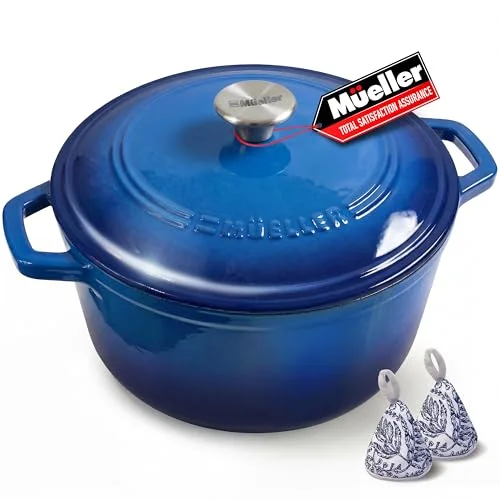
Mueller 6qt Aqua Blue
6 qt
Named “with Lid and Knob” in the listing title itself
Three pots, by what's actually known about the knob
01Knob named upfront
Mueller 6qt Enameled Cast Iron Dutch Oven, Aqua Blue
Best if you want the knob mentioned in the listing, not inferred
6 quarts·Enameled cast iron·Safe for all cooktops·Aqua Blue
This is the one pot in this comparison whose own title spells out “with Lid and Knob” rather than leaving the fastening to be assumed. That doesn't tell us the knob's exact material or its rated temperature — the listing is silent on both, and we won't guess — but it does confirm the knob is treated as a named, separate component of the product rather than an afterthought bundled silently into “lid.” At $49.97 for six quarts, it is priced in line with the rest of the category at this capacity.
The listing names the part. Everything else about it — what it's made of, what it's rated for — is still worth checking yourself before you run it hot.
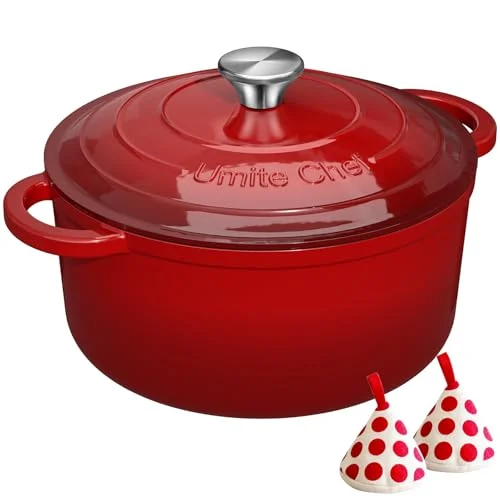
Umite Chef describes this lid as airtight and precision-engineered, with raised interior nodes that redistribute condensation back onto the food — a real, specific design claim about how the lid behaves during a cook. What the listing does not state is the knob's material, so treat it the way you'd treat any Dutch oven with no published knob spec: assume it's the lower-rated phenolic or plastic tier until you've confirmed otherwise, and keep it under the roughly 400°F range that's safe for essentially any knob if you aren't certain.
A genuinely detailed lid design, and a knob question the listing leaves for you to ask.
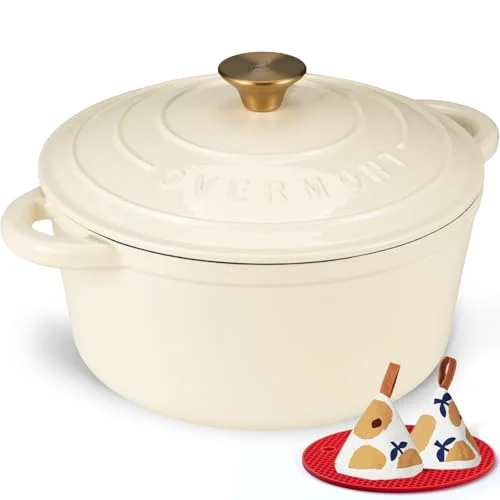
Overmont Enameled Cast Iron Dutch Oven, 7QT with Cookbook & Potholders, Cream White
Best if a stated oven-safe number matters more to you than the knob material itself
7 quarts·Thick-walled cast iron·Oven safe to 500°F·Cream White
Overmont publishes a specific oven-safe figure for this pot — 500°F — which is a genuinely useful number and, as covered earlier, usually describes whichever part of the lid fails first under sustained heat. Whether that 500°F figure already accounts for the knob specifically or describes the cast-iron body alone isn't broken out separately in the specifications we have on file, which is exactly the kind of silence worth asking the seller about directly before you push a bread bake past 450°F in this one.
A real number on the box is worth more than most listings offer. It still isn't the same as a knob material stated outright.
We compared the published specifications and current Amazon prices for the Mueller 6qt, the Umite Chef 7QT and the Overmont 7QT, limiting every claim about these three listings to what each manufacturer actually states. The explanation of how knobs, bolts and replacement kits generally fail and fit reflects well-documented, widely known behavior of phenolic resin, common cookware plastics and stainless steel under kitchen heat — not a claim about any one pot's specific knob, which none of these three listings break out separately.
What we didn’t
We don’t run a testing lab
We did not physically crack, melt or strip a knob on any of these three pots to write this guide, we do not own them, and we have no star ratings or review counts for these specific listings to report. The material behavior described here is general and well established; where a listing is silent on its own knob's material or oven-safe ceiling, we say so rather than guess. See more on the About page.
FAQ
Common questions
Will a cracked Dutch oven knob void my warranty?
Not by itself. A knob cracking from a drop or from exceeding its rated oven temperature is damage from use, not a manufacturing defect, so most warranties were never written to cover it regardless of brand. The part that can affect coverage going forward is fitting a knob the manufacturer didn't supply, which most warranty terms treat as a self-repair — it typically ends claims tied specifically to the lid, though it doesn't usually cancel coverage you already had on the cast iron and enamel body.
Can I keep using a Dutch oven with a cracked or missing knob?
For one more meal, yes, carefully. If the knob is cracked but still attached and not spinning, lift the lid by gripping as much of its edge as you can through a thick towel rather than pinching the damaged knob. If the knob is gone entirely, a spare stainless nut or washer threaded hand-tight onto the exposed bolt works as a one-night grip point. Treat either as a stopgap, not a long-term fix.
Are universal replacement Dutch oven knobs really universal?
Not literally. “Universal” typically means a single central bolt that adjusts to fit a range of lid thicknesses, which covers most of the category's standard single-bolt mounting, not every brand. Check the base-plate diameter, the lid's hole size, and the compatible thickness range before buying, since a handful of premium lids bond or rivet the knob in a way a generic bolt-through kit can't replace at all.
Why did my knob melt but the pot itself looks fine?
Because the knob and the cast-iron body are different materials with different heat ceilings. Cheaper nylon or ABS knobs soften and warp well below the temperature the iron and enamel can tolerate without any trouble, so a knob can fail from ordinary oven heat while the rest of the pot shows no damage at all. A phenolic knob is more likely to crack or char than to visibly melt, and a stainless knob shares the iron's own much higher ceiling.