Best Dutch Ovens
Comparison · Coatings Explained

Ceramic Non-Stick Dutch Ovens vs Enameled Cast Iron: Is Either Actually Non-Stick?

A handful of listings now call themselves ceramic non-stick instead of enameled cast iron. The coating is genuinely different chemistry, and it changes what you can and cannot do with metal utensils, how a sear behaves, and what your pot can take in the oven. We compared the published listings for three cast-iron Dutch ovens — two sold plainly as enamel, one that names itself non-stick and ceramic in the same breath — to work out what the label actually buys you.

By Ilane Tall · Updated November 20, 2026 · Research-based.

Affiliate disclosure: we may earn a commission if you buy through the Amazon links on this page, at no extra cost to you.

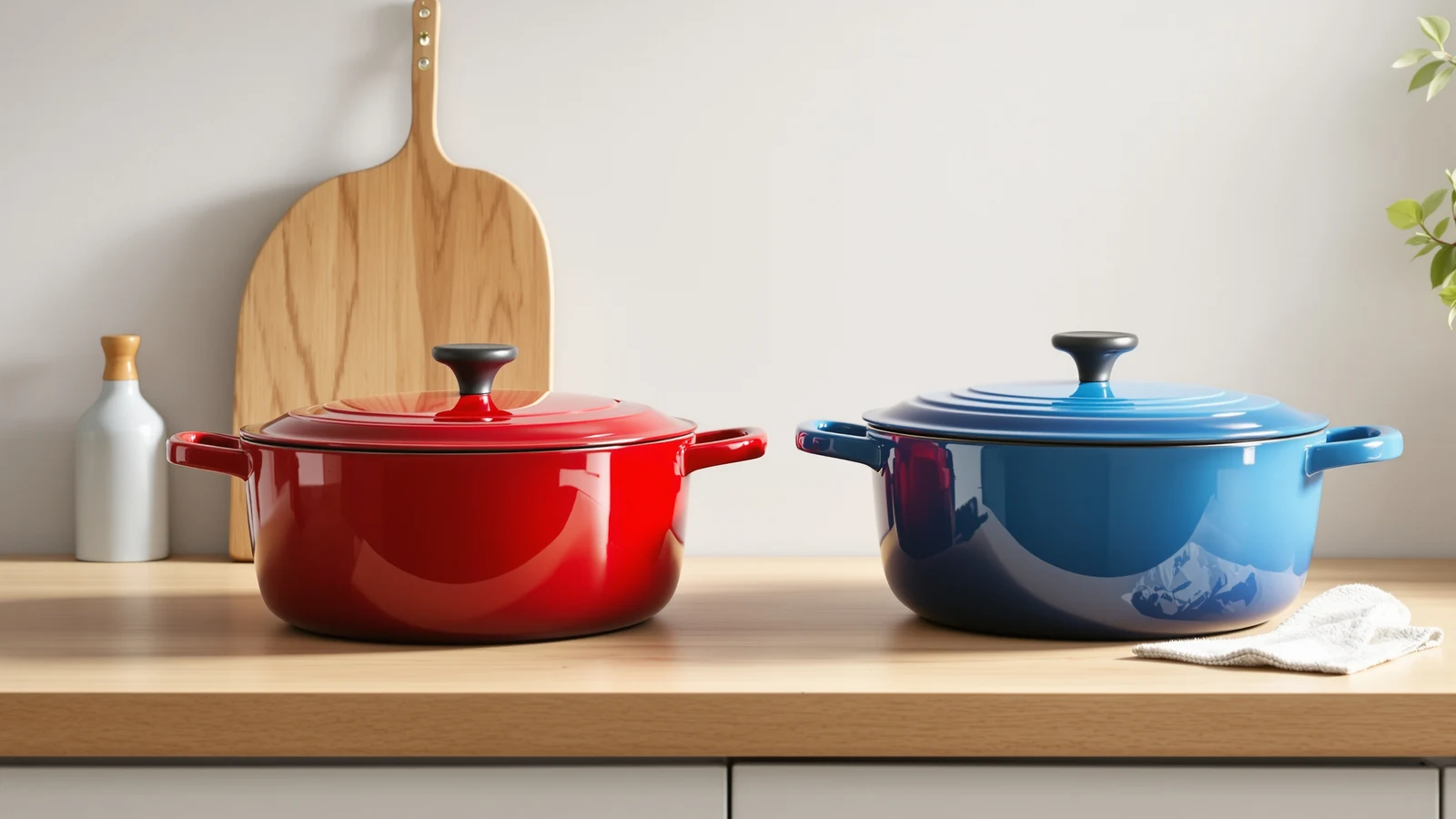
Two cast iron Dutch ovens side by side, one with a glossy enamel interior and one with a matte ceramic-style non-stick interior
Read the listing carefully

What "ceramic non-stick" actually means on a cast iron base

Every Dutch oven in this comparison starts as the same thing: cast iron, melted and poured into a pot-shaped mold. What happens to that iron afterward is where the category splits into two genuinely different products that both get sold under the umbrella term "Dutch oven." One path is vitreous enamel — ground glass, dusted or sprayed onto the iron and fired at very high heat until it fuses into a hard, glossy shell. The other path, newer to this category, coats the iron in a ceramic-style non-stick layer, a mineral-based formula cured onto the metal until it hardens into a smoother, more slippery surface than enamel was ever designed to be.

Those are not two names for the same coating. Enamel was never marketed as non-stick — it is glass, and food browns and clings to it the way food browns and clings to any hard, hot surface, which is exactly why it is good at building a sear. A ceramic non-stick layer is formulated specifically to reduce that cling, the same goal as the non-stick pans most kitchens already own, just baked onto a cast-iron Dutch oven instead of an aluminum skillet.

The listing that makes this split obvious is the 6 Quart Dutch Oven Pot with Lid, Non Stick Enameled Cast Iron Dutch Oven for Bread Baking (ASIN B0CWGJ918N, $37.99). Read its own title closely: it calls itself "Non Stick Enameled Cast Iron" and "Oven Safe Ceramic Cookware" in the same sentence, which tells you the market itself has not settled on one word for this coating. For a shopper, that means the product title is doing real work — if a listing says "non-stick" or "ceramic" anywhere in its name, treat that as a genuine chemistry claim worth reading closely, not a marketing synonym for ordinary enamel.

Two coatings, two jobs

Enamel vs. ceramic: two different glass-like coatings, compared

Both coatings look glassy and both get described in cookware copy with words like "smooth" and "durable," which is part of why the two get confused. But they are built to do different jobs. Vitreous enamel's job is to protect the iron underneath from rust and acid — a tomato braise that would eat through bare cast iron over time does nothing to a properly enameled interior — while being hard enough to survive decades of use. Hardness is the point; slickness never was.

A ceramic non-stick coating's job is release: getting an egg, a piece of fish, or a delicate sauce to lift cleanly off the surface with little or no fat. That slickness comes from a different formulation, and it is generally understood across non-stick cookware as a category to be the part of the coating that degrades first — repeated high heat and ordinary wear gradually reduce how slick a non-stick surface stays, well before the coating actually fails outright. Enamel does not carry that same decay curve, because it was never relying on surface slickness in the first place; it ages mainly by chipping or staining, not by quietly becoming less non-stick.

Price is one visible signal of how a maker is positioning a pot inside this split, though it is not a perfect one. The same six quarts can carry wildly different prices even within plain enamel, before a non-stick claim enters the picture at all. Here, the Amazon Basics 6-Quart (B073Q9WV8S, $44.99) and the Mueller DuraCast 6 Quart (B0C545KQQM, $49.27) are both sold as straightforward enameled cast iron with no non-stick claim in their listing titles, while the B0CWGJ918N 6-Quart sits in between at $37.99 and explicitly adds the non-stick, ceramic-cookware language the other two don't use.

What the coating costs you at the stove

Sticking in practice: searing, deglazing, and the fond you lose

The browned, slightly stuck-on bits left in a pot after you sear meat are called fond, and they are not an accident of bad technique — they are the whole point of searing. Meat proteins bond briefly to a hot, hard surface as they brown, then release when you add wine, stock, or water and scrape the pot with a spoon. That scrape-and-release step, deglazing, is where a braise's flavor base actually comes from. It depends on the food sticking at all, even just a little, during the browning step.

A coating engineered to minimize sticking works against exactly that mechanism. The more effectively a ceramic non-stick layer does its one job — releasing food easily — the less fond it tends to leave behind to deglaze, because there is less for the liquid to lift off the bottom in the first place. This is a real trade-off, not a flaw: a non-stick Dutch oven can still sear and still braise, but it is working against its own coating's purpose to build the same crust that a hard enamel or bare cast-iron surface produces almost by default. If you deep-fry in a Dutch oven on top of searing in it, the same logic applies in reverse — deep frying in a Dutch oven depends on consistent, very high, sustained heat, and a coating optimized for gentle release at moderate heat is not the surface that claim was built around.

None of the three listings in this comparison publish a searing-specific spec, because cookware manufacturers generally don't quantify browning behavior the way they quantify capacity or price. This section is general cookware chemistry, not a claim about how any one of these three specific pots performs at your stove — we have not cooked in any of them, and we are not going to pretend otherwise.

Day-to-day durability

Metal utensils and abrasive cleaning: which coating forgives them

This is the question that actually decides which pot survives in a real kitchen, where somebody eventually reaches for a metal spoon without thinking about it. Enamel is hard, fused glass, which means scratching is not really the risk — a metal spoon dragged across enamel mostly just makes noise. The risk with enamel is impact: a dropped pot, a hard knock against a faucet, or a sudden temperature shock chips the glass at the rim or base. That is a structural failure of the coating, and once it chips, the exposed iron underneath is permanently different from the rest of the surface. If that happens to you, what to do about a chipped or cracked Dutch oven covers it in more detail, including when a small chip is cosmetic and when it isn't.

A ceramic non-stick coating fails differently, and generally sooner under the same treatment. Non-stick surfaces as a category are understood to be more vulnerable to scratching from metal utensils and from abrasive scouring pads than a hard enamel surface is, because the slick top layer is thinner and softer than glass. The failure mode is gradual rather than sudden: no single scratch ruins the pot, but repeated scraping and scrubbing wears the slick layer down over time until the coating stops releasing food the way it did on day one. That is a meaningfully different kind of wear and tear than a glass chip, and it is the direct cost of asking a coating to be slick in the first place.

None of the three listings here publish a scratch-resistance figure, which is normal — this is general, well-established cookware-care knowledge, not a product-specific rating we are inventing. The practical upshot is simple: a plain enameled pot like the Amazon Basics or the Mueller DuraCast tolerates an occasional metal spoon far better than a coating marketed as non-stick will, and if you already know you cook with metal utensils out of habit, that habit alone is a reason to lean toward plain enamel rather than the ceramic non-stick listing.

Read the number, not the adjective

Oven-safe temperature limits, compared side by side

Of the three pots in this comparison, only one publishes an actual number. The B0CWGJ918N listing states it is oven safe up to 500°F, printed directly in the product title alongside its baking, braising, stew, and roasting uses. That figure covers the overwhelming majority of home-oven recipes, including a long low-and-slow braise and a hot bread bake. The Amazon Basics 6-Quart listing describes itself as oven safe for stews, roasting, and baking, but does not give a specific temperature in the title; the Mueller DuraCast listing does not state an oven-safe figure either. That is not a mark against either of those two pots — it simply means the number is not in front of you, and you should open the current Amazon listing and find it before you plan a recipe around a specific oven temperature, rather than assume it matches a different product.

It's also worth remembering that the pot body is rarely the actual limiting part. On almost every Dutch oven, enameled or non-stick, the lid knob has a lower heat tolerance than the cast iron and the coating beneath it, because many knobs are molded from phenolic resin or plastic rather than cast metal. A recipe that pushes a pot toward the top of its stated range, or under a broiler, is really testing the knob, not the coating. If you've ever pulled a pot out of the oven to find the knob deformed or discolored, what to do about a cracked or melted Dutch oven knob walks through when it's fixable and when it's just time to replace it. A non-stick coating and an enamel coating both share this same blind spot: the published oven-safe figure for the pot tells you nothing about the knob sitting on top of it.

Side by side

The three, compared

PotCoating, as listedCapacityPublished oven limitPriceGet it
Non-Stick / Ceramic 6 Quart Non-stick enameled cast iron, listed as ceramic cookware 6 QT 500°F $37.99 Get it
Amazon Basics 6-Quart Enameled cast iron, no non-stick claim 6-Quart Not stated — check listing $44.99 Get it
Mueller DuraCast 6 Quart Enameled cast iron, no non-stick claim 6 Quart – Round Not stated — check listing $49.27 Get it
The picks

Our picks, and who each one is for

01Best to try non-stick

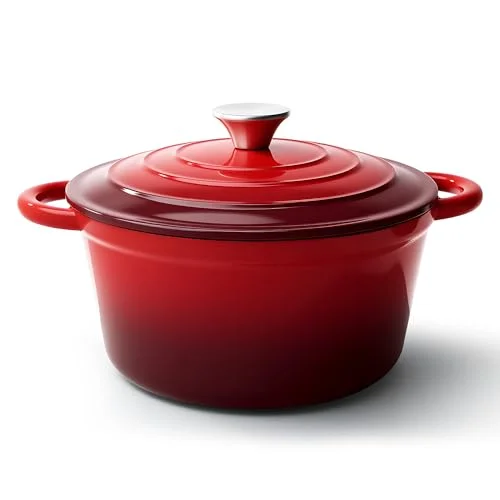
6 Quart Non-Stick Enameled Cast Iron Dutch Oven, Red

Best if you want to try the ceramic non-stick category

6 QT·Non-stick enameled, sold as ceramic cookware·Oven safe to 500°F·Heavy-duty

At $37.99, this is the only one of the three pots that names itself non-stick and ceramic cookware in its own listing title, and the only one that prints a specific oven-safe figure: 500°F. That combination — an explicit coating claim plus an explicit temperature — makes it the clearest entry point if you specifically want the easier release a non-stick surface offers for bread baking, eggs, or delicate fish, rather than the harder, slicker-for-browning surface of plain enamel.

Buy this one knowing the coating is doing a different job than enamel — easier release, not a better sear.

Non-stick enameled cast iron Dutch oven with lid, 6 quart, red
Price
$37.99
Check price →
02Best honest enamel

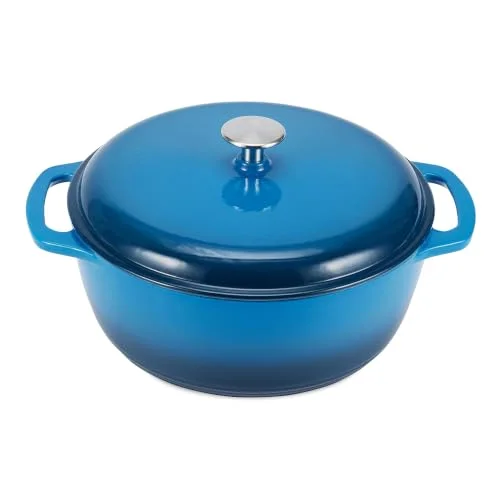
Amazon Basics Enameled Cast Iron Dutch Oven, 6-Quart, Blue

Best if you'd rather have plain, predictable enamel

6-Quart·Round, dual handles·Heavy-duty·No non-stick claim

At $44.99, this is the cheapest pot in the comparison and the most straightforward: it is sold as enameled cast iron, full stop, with no ceramic or non-stick language anywhere in the listing to parse. Dual handles on a round body cover the basics of safe lifting, and the listing describes it as oven safe for stews, roasting, and baking without naming a specific coating category you need to research before buying. If the whole point of reading this comparison was to avoid buying a coating you didn't understand, this is the pot that sidesteps the question entirely.

No ceramic claim to evaluate means no ceramic claim to second-guess later.

Amazon Basics enameled cast iron Dutch oven, 6-quart, blue
Price
$44.99
Check price →
03Best step-up enamel

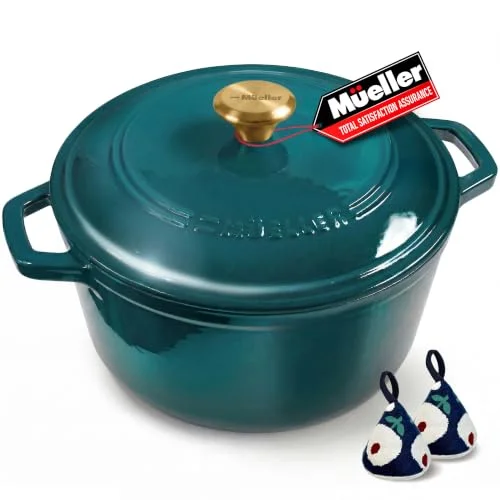
Mueller DuraCast 6 Quart Enameled Cast Iron Dutch Oven

Best if you want enamel without the cheapest listing on the page

6 Quart – Round·Enameled cast iron·No non-stick claim

At $49.27, the Mueller DuraCast sits above both of the other two pots in price while staying in the same plain-enamel category as the Amazon Basics — there is no ceramic or non-stick wording in its listing to weigh against the others. For a reader choosing purely on coating chemistry rather than price, that makes it functionally the same decision as the Amazon Basics: hard, glass-like enamel, no engineered slickness, the surface that favors a confident sear and a chip-risk failure mode rather than a gradual loss of release.

Same coating logic as the Amazon Basics, at a different price point — the choice between these two is about everything except the coating.

Mueller DuraCast 6 quart enameled cast iron Dutch oven
Price
$49.27
Check price →
Match the coating to the cooking

Which coating to buy if you mostly simmer, not sear

The honest answer depends almost entirely on what the pot spends most of its life doing, not on which coating sounds more modern. If your Dutch oven mostly simmers — soups, chilis, long low braises, rice, oatmeal — you are rarely asking it to build a hard sear or a deep fond in the first place, which is the exact situation where a non-stick surface's weaker browning has the least downside. A simmered dish releases easily from either coating, so the ceramic non-stick pot's easier cleanup becomes close to a pure upside with very little trade-off, since you were never relying on that surface to brown anything aggressively.

If searing is a regular step in how you cook — browning a roast before it braises, crisping the skin on a bone-in chicken thigh before the lid goes on — plain enamel is the more consistent choice, for the reasons covered above: it is the coating that was never built to resist the sticking that a good sear and a good deglaze actually depend on. Pick the Amazon Basics or the Mueller DuraCast for that kind of cooking and you are not giving anything up relative to the non-stick option; you are choosing the coating that matches the technique.

Size and cleanup habits matter here too. All three pots in this comparison are sold at 6 quarts, which is the capacity size most households actually use week to week, so the decision genuinely comes down to coating and price rather than capacity. And if your real deciding factor is how the pot gets washed rather than how it cooks, it's worth checking whether a 6-quart Dutch oven actually fits your sink and dishwasher before you commit either way — a pot that's awkward to hand-wash is a pot that will get scrubbed with whatever is closest, which matters more for a non-stick coating than for enamel.

Our method

How we compared

What we did

Listing language, specs, and current prices

We compared the published titles, specifications, and current Amazon prices for the three cast-iron Dutch ovens in this guide, paying particular attention to the exact coating language each listing uses — "enameled," "non-stick," and "ceramic cookware" are not interchangeable words, and we treated each one as a claim to read rather than a synonym. Where a listing states a specific oven-safe temperature, we reported that number; where it does not, we said so rather than estimate one from a similar-looking pot.

What we didn’t

We don’t run a testing lab

We do not physically test these pots, we do not own them, and we have no star ratings or review counts for these specific listings to report. How a non-stick coating actually releases food after fifty uses, or how an enamel surface holds up after a decade of metal spoons, cannot be answered honestly from a brief session with a borrowed pot, by us or by anyone else claiming to have tested it. What we can do is compare what each coating is chemically designed to do, read every specification each listing actually publishes, and say plainly when a number isn't there.

FAQ

Common questions

Is ceramic non-stick the same thing as enameled cast iron?

No, even though some listings use both words for the same pot. Vitreous enamel is ground glass fused onto cast iron mainly to block rust and acid, and it was never designed to be slick. A ceramic non-stick coating is a different, mineral-based formula cured onto the iron specifically to reduce sticking, the same underlying goal as a non-stick skillet. One listing in this comparison, the B0CWGJ918N 6-Quart, uses both terms in its own title, which is a fair sign of how blurry the marketing language has become.

Can I use metal utensils on a ceramic non-stick Dutch oven?

It's riskier than on plain enamel. Enamel is hard glass and mostly resists scratching from a metal spoon, with impact chips being its real failure mode instead. Non-stick coatings as a category are understood to be more vulnerable to scratching and abrasive scrubbing, and repeated metal-utensil use tends to wear down how slick the surface stays over time rather than fail all at once. If you cook with metal utensils out of habit, a plain enameled pot like the Amazon Basics or the Mueller DuraCast tolerates that habit better.

Which of these three Dutch ovens has the highest published oven-safe temperature?

Only one of the three states a number: the 6 Quart Non-Stick Enameled Cast Iron Dutch Oven (B0CWGJ918N) publishes an oven-safe rating of 500°F directly in its listing. The Amazon Basics 6-Quart and the Mueller DuraCast 6 Quart do not state a specific figure in their listings, so check the current Amazon page for either before planning a recipe around a precise oven temperature.

Should I buy ceramic non-stick or plain enamel if I mostly braise and sear?

Lean toward plain enamel, such as the Amazon Basics or the Mueller DuraCast. Searing and deglazing both depend on food sticking briefly to a hot surface before it releases, which is the exact behavior a non-stick coating is engineered to reduce. If your cooking is mostly simmering — soups, chilis, slow braises with no hard sear step — the easier release and cleanup of the non-stick 6-Quart becomes a genuine advantage instead of a trade-off.

Keep reading

More from Best Dutch Ovens