Best Dutch Ovens
How-To · Stovetop Safety

Deep Frying in an Enameled Dutch Oven: Is It Actually Safe?

The high, straight sides and heavy base that make a Dutch oven good at braising also make it good at holding oil at a steady 350°F. It is not a specialty fryer, and nobody built it with a frying basket in mind, but the shape happens to be close to correct anyway. Here is the oil depth a 6-quart pot can safely hold, the three things to check on a listing before you fill one, and what to do about the smell that lingers if you skip the cleanup.

By Ilane Tall · Updated November 12, 2026 · Research-based.

Affiliate disclosure: we may earn a commission if you buy through the Amazon links on this page, at no extra cost to you.

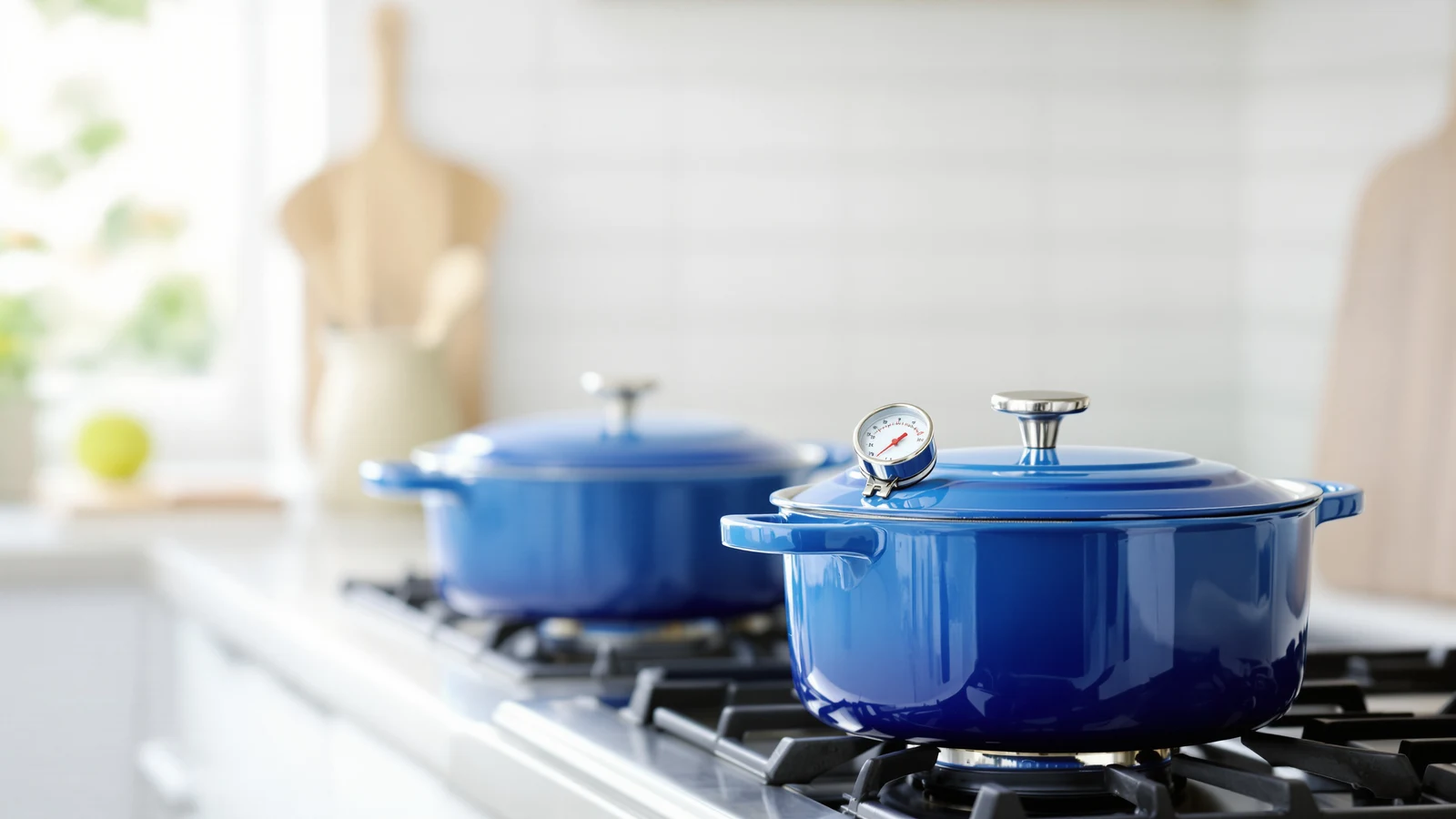
Enameled cast iron Dutch oven on a stovetop holding oil for deep frying, with a clip-on thermometer at the rim
Why it works

The shape built for braising is also the shape built for frying

Nobody designed an enameled Dutch oven as a fryer. It was designed to hold a braise at a steady simmer for three or four hours without drying out, and that happens to require almost exactly the same geometry a deep fryer needs: straight, high sides rather than the flared, sloped walls of a skillet or sauté pan, and a heavy, thick base that resists sudden temperature swings. A braise wants those sides because they keep liquid from reducing too fast around the edges. Hot oil wants them for a more direct reason — they keep splashes and the inevitable rolling bubble a piece of wet food creates contained inside the pot instead of over the rim and onto the stovetop or your hand.

The thick cast-iron wall and base matter just as much on the heat side of the equation. Cast iron has a high thermal mass, which is a clumsy way of saying it does not swing temperature quickly in either direction. That is exactly the behavior you want from a fryer: a thin pot loses several degrees the instant you drop in a cold, wet piece of chicken, and the oil temperature can crash below the point where food crisps instead of absorbs oil. A heavy Dutch oven absorbs that same shock and recovers faster, which is the whole reason cast-iron pots show up so often in frying guides despite not being marketed as fryers at all. The wall thickness that decides how well a pot sears a steak is the identical spec that decides how well it holds a fry temperature.

The one thing the shape does not solve for you is capacity planning. A round pot with straight sides holds its stated volume predictably, which makes the next question — how much oil is actually safe to put in one — a matter of simple arithmetic rather than guesswork.

Do the math first

How much oil a 6-quart pot can actually hold

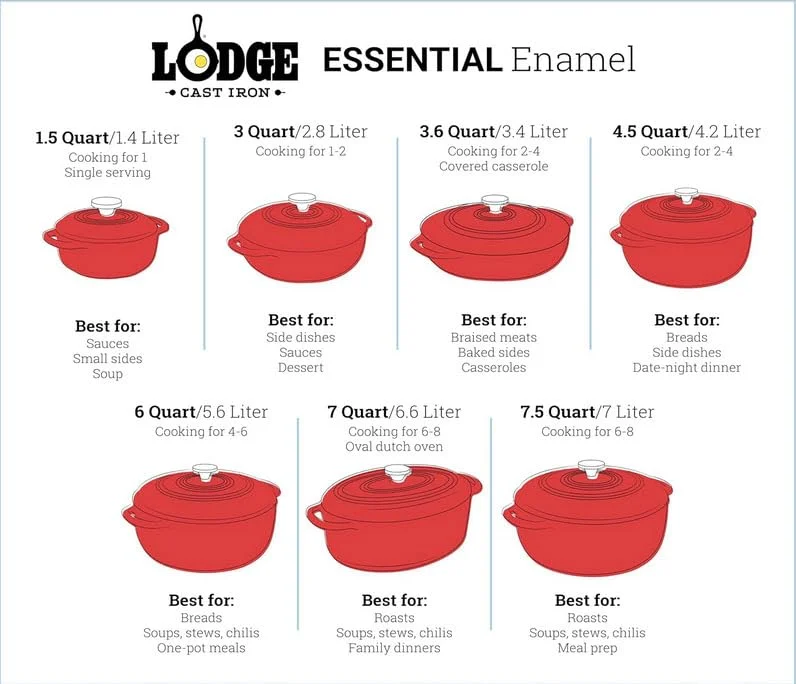
The number that matters is not the pot's stated capacity — it is how much of that capacity you are willing to fill. A 6-quart Dutch oven holds six quarts to the brim, but you should never fill it to the brim with hot oil. The standard, widely repeated guidance for any deep vessel used for frying is to fill it no more than halfway, and in a straight-sided pot like a Dutch oven that works out cleanly: roughly three quarts of oil in a 6-quart pot, leaving the other three quarts of volume as headspace above the oil line.

That headspace is not a safety margin you can shave down to save oil. Food releases water as it fries, and that water flash-boils the instant it hits 350°F oil, producing a sudden, aggressive rise in bubbles that can lift the oil level several inches in an instant. A pot filled to the halfway mark gives that surge somewhere to go before it reaches the rim. A pot filled two-thirds or three-quarters full does not, and that is how oil ends up on a stovetop burner or, worse, on you. The straight sides discussed above help here too: in a pot that tapers outward near the top, the same volume of oil sits higher and closer to the rim than it would in a true cylinder.

Smaller pots lose this margin fast. Drop the same three quarts of oil into a pot with meaningfully less than six quarts of total volume and you have erased the headspace that makes the halfway rule work at all — which is exactly the problem with reaching for an undersized pot just because it is the one already on the stove.

Before you turn on the burner

Check the published ratings before you check anything else

Frying happens on the stovetop, not in the oven, but the oven-safe rating on a listing is still worth reading before you start, because it is usually the clearest public statement a manufacturer makes about how much heat the pot and its lid knob are engineered to take. A listing that states a specific oven-safe temperature outright is telling you something real about its own confidence in the material; a listing that is silent on the figure is not necessarily unsafe, but it has told you less, and it is on you to confirm the stovetop side of the question directly rather than infer it from the oven number.

The stovetop rating is the one to actually confirm, and it is not the same question as oven-safe. Check whether the listing specifies the pot works on gas, electric coil, electric glass-top and induction — cast iron is compatible with most stovetops by default, but a smooth glass-top range can scratch under an unglazed base, and induction specifically requires a ferromagnetic base that not every enameled pot's listing bothers to confirm. None of the three pots compared further down this page publish a stovetop-compatibility list in the specifications we have on file, which is common for this category and is exactly why this is a check-the-current-listing step rather than something we can state on a brand's behalf.

Do this before the oil goes anywhere near the pot, not while it is already heating. A clip-on thermometer, covered next, only protects you from overshooting a temperature once you are frying — it does nothing about whether the pot and your specific stovetop are a safe match in the first place.

While it's heating

Clipping a thermometer on, and keeping the oil there

None of the Dutch ovens discussed on this site come with a built-in temperature probe, because none of them were built as fryers. That makes a separate clip-on deep-fry or candy thermometer the one piece of equipment that turns a Dutch oven into a genuinely controllable fryer instead of a pot of hot oil you are guessing at. Clip it to the rim with the probe tip suspended in the oil, not touching the base of the pot, where cast iron's own heat would read several degrees higher than the oil actually sitting above it.

Most shallow and medium-depth frying is done around 350°F, and the number matters in both directions. Oil that runs cold lets food absorb more of it before the surface sets, leaving a greasy result instead of a crisp one. Oil that runs hot burns the outside of the food before the inside cooks through, and it is also simply more dangerous — oil's flash point is not far above common frying temperatures, and an unwatched pot can climb past a safe range faster on a heavy cast-iron base than on a thin one, precisely because that same thermal mass that stabilizes the temperature also keeps climbing once a burner is left on high.

Expect the temperature to drop five to fifteen degrees the moment food goes in, and plan the burner adjustment for that in advance rather than reacting to it. Turn the heat down slightly as you add food, let the thermometer tell you when it has recovered, and resist the instinct to crank the burner to speed up the climb back — that is how oil overshoots past where you meant it to go. Never leave a pot of hot oil on a lit burner unattended, regardless of how heavy or well-rated the pot is.

After you're done

Cleaning enamel after frying, and the smell that lingers if you skip it

Let the oil cool to warm, not cold and not still hot, before you handle the pot. Strain the oil through a fine mesh or cheesecloth into a heatproof container if you plan to reuse it, and never pour hot oil directly into a sink or straight from a hot pot into a cold storage container — the sudden temperature change is hard on glass and risky to handle. Once the oil is out, wipe the enamel interior with paper towel to lift the bulk of the residue before it has a chance to cool and set.

Enamel is glass fused onto iron, and glass has a smooth, non-porous surface by design — which is good news here, because it means fried-oil residue does not actually soak into the cooking surface the way it can with bare cast iron or a well-seasoned pan. What it does do is sit on that surface as a thin film, and if that film is left to cool and harden rather than washed promptly with hot water and dish soap, it is the film itself, not the enamel, that holds onto the smell. A pot left to sit overnight with fry residue still on it is the common complaint behind "my Dutch oven smells like old oil" — wash it the same day, while the residue is still soft, and the smell has nothing to hang onto.

Avoid plunging a hot pot straight into cold dishwater; let it come down to warm first, the same caution that applies to any enameled pot you intend to keep for years rather than replace after a rough season of use. A soft sponge or nylon brush, hot water, ordinary dish soap, and a prompt wash is the entire routine. There is no special enamel-only degreaser required, and none of the three pots compared below need anything beyond that.

Side by side

The three, compared for a frying pot

PotBest forSize/variantMade byNotablePriceGet it
Lodge Essential Enamel, 6 Quart The frying pot to actually buy 6 Quart Lodge Oyster white, no seasoning needed $69.99 Get it
Amazon Basics 6-Quart Budget frying pot 6-Quart Amazon Basics Dual handles, round $44.99 Get it
Parmedu 5.5QT Sourdough Dutch Oven Bread, not frying 5.5QT Parmedu Sold for sourdough baking $39.99 Get it
The picks

The picks, and the one size too small to bother with

01Best for frying

Lodge Essential Enamel Cast Iron Dutch Oven, 6 Quart, Oyster White

Best for the halfway-fill math to actually work

6 Quart·Enameled, no seasoning·Made by Lodge

At six quarts, this gives you the full three quarts of oil the halfway rule allows plus the three quarts of headspace above it — the margin that absorbs a bubble surge instead of sending it over the rim. Lodge has been casting iron in Tennessee since 1896, which is a brand fact rather than a frying spec, but the pot's straight sides and heavy base are exactly the two things this guide argues you want. Confirm the current listing's stovetop guidance for your specific range before your first fry, as with any pot on this page.

The size where the oil-depth math and the headspace both come out right, in one pot.

Lodge Essential Enamel cast iron Dutch oven, 6 quart, oyster white
Price
$69.99
Check price →
02Budget pick

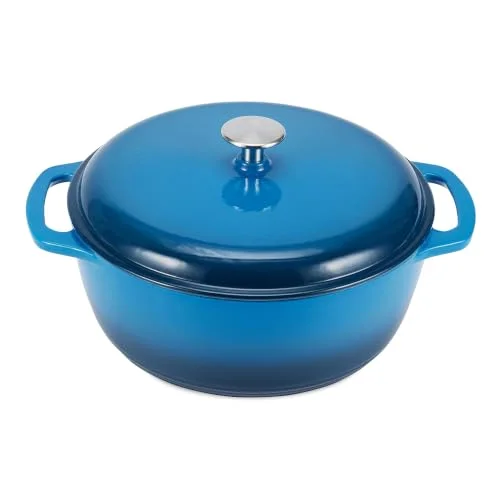
Amazon Basics Enameled Cast Iron Dutch Oven, 6-Quart, Round, Dual Handles

Best if you want the same 6-quart headroom for less

6-Quart·Dual handles·Round

Same capacity as the Lodge, at under half the price, with the same halfway-fill arithmetic applying cleanly. The dual handles are worth noting specifically for frying: a full pot of oil is a two-handed lift once you are done, and a round body with handles set symmetrically on either side is easier to carry level than an oval pot with offset grips. Read the current listing for its stovetop and oven-safe ratings before your first use, since that specification is not published in the data we have for this exact listing.

The same size the math calls for, at the lowest price that still gets you there.

Amazon Basics enameled cast iron Dutch oven, 6-quart, round, dual handles
Price
$44.99
Check price →
03Too small to bother with

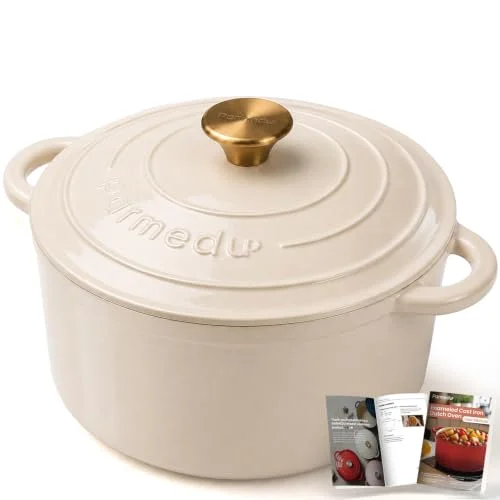
Parmedu 5.5QT Enameled Cast Iron Dutch Oven for Sourdough Bread, White

Skip this one for frying specifically

5.5QT·Sold for sourdough baking·White enamel

This is a perfectly reasonable pot — it is sold and sized specifically for baking a sourdough boule, which is a different job with a different safety margin. Apply the same halfway rule here and you land around 2.75 quarts of oil with roughly 2.75 quarts of headspace left, a smaller cushion against a bubble surge than the 6-quart pots above offer for the same oil volume. Half a quart does not sound like much until a piece of wet chicken hits the oil; in a half-quart-smaller pot, that is half a quart less room for the oil to rise into before it reaches the rim. Buy it for bread. For frying, the two 6-quart pots above give you more margin for a similar or lower price.

A good bread pot. Not the one to reach for on fry night.

Parmedu enameled cast iron Dutch oven for sourdough, 5.5 quart, white
Price
$39.99
Check price →
Our method

How we compared

What we did

Shape, size and published specs

We compared the published size, price and construction details for the Lodge Essential 6 Quart, the Amazon Basics 6-Quart and the Parmedu 5.5QT, and worked the oil-depth and headspace math directly from each pot's stated capacity. The safety guidance in this piece — fill depth, thermometer use, cleaning routine — reflects general, well-established practice for frying in any heavy, straight-sided pot, cast iron or otherwise, not a claim specific to any one brand.

What we didn’t

We don’t run a testing lab

We did not fry anything in any of these three pots ourselves, we do not own them, and we have no star ratings or review counts for these specific listings to report, so we don’t publish any. Where a listing does not publish a stovetop-compatibility or oven-safe figure, we say so rather than guess at it. Confirm the current listing for your exact unit before your first use, since specifications and included accessories can change between print runs.

FAQ

Common questions

Is it actually safe to deep fry in an enameled Dutch oven?

Yes, with the same precautions you would use for any deep pot of hot oil: fill it no more than halfway, use a clip-on thermometer rather than guessing at temperature, never leave it unattended on a lit burner, and confirm the specific listing's stovetop compatibility before you start. The straight sides and heavy cast-iron base that make these pots good at braising are the same two things that make them good at holding a steady fry temperature.

How much oil should I put in a 6-quart Dutch oven for frying?

Around three quarts, following the standard rule of filling a frying vessel no more than halfway. That leaves roughly three quarts of headspace above the oil line to absorb the sudden rise in bubbles that happens when wet food hits hot oil, which is the margin that actually prevents overflow rather than the fill line itself.

Do I need a special thermometer for frying in a Dutch oven?

You need some thermometer, since none of these pots have a temperature probe built in. A clip-on deep-fry or candy thermometer, clipped to the rim with the tip suspended in the oil rather than touching the pot's base, is the standard and sufficient tool for holding the oil around 350°F.

Why does my Dutch oven smell like oil after frying?

Because residue was left to cool and harden on the enamel instead of being washed the same day. Enamel itself does not absorb oil the way bare cast iron can, but a hardened film of fry residue sitting on top of it will hold the smell. Wash with hot water and dish soap while the residue is still soft and the smell has nothing to cling to.

Keep reading

More from Best Dutch Ovens