Best Dutch Ovens
Honest Take · Heat Retention & Searing

Heat Retention and Searing: The Spec Most Listings Don't Mention

Every listing tells you the capacity in quarts and shows you a swatch of colour. Almost none of them tell you how thick the iron actually is, which is the single number that decides whether the pan stays hot enough to sear a cold steak or quietly gives up and starts steaming it. We compared published specifications, prices and general cast-iron physics for three enameled Dutch ovens sold for braising and searing, to work out what wall thickness and weight actually buy you, and why none of the three manufacturers print either figure.

By Ilane Tall · Updated November 9, 2026 · Research-based.

Affiliate disclosure: we may earn a commission if you buy through the Amazon links on this page, at no extra cost to you.

A steak searing in an enameled cast iron Dutch oven on a stovetop, a deep brown crust forming on the meat
The physics of it

Why more iron means more heat held through a cold cut of meat

A sear is a race against a cold object. The moment a room-temperature steak or a browned batch of stew meat touches a hot pan, heat flows out of the iron and into the food, and the surface temperature of the pan drops — sometimes by a lot, depending on how much cold mass just landed on it. If the pan has enough stored heat, that drop is small and brief, and the surface stays above roughly 300–400°F, the range where the Maillard reaction actually browns proteins and sugars into a crust. If the pan doesn't have enough stored heat, the surface temperature falls below that range and stays there while the burner slowly tries to claw it back up. In the meantime, the meat is sitting in a lukewarm pan releasing moisture rather than browning, which is exactly the grey, steamed result everyone is trying to avoid when they reach for cast iron in the first place.

Cast iron is popular for searing precisely because it has a relatively high thermal mass for its size: it stores a meaningful amount of heat energy per pound at a given temperature, and that stored energy acts as a buffer against the cooling effect of whatever cold food you drop into it. More iron mass in the pan means a bigger buffer. This is simple physics, not a brand claim — it applies to any cast iron, enameled or bare, from any manufacturer. The practical consequence is that two pots of the same quart capacity are not necessarily equal searing tools if one of them contains noticeably more iron than the other.

And that is the quiet problem with how these pots are sold. Capacity tells you how much food fits inside. It does not tell you how much metal is doing the work of holding temperature steady while that food cooks. A tall, narrow 6-quart pot and a wide, shallow 6-quart pot can hold the same liquid volume while containing meaningfully different amounts of cast iron, and neither difference shows up anywhere in the listing title or the bullet points. The number that would actually tell you is wall thickness, and it is almost never published.

The missing number

Wall thickness: the spec nobody prints

Open any Dutch oven listing and you will find the capacity in quarts, the colour, the lid style, and usually a line about oven-safe temperature. You will almost never find a wall thickness measurement in millimetres or inches. That is true across the category, not just at the budget end: thickness is simply not a specification retailers have standardized on reporting, the way they have standardized on reporting quart capacity. Terms like "heavy-duty" show up constantly in product titles — the Overmont and Umite Chef lines compared elsewhere on this site both use it — but "heavy-duty" is marketing language, not a number you can compare across brands.

The three pots in this guide follow that pattern exactly. The Umite Chef 7QT, the Mueller 6-quart, and the Overmont 7QT are all marketed for braising, stewing and searing, and none of the three listings state a wall thickness figure. That is not unusual for this price tier or, frankly, for the category as a whole — it is simply the gap this article is pointing at, rather than a specific knock against any one of these three products. If wall thickness mattered enough to you that you needed an exact number before buying, the honest answer is that you would need to contact the seller directly, because the published specification does not exist for most Dutch ovens on the market.

What you can do instead is reason from the one number that is usually available: overall product weight, when a listing bothers to include it, or capacity relative to the pot's stated use case. A pot built and marketed specifically for braising and searing, rather than for light stovetop simmering, is more likely to have been designed with retained heat in mind, even without a thickness spec to prove it on paper. That is a weaker signal than an actual measurement, and we are not going to pretend otherwise — but it is the signal that is actually available on these listings today.

The step everyone shortcuts

Preheating time, and why rushing it defeats the point

Cast iron's biggest advantage for searing — that high thermal mass discussed above — is also exactly why it is slow to heat up. A thin stainless or carbon-steel pan reaches searing temperature in a minute or two because there is very little metal mass to bring up to heat. An enameled cast iron Dutch oven takes considerably longer, because the burner has to raise the temperature of a much larger quantity of iron, not just a thin cooking surface. Skipping that wait and dropping food into a pan that looks hot but hasn't actually equalized all the way through defeats the entire reason you reached for cast iron instead of a lighter pan.

The practical rule is patience over heat. Setting the burner to medium and letting the pot sit empty for several minutes before adding oil and food gives the iron time to come up to a stable temperature all the way through, not just at the surface closest to the flame. Cranking the burner to high in an attempt to shortcut this only heats the bottom of the pot unevenly and risks scorching oil before the iron itself has actually caught up — you get a pan that reads hot on a thermometer pointed at one spot while still being noticeably cooler everywhere else. A slower, steadier preheat produces a more even temperature across the whole cooking surface, which is the condition that actually supports a consistent sear from edge to edge.

This also connects directly back to wall thickness. A thicker-walled pot takes longer to preheat than a thinner one of the same capacity, for the same reason it then holds heat longer once a cold ingredient hits it: there is simply more iron to bring up to temperature and more iron to act as a buffer afterward. Buying a thicker pot without adjusting your preheat habits accordingly — rushing it the way you might rush a thin skillet — is a common way to lose the benefit you paid for.

What's actually happening in the pot

Getting a proper fond

Fond — the browned, caramelized residue that sticks to the bottom of a pot after searing meat — is a direct byproduct of the same heat-retention question running through this whole article. It forms when proteins and natural sugars on the surface of the meat hit a hot, dry metal surface and undergo the same Maillard browning that produces a seared crust, except the part that sticks to the pot rather than staying on the food becomes the base of a sauce once you deglaze it with wine, stock or water. A proper fond needs the pan to stay hot and dry enough, for long enough, for that browning reaction to actually happen — which means it is governed by exactly the same thermal mass and preheat discipline covered above, not by which name is stamped on the lid.

A pan that cools too far when the meat goes in — because it didn't have enough stored heat, or wasn't preheated long enough to begin with — will not build much fond at all. Instead of browning, the meat releases liquid into a lukewarm pan, and that liquid keeps the surface wet rather than dry, which actively works against the Maillard reaction. This is the mechanism behind the common complaint that a braise "tastes flat": the fond step was skipped or undermined before the braise even started, and no amount of simmering afterward fully recovers the depth of flavour that browning would have built in.

A lighter-coloured interior enamel makes it easier to watch a fond develop and judge doneness by sight rather than guesswork, since browning is simply more visible against a pale background than a dark one. None of the three listings in this guide specify an interior enamel colour separately from the exterior, so if that detail matters to your routine, check the current listing's photos directly rather than assume. What does not require guesswork is the underlying mechanism: get the pan properly preheated, keep the meat dry before it goes in, and don't crowd the pot so that released moisture pools and cools the surface faster than the burner can recover it.

The number that would actually tell you

Weight-per-quart, and how much it actually varies

If wall thickness isn't published, weight is the next best proxy for how much iron is actually in a given pot, because weight and wall thickness move together — a thicker-walled pot of a given capacity simply contains more cast iron and weighs more as a result. Dividing total weight by quart capacity gives you a rough, comparable figure across different pots and brands, and it is a more honest basis for comparing heat retention than capacity alone, since two pots can share a quart rating while containing noticeably different amounts of actual metal.

Here is the limitation worth stating plainly: none of the three listings in this guide — the Umite Chef 7QT or the Overmont 7QT, or the Mueller 6-quart — publish a product weight figure in the specifications available to us. That is a common gap across this price tier; weight is reported inconsistently even when wall thickness is omitted entirely, and the "shipping weight" sometimes shown on a listing includes the box and packaging, which is not the same number and shouldn't be treated as one. If weight-per-quart is genuinely the deciding factor for you — say, because you also want to be confident you can lift the pot safely when full — the only reliable path is to check the current Amazon listing's "Item Weight" or "Product Dimensions" field yourself before buying, since it can change between listing updates and we are not going to estimate a number none of these three manufacturers has stated.

What we can say with confidence, because it holds across the category rather than for any one brand, is that the variation is real and sometimes substantial: a Dutch oven built with thin walls to save on material and shipping cost can weigh meaningfully less per quart than one built with thick walls specifically for retained heat, even at an identical capacity. That gap is the entire reason this article exists — the spec that would resolve it in five seconds almost never appears on the page you're actually buying from.

Side by side

The three, compared

PotBest forCapacityMade byNotablePriceGet it
Umite Chef 7QT Bigger cuts, long braises 7 qt Umite Chef Cotton potholders included $55.99 Get it
Mueller 6qt Round A compact sear-and-braise pot 6 qt – Round Mueller Safe for all cooktops $49.97 Get it
Overmont 7QT Feeding a crowd after a sear 7 Quart Overmont Cookbook and cotton potholders included $62.99 Get it
The picks

The picks for searing before a long braise

All three of these are marketed specifically for braising and searing rather than light stovetop work, which is the strongest available signal in the absence of a published wall-thickness figure. The differences between them come down to capacity and what ships in the box, not which one browns meat better — we have no basis to claim otherwise.

01Best for a big cut

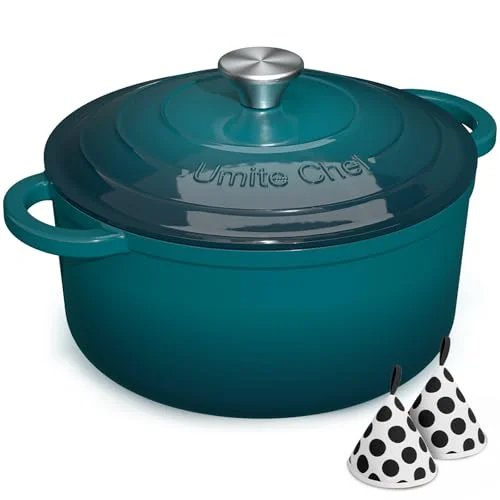
Umite Chef 7QT Enameled Cast Iron Dutch Oven with Lid & Cotton Potholders, Emerald

Best for searing a larger roast before a long braise

7 quarts·Enameled cast iron·Cotton potholders included·Emerald

Seven quarts of capacity gives a large roast or a double batch of braising meat room to brown in batches without crowding the pot — crowding being one of the more reliable ways to undercut a sear, since it traps released moisture against the surface instead of letting it evaporate off. Marketed for bread baking, braising, stews and marinating, it is squarely built around the sear-then-braise workflow this article is about. No wall thickness or weight figure is published, which is true of the other two pots here as well.

The included potholders are worth noting for exactly one reason: a full seven-quart pot of braised meat coming out of the oven is genuinely heavy to carry.

Umite Chef 7QT enameled cast iron Dutch oven, emerald
Price
$55.99
Check price →
02Best compact option

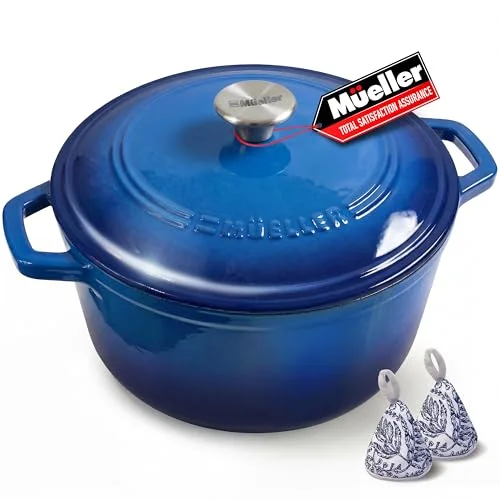
Mueller 6qt Enameled Cast Iron Dutch Oven, Aqua Blue

Best for a sear-and-braise routine without the counter space a 7-quart pot demands

6 Quart – Round·Safe for all cooktops·Lid with knob·Aqua Blue

A round 6-quart body is the more common footprint for a household that sears and braises for two to four people rather than a crowd, and "safe for all cooktops" is a genuinely useful line item if you are searing on induction, where not every enameled pot is rated to work. At $49.97 it sits within a couple of dollars of the larger Overmont below, which makes the real choice between these two almost entirely about capacity rather than price.

If seven quarts of pot is more than your stovetop or your household needs, this is the sized-down version of the same idea.

Mueller 6-quart enameled cast iron Dutch oven, aqua blue
Price
$49.97
Check price →
03Best for a crowd

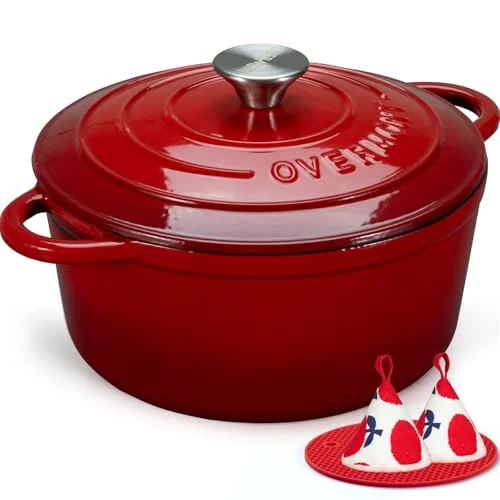
Overmont Enameled Cast Iron Dutch Oven, 7QT, Red

Best for searing in batches ahead of a braise that will feed five or more

7 Quart·Cookbook included·Cotton potholders included·Red

Overmont markets this one explicitly for braising, stews, roasting and sourdough baking, which is the broadest stated use case of the three pots here and lines up with a household that sears, braises and bakes in the same pot rather than keeping separate cookware for each job. At $62.99 and 7 quarts, it is priced within two dollars of the smaller Mueller, so the decision between the two really comes down to how much capacity your braises actually need, not which one is the better value.

The cookbook that ships with it is a nice-to-have, not the reason to buy it — the reason is the capacity, at a price close to the smaller pot above.

Overmont 7-quart enameled cast iron Dutch oven, red
Price
$62.99
Check price →
Putting it together

When this spec actually changes your decision

None of this means you need to chase down a wall-thickness figure before buying any Dutch oven. For a household that mostly simmers soup or reheats leftovers — the use case covered in our guide to Dutch ovens for soup and chili — thermal mass barely matters, because nothing in that routine depends on the pan holding a precise searing temperature against a cold ingredient. It matters specifically when the plan is to sear meat hard, in a dry pan, before adding liquid for a braise. That is a narrower use case than "owns a Dutch oven," and it's worth being honest that most of the pots sold under this category, including the premium French ones, will sear adequately if you preheat properly regardless of exactly how thick the walls are.

Where the missing spec genuinely costs you is at the margins: a thin-walled pot being rushed through a short preheat, asked to sear a large batch of cold meat in one go, on a stovetop that can't fully compensate. A manufacturer's warranty will cover a cracked lid or chipped enamel, but it has nothing to say about whether the pot has enough mass to sear well — that's a design choice baked in at the foundry, not a defect a warranty claim can fix. If searing is the main reason you're buying, the safest move with any of the three pots in this guide, or any other, is to preheat longer than feels necessary and sear in smaller batches rather than assume the capacity number on the box tells you anything about how the pan will behave with a cold steak in it.

Our method

How we compared

What we did

Specs, prices and established cast-iron physics

We compared the published specifications and current Amazon prices for the Umite Chef 7QT, the Mueller 6-quart and the Overmont 7QT, and grounded the explanation of heat retention, preheating and fond formation in well-established, general facts about how cast iron and the Maillard reaction behave — facts that apply to the category as a whole, not claims specific to any one listing. Where a specification such as wall thickness or product weight is not published for a given pot, we say so directly rather than estimate it from a similar-looking product.

What we didn’t

We don’t run a testing lab

We do not physically test these pots, we do not own them, and we have no star ratings or review counts for these specific listings to report, so we don't publish any. We also don't have verified owner feedback tied to these three listings, so this guide anchors every searing and heat-retention claim in general cast-iron science and in what each manufacturer actually states, rather than in sentiment we can't verify. See more about our approach on the About page.

FAQ

Common questions

Does a heavier Dutch oven really sear better than a lighter one?

Generally, yes, for a straightforward physical reason: a heavier pot of the same capacity typically contains more cast iron, and more iron mass stores more heat energy. That stored heat acts as a buffer when a cold piece of meat hits the pan, keeping the surface temperature in the browning range instead of dropping below it. Capacity alone doesn't tell you this; two pots of the same quart rating can differ in actual iron mass.

How long should I preheat a Dutch oven before searing?

Longer than feels necessary. Set the burner to medium and let the empty pot sit for several minutes before adding oil, so the heat has time to travel all the way through the iron rather than just warming the surface closest to the flame. Rushing this with high heat tends to produce an unevenly heated pan rather than a genuinely hot one.

Why don't Dutch oven listings publish wall thickness or weight?

It simply isn't a specification the category has standardized on reporting, the way quart capacity is. None of the three pots in this guide — the Umite Chef 7QT, the Mueller 6-quart, or the Overmont 7QT — list a wall thickness or product weight figure. If that number matters to your decision, the only reliable path is checking the current listing's dimensions field or contacting the seller directly.

Which of these three Dutch ovens is best for searing before a braise?

All three are marketed specifically for braising and searing rather than light simmering, which is the strongest signal available without a published thickness spec. The Umite Chef 7QT and Overmont 7QT suit larger batches or bigger cuts at the same quart capacity; the Mueller 6-quart is the more compact option, and specifically states it's safe for all cooktops, including induction.

Keep reading

More from Best Dutch Ovens