Best Dutch Ovens
Buying Guide · Sizing

What Size Dutch Oven Do You Actually Need?

Five quarts, six, or seven. The real question is not how many quarts sound impressive on the box, but what you actually cook on a normal week — a loaf of bread, a chicken, a stew for the household — and which size of pot does that job without fighting you. We compared published capacities, dimensions and prices across three Dutch ovens that sit in the three sizes most US kitchens choose between.

By Ilane Tall · Updated October 14, 2026 · Research-based.

Affiliate disclosure: we may earn a commission if you buy through the Amazon links on this page, at no extra cost to you.

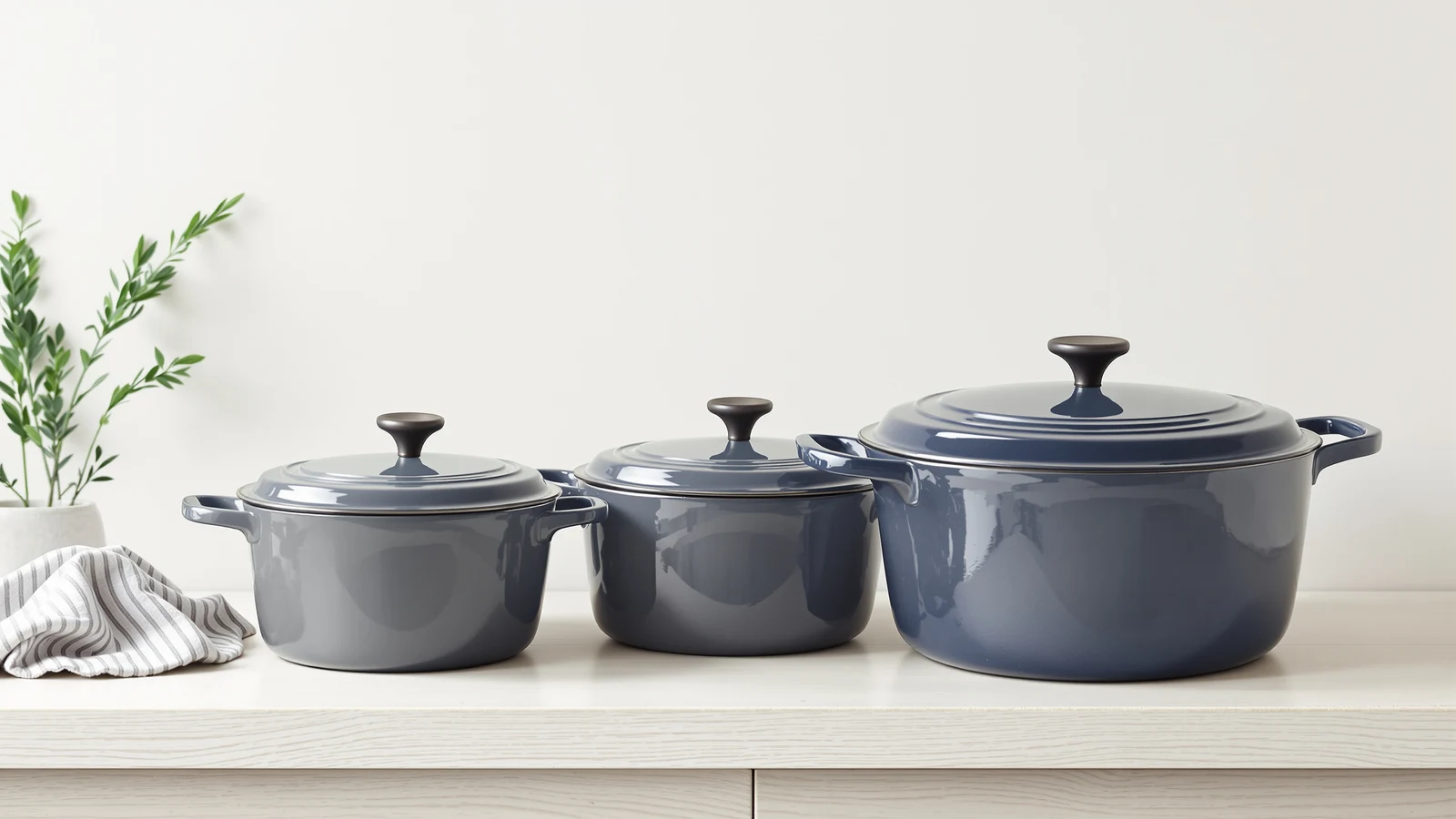
Three enameled cast iron Dutch ovens of different sizes lined up on a kitchen counter
Start here

Quarts, translated into people

Every Dutch oven listing leads with a number in quarts, but a quart is a unit of volume, not a unit of dinner. What you actually want to know is how many people the pot on your stove or shelf of your oven will feed in one sitting, with maybe enough left over for lunch the next day — and that number shifts depending on whether you're making soup, baking bread, or roasting a chicken with vegetables packed around it.

A rough but useful conversion: treat each quart of stated capacity as a little more than one generous adult serving of a one-pot meal, once you build in the headroom you need to actually use the pot. Cast iron Dutch ovens are not meant to be filled to the rim. A stew needs an inch or two of clearance below the lid so it can simmer without spitting over, and bread needs the opposite problem solved — headroom for the dough to spring upward in the first blast of oven heat. That headroom, more than the number printed on the box, is why the practical serving count runs a little lower than the raw arithmetic of quarts-to-servings suggests.

With that adjustment, the market sorts into three bands that show up across almost every Dutch oven line sold in the US, including the three compared in this guide: five to five and a half quarts, six quarts, and seven quarts and above. Pick the band that matches the meal you cook on an ordinary Tuesday, not the one you cook twice a year, and the right pot gets a lot easier to find.

The compact size

5 to 5.5 quarts: two to four, and a pot that fits the oven shelf

Five to five and a half quarts is the smallest size that still counts as a full-sized Dutch oven rather than a lidded saucepan, and it is sized for two to four people — generous portions for two with leftovers, or a straightforward dinner for four without much left over. It is also, not coincidentally, the size most associated with baking bread rather than braising dinner for a crowd.

The dimension that matters here is not just the volume but the footprint. A 5 to 5.5-quart round pot runs roughly 10 to 10.5 inches across, which means it sits on a standard oven shelf with real clearance on either side — you can run a sheet pan of vegetables alongside it, or slide two shelves in at once, in a way a wide 7-quart pot simply does not allow in a typical home oven. If your kitchen has a small oven, a narrow galley layout, or you're cooking in an apartment, this is the size that solves a problem the quart number alone never reveals.

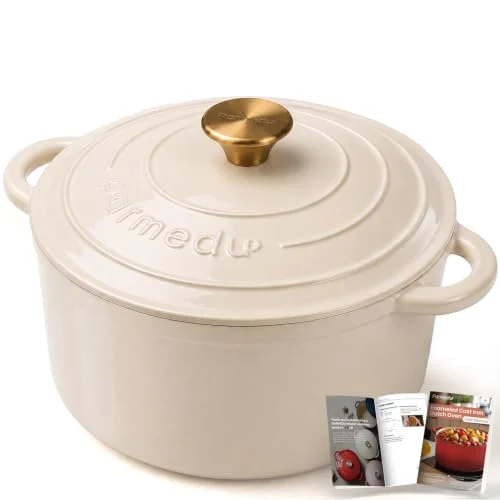
The Parmedu 5.5QT Enameled Cast Iron Dutch Oven for Sourdough Bread is built around exactly this logic. It's sold specifically for sourdough baking, in white enamel, at $29.67 — a deliberately narrow pitch rather than a do-everything pot. The size matches what a standard sourdough boule actually needs: enough interior height for the dough to spring upward without the loaf doubling back on itself, in a pot that still fits comfortably on an oven shelf next to whatever else you're baking that day. It will also hold a stew or braise for two without complaint, the same way any enameled cast iron pot does, but bread is the job this size — and this particular pot — is priced and built for. We compare it against five other sizes and price tiers in our full Dutch oven roundup.

The common size

6 quarts: the household default, and why

Six quarts is the size most Dutch oven recipes are quietly written for, and the size most brands treat as their flagship SKU, for the same reason: it is the smallest size that comfortably fits a whole roasting chicken — typically four to five pounds — with room for onions, carrots and potatoes around it, and it is the largest size most single cooks can lift one-handed out of the oven without needing a second person to spot them.

Six quarts covers the three meals that come up most often in a Dutch oven household: a whole chicken, a stew or chili for four to six people, and a loaf of bread with enough extra headroom that the slightly larger-than-5.5-quart interior rarely feels restrictive, even for a big boule. It's also, usually, the size where price competition is fiercest, since nearly every brand from the budget end to the premium end fields a six-quart pot, and shoppers end up comparing them head to head.

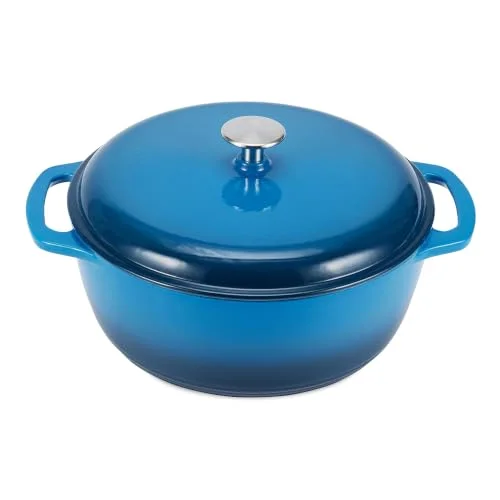
The Amazon Basics Enameled Cast Iron Dutch Oven, 6-Quart is the plainest version of this logic, at $49.99: round, dual handles, heavy-duty, and marketed for stews, roasting and baking. No foundry history, no included cookbook, just the default size at close to the floor price a genuinely enameled six-quart pot reaches. We've covered it in more detail, alongside two other pots under the same price ceiling, in our guide to Dutch ovens under $100, where it's also the default budget pick. If you only ever buy one Dutch oven in your life, six quarts is the size that will disappoint you least often in either direction — rarely too small for a weeknight meal, and rarely so large that you're heating an oven's worth of cast iron to cook dinner for two.

The big size

7 quarts and above: what it weighs when full

Seven quarts and up is the size built for a crowd — serving five to eight people, a full brisket, or a double batch of chili — and the size where the conversation stops being only about capacity and starts being about weight. This is also where some of the heaviest-walled premium French pots concentrate, the same brands compared directly in our piece on whether that premium is worth paying for.

Here's the arithmetic worth doing before buying at this size, using nothing but the volume printed on the box: a US quart of water weighs roughly 2.09 pounds. Seven quarts of liquid alone — before you've added a chicken, a chuck roast, or a few pounds of vegetables — already comes to close to 14.5 pounds. Add the empty weight of a cast-iron pot this size, which runs heavier than a 5.5-quart pot simply because there is more iron in the walls and base, and a genuinely full 7-quart Dutch oven coming out of a 400°F oven is a two-handed, both-mitts lift for almost anyone. That's arithmetic, not a manufacturer's specification, and it holds regardless of brand.

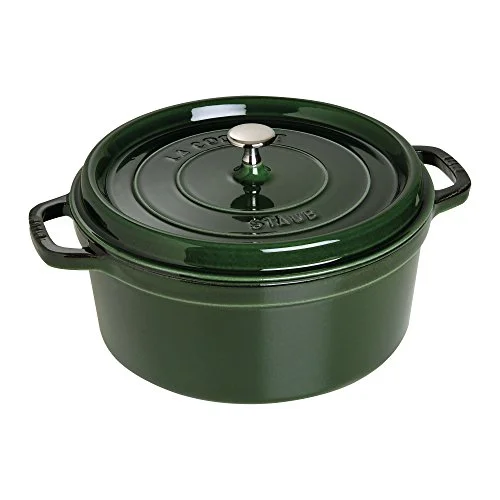
The Staub Cast Iron 7-qt Round Cocotte in this guide, made in France and priced at $299.95, sits exactly in this size and this category of lift. It's built for long braises rather than everyday dinners — the spiked underside of a Staub lid is designed to collect condensation and rain it back onto the food during a slow cook, a detail that matters most in a pot this size, holding a braise for hours rather than a quick weeknight stew. Handle geometry becomes the deciding factor once you're in this weight range, more than it does at 5.5 or 6 quarts: look at how far the handles stand away from the body in the listing photos, and recognize that a pot described as feeding "a crowd" is also, honestly, describing a pot you'll want a second person nearby for once it's full.

Work backward from the dish

Bread, chicken and stew: the three jobs that set the size

Rather than starting from a headcount, it can be faster to start from the dish. Across the category, three jobs come up again and again, and each one points toward a different size before you've thought about people at all.

Bread wants the smallest pot that still gives the dough room to spring upward. A standard sourdough boule is sized for a 5 to 5.5-quart Dutch oven; put the same dough in a 7-quart pot and the loaf tends to spread sideways instead of rising, because there's more room to spread into and the trapped steam — the thing that gives a home oven a bakery-style crust — has farther to travel before it does its job. That's the entire reason a pot like the Parmedu is sized and marketed at 5.5 quarts specifically for sourdough rather than at some other capacity.

Chicken wants the middle size. Four to five pounds of bird plus vegetables needs enough width to avoid crowding the chicken against the sides of the pot — crowding that steams the skin instead of letting it brown — and six quarts is reliably the smallest size that gives a chicken this room while still fitting most home ovens without a fight.

Stew and chili, cooked in volume for a household of five or more, wants the largest practical size. Once you're feeding six or eight people a liquid-based meal, a 5.5 or 6-quart pot runs out of headroom fast — simmering liquid needs an inch or two of clearance below the lid, and a crowd-sized batch eats into that margin quickly. Seven quarts and up, like the Staub in this guide, is the size that keeps a big stew from threatening to boil over the lid partway through a long simmer.

Put plainly: if bread is the main job, buy small. If dinner for the household is the main job, buy the default six quarts. If the main job is cooking for a crowd on a regular basis, the extra weight of a 7-quart-plus pot is the trade you're making on purpose.

Side by side

The three sizes, compared

PotBest forCapacityFeedsPriceGet it
Parmedu 5.5QT Sourdough Dutch Oven Bread, two to four people 5.5 qt 2–4 $29.67 Get it
Amazon Basics 6-Quart Whole chicken, household default 6 qt 4–6 $49.99 Get it
Staub 7-qt Round Cocotte Long braises, feeding a crowd 7 qt 5–8 $299.95 Get it
The picks

Our picks, by the job they're sized for

01Best for bread

Parmedu 5.5QT Enameled Cast Iron Dutch Oven for Sourdough Bread

Best if bread is the main reason you're buying one

5.5 quarts·Sold for sourdough·White enamel·Fits a standard oven shelf

At $29.67, this is the cheapest honest route into the category if a sourdough boule is what's driving the purchase. The size is the point: small enough that trapped steam reaches the crust quickly and the dough has somewhere to spring upward rather than spread sideways, and compact enough to share oven space with a sheet pan. It handles a stew or braise for two as well, since the iron underneath does the same job as any other enameled pot — bread is simply what it's built and priced around.

If your Dutch oven's first job is a loaf, buy the size made for that loaf.

Parmedu 5.5QT enameled cast iron Dutch oven for sourdough bread
Price
$29.67
Check price →
02Best default

Amazon Basics Enameled Cast Iron Dutch Oven, 6-Quart

Best for most households, most weeks

6 quarts·Dual handles·Round·Heavy-duty

At $49.99, this is the size that fits a whole roasting chicken with vegetables, a stew for four to six, or a loaf of bread without feeling cramped by any of the three. It's the capacity most Dutch oven recipes are written around precisely because it's the largest size most people can comfortably lift one-handed and the smallest size that doesn't crowd a chicken against the walls. There's no heritage story here, just the default size at a price close to the floor for genuinely enameled cast iron.

If you're not sure which size to buy, this is the one that's wrong the least often.

Amazon Basics enameled cast iron Dutch oven, 6-quart, blue
Price
$49.99
Check price →
03Best for a crowd

Staub Cast Iron 7-qt Round Cocotte

Best for long braises and feeding five to eight

7 quarts·Made in France·Spiked self-basting lid·Heavy, tight-fitting

At $299.95, this is the size and the pot for a household that regularly cooks past six portions, or for a four-hour braise that needs margin below the lid so it doesn't threaten to boil over. The spiked underside of the lid collects condensation and returns it to the food, a genuine design choice rather than a flourish, and it matters most in a pot this size holding liquid for hours. Full, it is a real lift — budget for using both hands and both mitts.

Buy this size because you cook for a crowd, not because a bigger number sounds better on the box.

Staub cast iron 7-qt round cocotte, basil
Price
$299.95
Check price →
Our method

How we compared

What we did

Published capacity, dimensions and price

We compared the published capacity, approximate footprint and current Amazon price for the Parmedu 5.5QT, the Amazon Basics 6-Quart and the Staub 7-qt Round Cocotte, then mapped each one to the meals it's actually sized for — bread, a whole chicken, or a crowd-sized stew — using plainly stated assumptions about volume and weight rather than guesswork. Where a figure such as exact weight isn't published for a specific listing, we calculated it from the stated capacity and said so, rather than present it as a manufacturer spec. Every other guide and comparison on this site uses the same approach; see the full list on All Guides.

What we didn’t

We don’t run a testing lab

We do not physically test these pots, we do not own all three, and we do not publish invented ratings or review counts for them. Sizing decisions like these come down to arithmetic and the physical dimensions a manufacturer publishes, not a lab score — a quart of water weighs what it weighs regardless of who is holding the pot. What we can do honestly is work through that arithmetic in the open and tell you plainly when a figure, like handle length, simply isn't published. Read more about our approach on the About page.

FAQ

Common questions

What size Dutch oven do most people need?

Six quarts. It's the smallest size that comfortably fits a whole roasting chicken with vegetables, the largest size most single cooks can lift one-handed out of the oven, and the capacity most Dutch oven recipes are written for in the first place. If you only buy one Dutch oven, six quarts is the size that disappoints you least often, whether the meal is small or ambitious.

Is a 5.5-quart Dutch oven too small for a family?

Not necessarily, but it's a size built around a different job. 5.5 quarts feeds two people generously or four without much left over, and it's the size most associated with baking sourdough bread, since the smaller interior gives trapped steam less distance to travel for a good crust. For a family cooking liquid-based meals like stew most nights, six quarts or above gives more margin below the lid.

How much does a full 7-quart Dutch oven weigh?

More than most people expect. A US quart of water weighs about 2.09 pounds, so seven quarts of liquid alone comes to roughly 14.5 pounds, before adding a chicken, a roast or vegetables. Add the empty weight of a cast-iron pot this size, which is heavier than a 5.5-quart pot simply because it contains more iron, and a genuinely full 7-quart Dutch oven coming out of a hot oven is a two-handed lift for almost anyone.

Can I bake sourdough in any size Dutch oven?

You can, but size changes the result. A standard boule is sized for a 5 to 5.5-quart pot; in a larger pot like a 7-quart cocotte, the dough has more room to spread sideways instead of rising, and the trapped steam that builds a bakery-style crust has farther to travel. The Parmedu 5.5QT in this guide is sized and sold specifically around that standard boule.

Keep reading

More from Best Dutch Ovens