Best Dutch Ovens
Roundup · Bare Cast Iron for Open Flame

The Best Dutch Ovens for Camping and Campfire Cooking

A pot built for a stovetop is not built for a bed of coals. Enameled cast iron — the kind this site usually recommends for a kitchen — is not meant to go anywhere near an open flame. Outdoors, the two features that actually decide whether a Dutch oven works are a bail handle to hang it over a fire, and legs with a flanged lid to let it stand over coals and hold more coals on top. We compared the published specifications and current Amazon prices for three bare cast-iron Dutch ovens built around exactly those two features.

By Ilane Tall · Updated November 17, 2026 · Research-based.

Affiliate disclosure: we may earn a commission if you buy through the Amazon links on this page, at no extra cost to you.

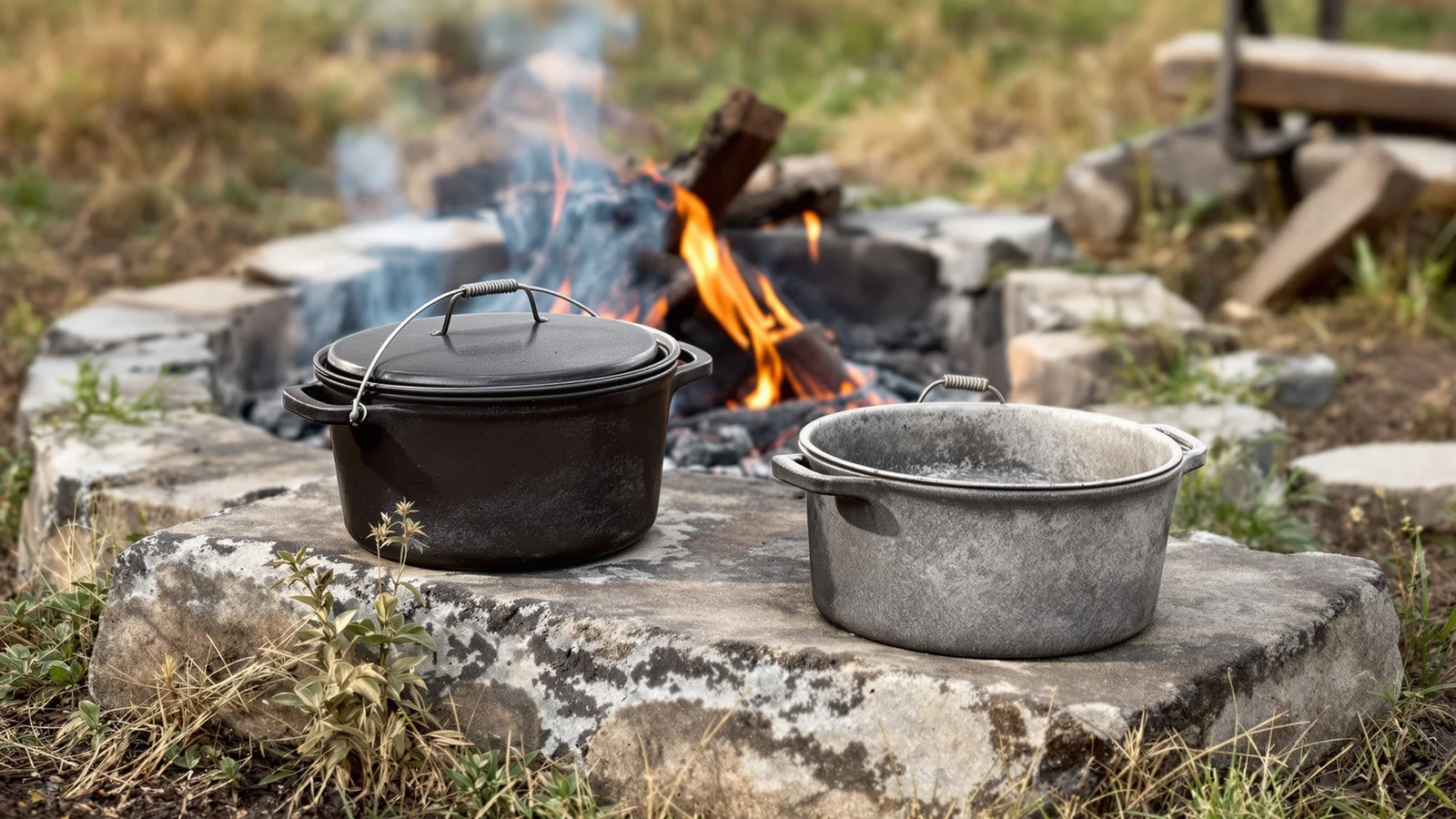
Bare cast iron Dutch oven with a bail handle sitting on legs over glowing campfire coals outdoors
Material, not marketing

Why bare cast iron, not enameled, is the right call near a flame

Every other guide on this site is about enameled cast iron, and for good reason indoors: the enamel means no seasoning, no rust, and no worrying about a tomato sauce. None of that survives contact with an actual fire. Enamel is glass fused to iron, and glass does not like sudden, uneven, extreme heat — the kind a campfire produces, where one side of a pot sitting in coals can run hundreds of degrees hotter than the side facing the open air. Manufacturers of enameled Dutch ovens routinely warn against using them directly over an open flame or in a campfire for exactly this reason: the risk of cracking or crazing the enamel is real, and once it cracks, it does not heal the way bare iron does. Heat retention and searing on bare cast iron work the same way they do in an enameled pot — the iron underneath is still iron — but bare iron can take direct flame contact that would ruin a glass coating.

Bare cast iron has no coating to protect. Instead, it relies on seasoning: a thin, polymerized layer of oil baked into the metal's surface that builds up with use and gets more nonstick over time rather than less. That layer can scorch, flake a little, or go patchy after a hard night over coals, and the fix is simply to re-oil and reheat it — not a trip back to the manufacturer. That tolerance for abuse, more than any single spec on a listing, is the actual reason every one of the three products below is sold as bare, pre-seasoned or seasonable cast iron rather than enameled.

The feature that defines a camp oven

The bail handle: hanging a pot over coals instead of a grate

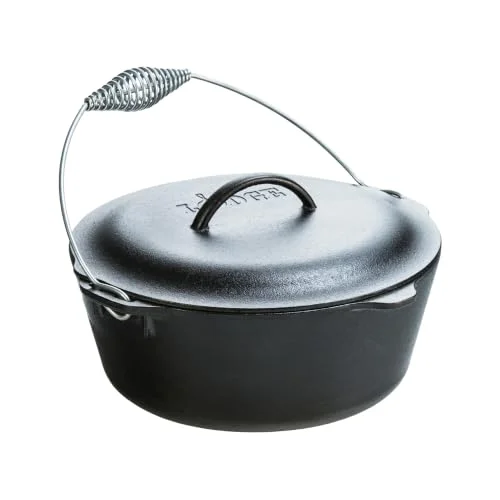
A bail handle is the wire loop that arcs over the entire lid from one side of the pot to the other, sized to be lifted with a gloved hand, a stick, or a dedicated lid lifter rather than two side handles. It exists for one reason: so the whole pot can be hung from a tripod or a chain over a fire, with the coal bed underneath doing the heating, instead of needing a grate, a stand, or a flat bed of coals to sit on. Of the three pots in this guide, the Lodge Pre-Seasoned Cast Iron Dutch Oven with Bail Handle is the one built and marketed specifically around this — Lodge calls it “campfire ready” in the listing, which is the phrase to look for if hanging over a fire, rather than setting the pot down on coals or a grate, is how you actually plan to cook.

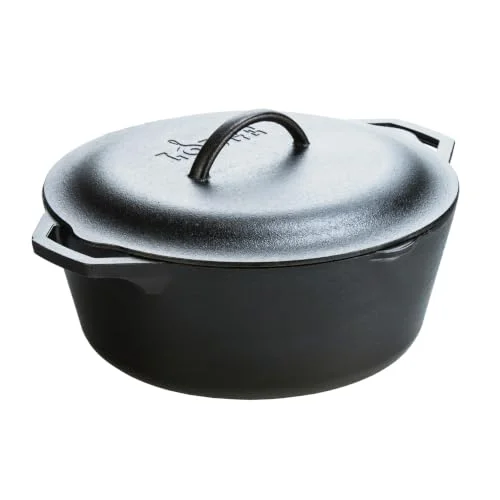
The other two pots here use loop or dual handles on the sides of the body instead of a full bail. That is not a flaw; it simply means they are built to sit — on a camp stove grate, a tripod stand, or directly on a bed of coals — rather than to hang free over an open fire. If hanging matters to your setup, confirm the bail is present in the listing photos before you buy, since not every “outdoor” cast-iron pot includes one.

The two-piece design

Legs and a flanged lid: how a camp oven holds its own coals on top

The classic camp Dutch oven design does two things a kitchen pot never needs to: it stands on three short legs so a shovel can slide coals underneath it, and its lid has a raised flange — a lip around the edge — deep enough to hold a second layer of coals on top without them sliding off onto the ground. Put coals both underneath and on the flanged lid and the pot heats from both directions at once, the way a real oven does, instead of just from the bottom like a pot on a stovetop. Camp cookbooks and Dutch-oven baking charts have used variations of this bottom-and-top coal arrangement for generations to bake bread, cobbler and casseroles over a fire with no oven anywhere nearby.

This is also the design detail we have to be most careful about from the listings alone. None of the three product pages we sourced for this guide states a leg count or a flange depth in the specifications available to us, so we are not going to assign that spec to one pot over another from guesswork. What we can tell you is what to look for: in the product photos, check for short feet on the base and a lip around the lid rather than a flat rim, and treat phrases like “campfire ready” or “heavy-duty” in a listing as a prompt to look closely at those photos, not as a guarantee of the feature itself. A camp oven also has no reason to carry a separate plastic or phenolic lid knob — the kind that cracks or melts under sustained oven heat on enameled pots — since a flanged, flat-topped lid built to hold coals is handled by its flange or bail instead.

Before you ever leave the driveway

Seasoning before the first trip, not after

Two of the three pots in this guide, the EDGING CASTING 2-in-1 and the Lodge Bail Handle oven, are listed as pre-seasoned, meaning they ship with an initial layer of baked-on oil already in place and are usable straight out of the box. The third, the Lodge Cast Iron Dutch Oven with Loop Handle, is not described as pre-seasoned in its listing, which means the responsible move is to season it yourself — a thin coat of a high-smoke-point oil, baked on in a hot oven or over consistent heat, repeated two or three times — before it ever sees a campsite.

Even a pre-seasoned pot benefits from a trial run at home before a trip. Heat it, oil it again, and cook something forgiving and fatty in it — bacon, or a batch of cornbread — so you know how it releases food and how its handle behaves under weight while you are still standing in your own kitchen, not forty miles from the nearest hardware store. Doing that the night before you pack the car, rather than for the first time over unfamiliar coals, is the difference between a pot that behaves predictably outdoors and one that surprises you at dinner.

One pot, two cooking surfaces

A 2-in-1 lid that doubles as a skillet or griddle

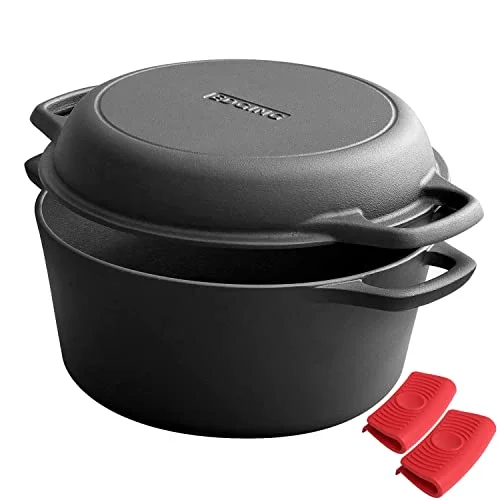
A second, smaller design idea worth knowing before you shop: some camp-style Dutch ovens pair the pot with a lid shaped so it can be flipped over and used on its own, flat side up, as a skillet or griddle. That turns one piece of cookware into two cooking surfaces — a deep pot for a stew or beans, and a flat sear or griddle surface for eggs, bacon or pancakes — without packing a second pan. The EDGING CASTING 2-in-1 Pre-Seasoned Cast Iron Dutch Oven Pot with Skillet Lid is built specifically around this: the listing describes the lid doubling as a skillet pan, with dual handles on both pieces, and it is sold for exactly this kind of indoor-to-outdoor, bread-to-frying flexibility.

The trade-off is the one you would expect: a lid engineered to also work as a standalone skillet is not the same lid as one engineered purely to hold a thick layer of coals for a long bake. If your priority is genuinely hanging a pot over a fire for a multi-hour cook, weight that against how often you would actually use the second cooking surface. If you cook a wider range of simple camp meals — some fried, some stewed — the versatility earns its place in a single bag.

Side by side

The three, compared

PotBest forCapacityMade byNotablePriceGet it
Lodge Bail Handle Dutch Oven Hanging over coals 7 qt Lodge Pre-seasoned, campfire ready, naturally nonstick $79.90 Get it
EDGING CASTING 2-in-1 A second cooking surface 7 qt EDGING CASTING Pre-seasoned, skillet lid, dual handles $67.99 Get it
Lodge Loop Handle Dutch Oven Grate or camp-stove cooking 7 qt Lodge PFAS-free, oven-safe, even heat retention $79.90 Get it
The picks

Our picks, and who each one is for

01Best for the campfire

Lodge Pre-Seasoned Cast Iron Dutch Oven with Bail Handle, 7 Quart

Best for actually hanging a pot over coals

7 quarts·Bail handle·Pre-seasoned·Naturally nonstick

At $79.90, this is the pot in this guide built around the one feature that matters most for true campfire cooking: a bail handle, so it can be lifted and hung rather than only set down on a flat surface. Lodge markets it as heavy-duty and campfire ready, and it ships pre-seasoned, which means it is usable on the first trip rather than needing a seasoning session at home first. It is also naturally nonstick, which on bare cast iron means the seasoning layer, not a coating, so it improves with use instead of wearing out. We don't have a published leg count or flange depth for it, so check the listing photos if that specific detail decides your purchase.

If the plan is a tripod and a bed of coals, this is the pot built for that plan.

Lodge pre-seasoned cast iron Dutch oven with bail handle, 7 quart
Price
$79.90
Check price →
02Best 2-in-1

EDGING CASTING 2-in-1 Pre-Seasoned Cast Iron Dutch Oven with Skillet Lid, 7QT

Best for frying, baking and stewing from one pot

7 quarts·Skillet lid·Pre-seasoned·Dual handles, indoor or outdoor

$67.99, the least expensive of the three, and the only one of the three built so its lid works on its own as a skillet. The listing describes it for bread, frying, baking and camping specifically, with dual handles on both the pot and the lid for carrying either piece separately. It arrives pre-seasoned, so there is no at-home prep step before the first trip. There is no bail handle here — it is designed to sit rather than hang — so weigh that against the second-surface flexibility depending on how you actually plan to cook over a fire or a camp stove.

One pot that packs like two, which matters more than a bail handle if your menu is varied.

EDGING CASTING 2-in-1 pre-seasoned cast iron Dutch oven with skillet lid, 7 quart
Price
$67.99
Check price →
03Best for a grate or camp stove

Lodge Cast Iron Dutch Oven with Loop Handle, 7 Quart

Best for cooking on a grate, tripod stand or camp stove rather than hanging free

7 quarts·Loop handle·PFAS-free & non-toxic·Even heat retention

$79.90, and the pot in this trio most at home crossing between a kitchen and a campsite grate rather than hanging over open coals. Lodge's listing emphasizes a loop handle, oven-safe use, and heat that stays even across the base — it does not describe this one as pre-seasoned, so plan on seasoning it yourself before the first real use, following the same process you would for any new bare cast-iron piece. Without a bail, it is better suited to a stand, a grate, or a camp stove than to being hung directly over a fire.

If your setup already includes a grate or a stove, the bail handle on the other two pots buys you nothing.

Lodge cast iron Dutch oven with loop handle, 7 quart
Price
$79.90
Check price →
What the price actually buys

Why three similar-sized pots land within $12 of each other

All three pots here sit in the same 7-quart range and within twelve dollars of each other, between $67.99 and $79.90, which is a much tighter spread than you'll find comparing six-quart enameled pots at wildly different prices on the rest of this site. That tightness makes sense once you know what you're actually paying for outdoors: there is no enamel grade to upcharge for, no light interior finish, no decades-old French foundry name on the box. The price differences here track specific hardware — a bail versus a loop handle, a second cooking surface built into the lid — rather than a brand premium.

That also means the cost-per-year math that matters for a $300 enameled showpiece largely doesn't apply here. A camp Dutch oven in this price range is already bought to be used hard, scraped with a metal spatula over an open fire and stored dusty in a truck bed; see our breakdown of whether a premium pot is worth it over years of use if you're deciding between a showpiece for the kitchen and a workhorse for the trail — for most campers, the workhorse is the better seventy dollars.

After the trip

Packing and cleaning one after a weekend outdoors

Let the pot cool most of the way down before you touch it with water or pack it — plunging hot cast iron into a cold stream or a sink full of cold water risks cracking it, bare iron or not. Once it's cool enough to handle, scrape out ash and food residue with a plastic scraper, a stiff brush, or a chainmail scrubber rather than steel wool, which strips the seasoning along with the grime. A little hot water and minimal soap is fine for a quick clean; what actually damages bare cast iron is leaving it wet, not an occasional touch of dish soap.

Dry it completely — set it back over low heat for a few minutes if you have any fire left, specifically to drive off the last of the moisture, since air-drying alone can leave a damp pot to flash-rust by the time you're home. Rub in a thin layer of oil while it's still faintly warm, then wrap it in a cloth or an old pillowcase rather than sealing it in plastic, since trapped moisture under plastic is exactly what causes rust spots during the drive home. None of this is unique to camping, either: the same questions about whether a pot this size will actually fit in your kitchen sink or clear your dishwasher rack at home are worth checking before the trip, not after you're standing at the sink with a dripping seven-quart pot and nowhere to put it.

Our method

How we compared

What we did

Specs and current prices, cross-checked

We compared the published specifications and current Amazon prices for the Lodge Bail Handle Dutch Oven, the EDGING CASTING 2-in-1, and the Lodge Loop Handle Dutch Oven, limiting every claim in this guide to what each listing actually states — capacity, handle type, pre-seasoning status, and included accessories. Where a detail such as leg count or flange depth is not published for a given pot, we say so rather than infer it from a similar-looking product or a different size in the same line.

What we didn’t

We don’t run a testing lab

We do not physically test these pots over an actual campfire, we do not own them, and we have no star ratings or review counts for these specific listings to report, so we don’t publish any. How a seasoning layer holds up after a real weekend of coals is a question that takes repeated outdoor use to answer honestly, not a single cook, by us or by anyone claiming otherwise. What we can do is read every specification carefully, compare them plainly, and tell you when a listing is silent on something that matters. See more on the About page.

FAQ

Common questions

Can I use an enameled Dutch oven over a campfire?

It's not what enamel is built for, and most manufacturers advise against direct open-flame use. The uneven, extreme heat of a fire can crack or craze an enamel coating in a way a kitchen oven never would. Bare cast iron, like the three pots in this guide, has no glass coating to protect and is the material actually built for coals and open flame.

Do I need a bail handle for camping, or is a loop handle fine?

It depends on how you plan to cook. A bail handle lets you hang the whole pot from a tripod or chain over a fire, which is the classic campfire setup. A loop or dual-handle design, like the Lodge Cast Iron Dutch Oven with Loop Handle in this guide, is built to sit on a grate, stand or camp stove instead — perfectly capable outdoors, just not meant to hang free over open coals.

What is a 2-in-1 Dutch oven lid used for?

It's a lid shaped so it can be flipped over and used on its own as a skillet or griddle, turning one piece of cookware into two cooking surfaces. The EDGING CASTING 2-in-1 in this guide is built around this, pairing a 7-quart pot with a skillet lid for frying, baking and stewing without packing a second pan.

Do pre-seasoned camp Dutch ovens still need care before the first trip?

Yes. Pre-seasoned means the pot ships with an initial oil layer already baked on and is usable out of the box, but it still benefits from a trial run at home — reheating it, adding another thin coat of oil, and cooking something simple and fatty — before you're relying on it forty miles from the nearest store. A pot not listed as pre-seasoned should be seasoned at home before it ever sees a campsite.

Keep reading

More from Best Dutch Ovens