A loaf of sourdough bakes itself a crust using steam it releases in the first fifteen minutes of oven time — and a heavy, close-fitting lid is what holds that steam against the dough instead of letting it vent into the oven. We compared published capacities, lid designs and prices across three enameled cast-iron Dutch ovens, from $29.67 to $289.00, to find out what a loaf of bread actually needs and how much of that you have to pay for.
By Ilane Tall · Updated October 15, 2026 · Research-based.
Affiliate disclosure: we may earn a commission if you buy through the Amazon links on this page, at no extra cost to you.
Quick Answer
For most home bakers, a 5.5-quart enameled Dutch oven is the right size for a standard sourdough boule: enough room for the dough to spring upward without spreading sideways, and small enough to hold the steam a loaf releases against the crust. The Parmedu 5.5QT, priced at $29.67 and sold specifically for sourdough, is the cheapest honest way into that size. The lid has to seat closely against the pot — that fit, not the enamel's price tag, is what actually traps steam in the first fifteen minutes, which is why we don't recommend spending more unless you want the design and warranty details covered below.
Size changes how the loaf rises, not just how many loaves fit. A 5 to 5.5-quart pot is the size most associated with a standard boule; a much larger pot gives the dough room to spread sideways instead of up.
Lid fit, not enamel grade, is what holds steam in. A heavy lid that seats closely against the rim keeps the moisture a loaf releases pressed against the crust. A loose-fitting lid lets that moisture escape no matter how good the enamel underneath it is.
The knob caps your oven temperature, not the iron. Most sourdough recipes call for 450–500°F. Cast iron and enamel tolerate that easily; a plastic or phenolic knob is usually the actual limiting part, and some are not rated that high.
Preheating the empty pot is standard technique, and it is also where burns happen. A 450°F lid and body straight out of the oven look identical to a cool pot. Treat every surface as hot until you've set it down.
None of these three listings publish review data for this specific use case. We compare specs, capacity and price, not invented star ratings or paraphrased sentiment.
Why trust us
Why You Should Trust Us
This guide is written by Ilane Tall for Best Dutch Ovens, an independent, research-based site that compares enameled cast-iron cookware using published manufacturer specifications and current Amazon pricing. We do not accept samples in exchange for coverage, and every price quoted here was checked against the product database shortly before publication. We do not run a testing lab and do not claim to have baked bread in any of these specific pots — what follows is a comparison of what each manufacturer states about size, lid design and price, mapped against the established, well-documented mechanics of how steam, heat and enameled cast iron behave in a home oven.
Our method
How We Picked
We started from the Best Dutch Ovens product database and filtered for enameled cast-iron pots with a published capacity in the 5 to 6-quart range most commonly recommended for a single sourdough boule, since a pot sized for a crowd-sized stew is the wrong tool for a loaf of bread regardless of brand. From that shortlist we kept products that either state sourdough or bread baking directly in their listing, or are widely used for it across the category because the size and lid design fit the job. We excluded pots with no published size or variant data we could verify, since we won't guess at a bowl shape or capacity a listing doesn't state. That left three pots spanning the category's price range: a budget pot built and marketed specifically for sourdough, a mid-range pot that bundles bread-adjacent accessories, and a premium French pot that represents the top of the enamel-confidence tier.
Start here
Why a lidded pot works: steam in the first fifteen minutes
A loaf of sourdough baked directly on an oven rack, with no lid, comes out with a pale, soft crust and often a flatter rise, because the surface of the dough dries out and sets before the loaf has finished expanding. A home oven also can't hold the near-saturated humidity of a commercial steam-injected deck oven, which is the entire reason the Dutch-oven method became the standard home workaround: it builds its own sealed, humid chamber around a single loaf using nothing but the dough's own moisture.
Here's the mechanism. Raw dough is mostly water. The instant it hits a preheated pot, the water at the loaf's surface starts flashing into steam. In an open oven, that steam disperses into a huge volume of dry air and does almost nothing. Inside a closed Dutch oven, the same steam has nowhere to go — it stays pressed against the dough, keeping the crust soft and extensible for roughly the first ten to fifteen minutes of baking, which is precisely the window in which a loaf does most of its oven rise, a phenomenon bakers call "oven spring." A crust that sets too early physically blocks that spring; a crust kept soft by trapped steam lets the loaf expand fully before it firms up and browns.
This is also why the lid matters more than almost any other part of the pot for this specific job. The steam only does its work if it stays in the pot. A lid that sits loosely, or a knob assembly with gaps around it, lets that moisture vent out exactly when the dough needs it most, and the result looks like baking without a lid at all — a paler, less dramatically risen crust, even though the recipe and the oven temperature were both right. We go deeper on lid geometry specifically below, because it's the single detail that most determines whether a given Dutch oven is good for bread, independent of its price.
Get this right first
The size that suits a standard boule
A standard home sourdough recipe — roughly 500 grams of flour, give or take a loaf built for a 900-gram to 1-kilogram finished boule — is sized for a 5 to 5.5-quart Dutch oven, and the reason is the same oven-spring mechanism described above. The dough needs enough interior height to expand upward, but not so much lateral room that it spreads sideways into a flatter disc before it has a chance to rise. Put the same dough into a 7-quart or larger pot, built for a crowd-sized stew, and the loaf has more room to spread into; the dough relaxes outward instead of climbing, and the trapped steam has a larger volume to fill, diluting the effect right when the crust most needs it concentrated near the dough's surface.
A 5.5-quart round pot runs roughly 10 to 10.5 inches across on the inside, which is close to the footprint of a round banneton most home bakers already proof their dough in — the dough drops in with a snug but not cramped fit. That's also narrow enough to leave real clearance on either side of a standard oven shelf, useful if you're baking two loaves in sequence or running a sheet pan alongside it.
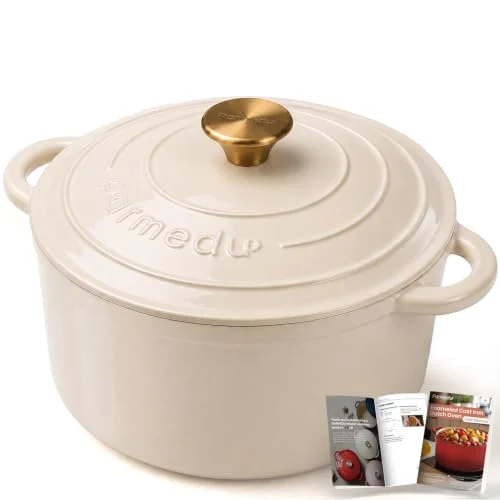
The Parmedu 5.5QT Enameled Cast Iron Dutch Oven in this guide is sized exactly to this logic and is sold specifically for sourdough baking, which is unusual among the pots in this category — most Dutch ovens are marketed as general-purpose cookware with bread mentioned as one use among several. At $29.67, it's priced less like a specialty bread tool and more like the category's budget floor, but the size is the specialty part: it gives a standard boule the interior geometry a sourdough recipe is actually written around, rather than the geometry a six-quart stew pot happens to also provide. For a fuller breakdown of how capacity maps to specific meals across the whole category, not just bread, see our guide to what size Dutch oven you actually need.
Both the Overmont and the Le Creuset pots compared in this guide are also listed at 5.5 quarts, which puts all three in the size range sourdough actually calls for — useful, because it means the choice between them comes down to lid fit, oven-safe ceiling and price, not capacity.
The detail that decides the crust
Lid fit matters more than enamel quality here
It's tempting to assume that a more expensive enamel — smoother, glossier, backed by a longer warranty — is also the better choice for bread. For this specific job, that's the wrong variable to optimize. Enamel quality is almost entirely about how the glass coating resists chipping, staining and acid over years of cooking stews and sauces. None of that affects whether steam stays inside the pot during a 15-minute bake. What determines that is the lid: its weight, how precisely it's machined to seat against the rim, and whether there's a gap anywhere around that seal for steam to escape through.
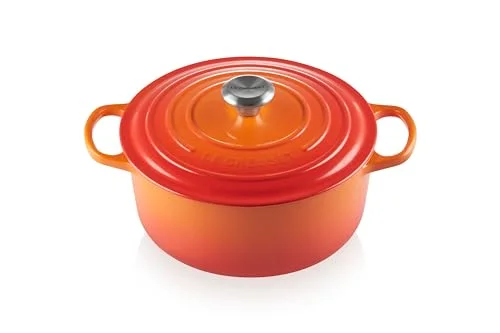
Le Creuset has built its reputation substantially on this exact detail — a heavy, flat lid engineered to sit flush against the pot's rim, which is part of why its cookware is widely regarded as reliable for braising, where retained moisture matters over hours, not just minutes. The Le Creuset Round Dutch Oven, 5.5 qt., in Flame, priced at $289.00, carries that reputation into the bread-baking use case, even though its listing doesn't publish a bread-specific claim. Neither the Parmedu nor the Overmont listing publishes a specific seal-tolerance figure either — no manufacturer in this category routinely does — so we won't claim one pot's lid seals measurably tighter than another's from specs alone. What we can tell you is the physical principle to check for yourself: set the lid on the pot and look for light or a visible gap anywhere around the rim. A lid that rocks, or that you can see daylight through at any point around the circumference, will underperform a snugly seated lid for bread regardless of what either pot costs.
This is also the honest answer to "do I need to spend $289 to bake good sourdough at home." You don't, as long as the lid you have actually seats closely. The $29.67 Parmedu and the Le Creuset do the same fundamental job — trap steam against rising dough — and the size that matters most for that job, 5.5 quarts, is identical between them. The premium buys you a brand's specific engineering reputation and warranty, not a different physical mechanism.
Read the label
The knob, and the temperature your recipe asks for
Most sourdough recipes call for a hot oven and an even hotter initial pot — commonly 450°F, with some recipes pushing to 475°F or 500°F for the first portion of the bake before dropping the temperature to finish. The cast iron and the enamel on a Dutch oven comfortably tolerate heat well past that range. The part of the pot most likely to actually limit you is the lid knob, which on many Dutch ovens, at nearly every price point, is a separate material from the body — often a plastic or phenolic knob rated to a lower ceiling than the pot itself.
Of the three pots compared here, none of the listings we have on file state a specific knob material or a separate knob temperature rating, so we won't assign one. What we can tell you plainly is to check your specific listing's oven-safe temperature before committing to a 475°F or 500°F bake, and to look specifically for whether that published figure covers the lid and knob or only the pot body — the two aren't always the same number. If a listing is silent on this, treat that silence as a reason to verify with the current product page rather than assume the knob matches whatever your recipe calls for.
This is a detail that applies identically whether you're baking in a $29.67 pot or a $289.00 one: a stainless-steel or all-metal knob, where a brand specifies one, generally clears sourdough-range temperatures without issue, while an unspecified plastic knob is the thing actually worth confirming before you preheat.
Technique, and the risk that comes with it
Preheating the pot, and the burns that follow
Most sourdough recipes that use a Dutch oven call for preheating the empty pot, lid on, inside the oven for 30 to 45 minutes before the dough ever goes in — the idea being that a pot already at 450°F gives the dough an immediate, aggressive burst of heat on contact, which helps drive the same oven-spring effect the steam is working toward. It's a standard, well-established technique, not a brand-specific trick, and it works the same way regardless of which of these three pots you're using.
It's also the single step in sourdough baking most likely to cause a burn, and worth being explicit about rather than treating as obvious. A Dutch oven that has been in a 450°F oven for 40 minutes looks, from across the kitchen, identical to the same pot sitting cool on a counter. There is no visual cue — no glow, no steam yet, nothing — that distinguishes a pot that will take skin off contact from one that's room temperature. The handles, the knob, and the full exterior of the lid and body are all at oven temperature, not just the parts that look like they'd be hot.
The practical rule: treat every surface of the pot, including handles typically assumed to be "cool-touch" on cheaper cookware, as oven-temperature from the moment you open the oven door until the pot is back on a trivet, using thick oven mitts on both hands for the entire transfer — lid removal, dropping the dough in, and resealing the lid. Scoring the dough once it's in the pot, which many recipes call for, is also done with the pot sitting on a heatproof surface, not held in your hands. None of the three pots in this guide publish a cool-touch handle claim, which is typical for enameled cast iron generally; budget for mitts on every single preheated bake, not just the ones where you remember.
Parmedu 5.5QT Enameled Cast Iron Dutch Oven for Sourdough Bread White
Best for most home sourdough bakers, at the lowest honest price
5.5 quarts·Sold for sourdough·White enamel·Made by Parmedu
At $29.67, this pot is sized and marketed around exactly the job in this guide: a standard sourdough boule, not a general-purpose stew pot that happens to also bake bread. The 5.5-quart interior gives a typical loaf room to spring upward rather than spread sideways, and the pot shares a lid-and-rim category with every enameled Dutch oven compared here — the same trapped-steam mechanism, at a fraction of the price of the premium option in this guide. We don't have a published knob-material or seal-tolerance spec for this listing, so check the current page before pushing it past 450°F, the same caution we'd give for any pot in this category.
If bread is the reason you're buying a Dutch oven at all, this is the size and the price built around exactly that.
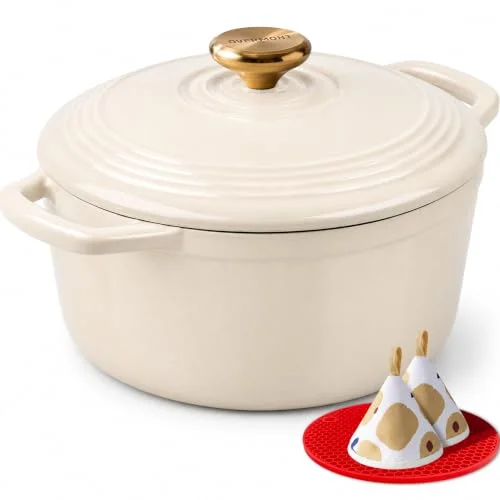
At $42.99, this is the same 5.5-quart sizing as the Parmedu, built, according to its own listing, for braising, stews, roasting and sourdough baking specifically — a broader pitch than a bread-only pot, useful if you want one Dutch oven that also handles weeknight dinners without compromise. The included cookbook and cotton potholders are genuinely useful starting points if you're new to both Dutch-oven cooking and sourdough at once, rather than a pure marketing add-on; the potholders in particular matter given how hot every surface of a preheated pot gets, discussed above.
The same size as the budget pick, with a cookbook and potholders folded into a still-modest price.
Le Creuset Enameled Cast Iron Round Dutch Oven, 5.5 qt., Flame
Best if you want the lid-engineering reputation and the warranty behind it
5.5 quarts·Made in France·Flame enamel·Lifetime limited warranty
At $289.00, this is the same 5.5-quart size as the two pots above it, which means it isn't buying you a better-suited capacity for bread — it's buying a brand's specific reputation for a precisely machined, flush-seating lid, backed by a lifetime limited warranty against manufacturing defects, plus Le Creuset's own stated claims about chip and stain resistance on the enamel. None of that changes the physics of trapped steam in the first fifteen minutes, which this pot shares with the $29.67 option in this guide. It's the right buy if you already know you'll use a Dutch oven constantly, for bread and everything else, and want the enamel confidence and warranty that come with paying for it.
Same size, same steam mechanism as the budget pick — this buys the brand's engineering reputation, not a different physical result on day one.
We didn't include any pot above 6 quarts in the main picks here, even though several appear elsewhere on this site, because capacity much past that range works against the specific mechanics a sourdough boule needs — more room for the dough to spread sideways, and a larger volume for trapped steam to fill rather than concentrate near the crust. A 7-quart pot like the one we compare in our sizing guide is the right tool for a crowd-sized stew or a double batch of chili, not a single boule, and we didn't want to recommend a size mismatch just to add a fourth option to this page.
We also left out pots without a clearly stated size or variant in our product data. Guessing at a bowl shape or capacity a listing doesn't publish is exactly the kind of invented spec we won't put in front of readers, so if a product looked plausible for this use case but didn't have a verifiable size listed, it didn't make the cut here.
Our method
How We Compared
What we did
Specs, sizing and current prices
We compared the published capacity, lid design claims, and current Amazon prices for the Parmedu 5.5QT, the Overmont 5.5QT, and the Le Creuset Round 5.5 qt., then mapped each to the mechanics a sourdough boule specifically needs — interior room for oven spring, and a lid built to hold steam against the crust. Where a specification like knob material or seal tolerance isn't published for a given listing, we say so plainly instead of estimating it from a similar-looking product.
What we didn’t
We don’t run a testing lab
We do not physically test these pots, we do not own all three, and we have no star ratings or review counts for these specific listings to report, so we don’t publish any. What we can do honestly is explain the established, well-documented physics of steam, heat and oven spring, and apply it to what each manufacturer actually states about size and lid design, rather than invent product-specific sentiment we don’t have. Read more about our approach on the About page.
FAQ
Frequently Asked Questions
What size Dutch oven is best for sourdough bread?
5 to 5.5 quarts, for a standard home boule made from roughly 500 grams of flour. That size gives the dough enough room to spring upward during baking without so much lateral space that it spreads sideways instead of rising. All three pots in this guide, including the $29.67 Parmedu, are sized at 5.5 quarts for exactly this reason.
Do I need an expensive Dutch oven to bake good sourdough?
No. The mechanism that makes a Dutch oven work for bread — trapping the steam a loaf releases against its own crust during the first fifteen minutes — depends on size and lid fit, not enamel price. A $29.67 pot sized at 5.5 quarts with a close-fitting lid does the same fundamental job as a $289.00 pot of the same size. The premium buys a brand's specific engineering reputation and warranty, not a different physical result.
What temperature should I bake sourdough at in a Dutch oven?
Most recipes call for 450°F, with some pushing to 475–500°F for the first portion of the bake. The cast iron and enamel handle this easily; the part most likely to actually limit you is the lid knob, which on many Dutch ovens is a separate, lower-rated material. Check your specific listing's published oven-safe temperature, and whether it covers the lid and knob, before baking at the high end of that range.
Is it safe to preheat an empty Dutch oven for bread?
Yes, it's standard technique, but it comes with a real burn risk worth taking seriously. A pot that has preheated for 30–45 minutes at 450°F looks identical to a cool pot — there's no visual cue that it's hot. Use thick oven mitts on both hands for the entire transfer: removing the lid, placing the dough, and resealing it, every time, not just when it looks obviously hot.