Best Dutch Ovens
Roundup · Large Dutch Ovens, 7 Quarts and Up

The Best Large Dutch Ovens, 7 Quarts and Up

Seven quarts is where a Dutch oven stops being a stew pot for a family of four and becomes a piece of equipment you plan a kitchen around. It feeds a crowd, it fills most of an oven shelf, and full, it is genuinely heavy to lift out of a hot oven one-handed. We compared the published specifications and current prices of three large enameled cast-iron Dutch ovens, at seven quarts and up, to find out what that extra capacity actually costs you — in dollars, in arm strength, and in cupboard space.

By Ilane Tall · Updated October 18, 2026 · Research-based.

Affiliate disclosure: we may earn a commission if you buy through the Amazon links on this page, at no extra cost to you.

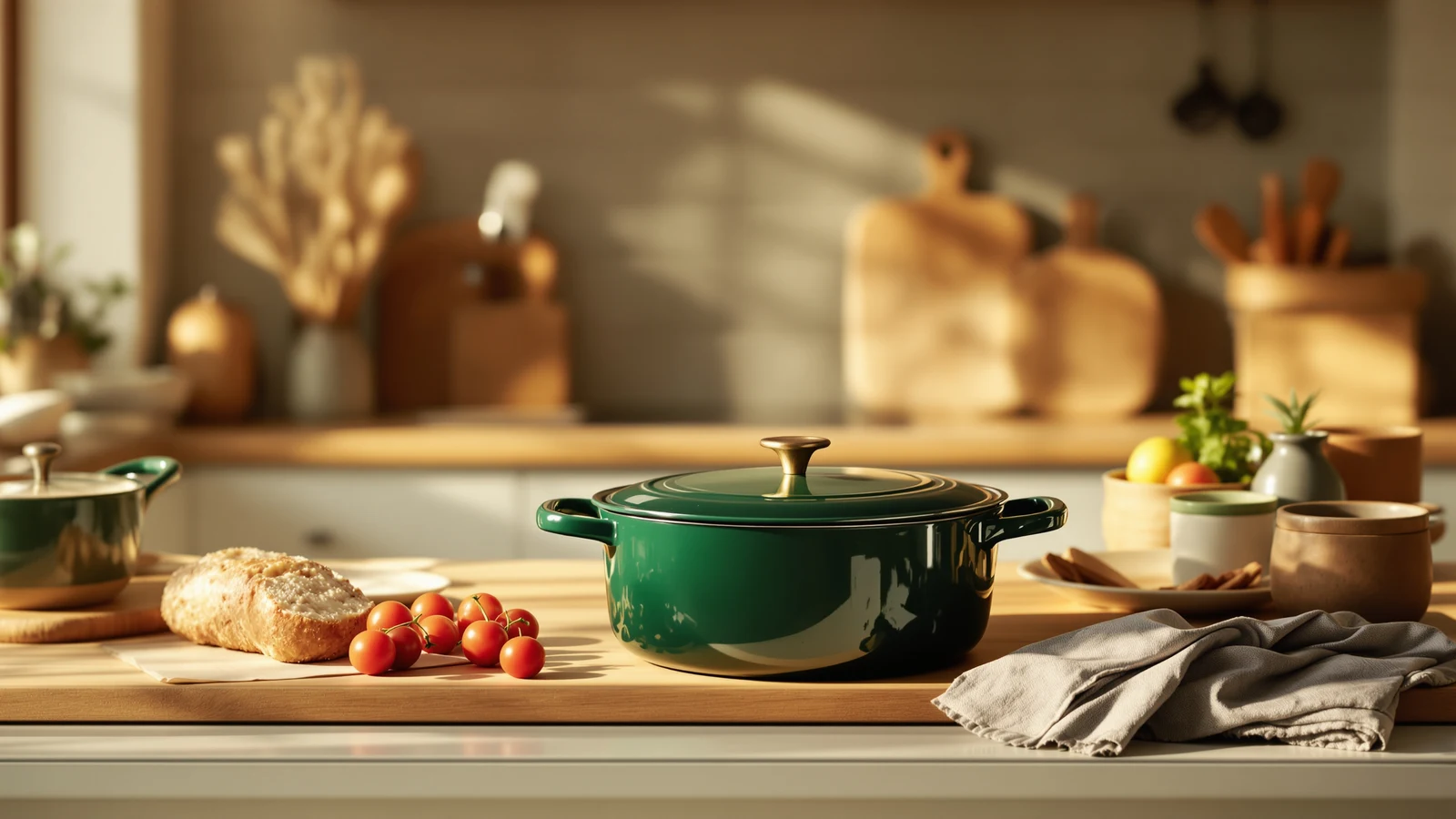
A large seven-quart enameled cast iron Dutch oven with its lid resting beside it on a kitchen counter
The size itself

What seven quarts actually holds

Seven quarts is just under 6.6 liters, and in practical kitchen terms that is the size where a Dutch oven stops cooking for a household and starts cooking for an occasion. Our sizing guide puts six quarts as the default for most households — a whole chicken, a loaf, a stew for six. Seven and up is a deliberate step past that default: both the Overmont 7QT and the Staub 7-qt Round Cocotte are built at 7 quarts, and the Lodge Essential Enamel in this guide is sized at 7.5 quarts, a half-step larger still. Manufacturer copy for pots in this range typically describes them as serving five to eight people, and that framing is the right way to think about the size: not how many quarts of liquid fit in the bowl, but how many plates come off the stove in one batch.

What that translates to at the stove is room. A whole turkey breast, a double batch of chili, a pot roast with vegetables packed around it, or a dozen chicken thighs browned in two batches but braised in one — all of that fits comfortably at seven quarts in a way it does not at five or six. The wide, deep bowl also matters for a specific kind of cooking: recipes that need you to brown meat in batches before adding liquid benefit from the extra surface area at the base, since a crowded pan steams meat instead of browning it. A seven-quart pot gives you more base to work with even before you add the braising liquid.

The trade is capacity you may not use most weeks. If your household is two to four people and your largest gathering is a handful of guests twice a year, a pot sized for eight is overbuilt for Tuesday dinner — you will be heating and washing more pot than the meal needs. The right read on "what seven quarts holds" is less about the number on the box and more about whether you regularly cook in batches this large. If you do, every pot on this page earns its size. If you don't, read the section below on when two smaller pots serve you better than one large one.

The part nobody mentions

Weight full, and moving it out of a hot oven

An empty seven-quart enameled cast-iron pot is already a two-hand object for most people; cast iron is dense, and the enamel coating on top of it adds more weight than it looks like it should. Fill that pot with a braise — meat, vegetables, a few cups of stock and wine — and you are routinely adding ten to fifteen pounds of food and liquid on top of a pot body that was never light to begin with. None of the three manufacturers in this guide publish a filled weight, because nobody in this category does; the number that matters practically is simpler than a spec sheet anyway: can you lift this, full, out of a 400°F oven, safely, in the kitchen you actually have.

The lift itself is the moment that goes wrong. You are reaching into a hot oven, often bent slightly at an awkward angle, wearing thick oven mitts that reduce your grip and your sense of exactly where your fingers are. A pot that is heavy and well-balanced is manageable. A pot that is heavy and awkward — handles too small, too close to the body, or positioned so the weight pulls your wrists outward — turns a routine task into the kind of moment that ends with a dropped pot, a burn, or both. This is precisely why the next section on handles matters more at seven quarts and up than it does at five or six: the margin for error is smaller because the mass you're carrying is larger.

Our practical advice, since no manufacturer gives you a number to plan around: assume a full seven-quart pot is a slow, deliberate, two-handed lift, every time, regardless of how strong you are on a good day. Clear the path to the counter before you open the oven door. Use a trivet or folded towel positioned in advance, not grabbed mid-lift. And if you cook with a shared kitchen — a partner, a housemate, a teenager who also uses the oven — make sure everyone who might lift this pot has actually done it once while it's full, rather than finding out during a holiday dinner that it is heavier than they expected.

The spec photographs hide

Handles: the specification photographs hide

A product photo shows you a handle's shape, not its size relative to a hand in an oven mitt, and that gap is exactly where large Dutch ovens disappoint people after the fact. At six quarts and below, a slightly undersized handle is an inconvenience. At seven quarts and up, full, it is the difference between a controlled lift and a dropped pot. The three pots in this guide differ in what they tell you here: the Overmont 7QT ships with cotton potholders included — a detail Overmont itself frames around the weight of the filled pot, which is a tell about how seriously the brand expects you to need grip help. Neither the Lodge Essential 7.5 Quart nor the Staub 7-qt Round Cocotte publish a handle measurement in the specifications available to us, and we will not estimate one from a photo.

What we can tell you, honestly, is what to check yourself before buying: look at how far the handle stands away from the pot's body in the product photos, since a handle sitting flush against a hot pot gives your mitted fingers nowhere to go that isn't also hot. Look for handles large enough to fit a gloved hand fully underneath, not just two fingertips. And treat an absence of published handle dimensions as a reason to read current owner photos on the listing itself rather than assume a handle is adequate because the pot looks similar to one you already own.

This is also where the gap between a $60 pot and a $300 one sometimes shows up for a real reason, rather than just the enamel. Staub's cocotte design is built around a tight-fitting, heavy lid for braising, and a brand charging a premium for that engineering has more incentive to also engineer the handles well — though absent a published measurement, that is an inference about incentive, not a confirmed spec. Our comparison of Le Creuset and Lodge covers the same handle-size pattern at a smaller capacity, and the lesson transfers directly: never assume generous handles from price alone, check the listing.

Measure before you buy

Oven shelf space and the lid clearance nobody checks

A seven-quart Dutch oven is wide, and width is the dimension that gets forgotten when people picture "a bigger pot" as simply a taller version of what they already own. At this capacity, the pot's diameter can leave little or no room on either side of it on a standard oven shelf, and if your oven has a lower shelf position fixed close to a heating element or a second rack above it, a tall, domed lid may not clear the space at all. None of the three listings here give an exact height-with-lid-on figure, which is common across this category — it is one more reason to check your own oven's interior dimensions against the product's listed dimensions before ordering, rather than after.

The clearance problem has two parts worth separating. The first is simple fit: does the pot, lid on, physically clear your oven's shelf height at the position you intend to use. The second is airflow: ovens rely on some gap around a dish for heat to circulate evenly, and a pot that just barely squeezes in with an inch of clearance on every side will cook less evenly than one with real room around it, particularly in a convection or fan oven. If your kitchen has a compact or older oven, that second issue is worth weighing even if the pot technically fits.

Our practical suggestion: before ordering any pot at this size, open your oven, put a tape measure on the shelf you actually use, and check both the diameter the pot needs at its widest point (the handles, not just the bowl) and the height with the lid seated. Compare that against the dimensions on the current Amazon listing, which are more reliable than any number we could publish here since manufacturers occasionally revise sizing between production runs. A pot that doesn't fit the oven you have is the single most avoidable disappointment in this category, and it is also the easiest one to prevent with five minutes and a tape measure.

Side by side

The three, compared

PotBest forCapacityMade byNotablePriceGet it
Overmont 7QT Enameled Feeding a crowd on a budget 7 qt Overmont Cookbook and potholders included $62.99 Get it
Lodge Essential Enamel 7.5 Quart Most households that need extra size 7.5 qt Lodge No seasoning needed, Indigo color $83.99 Get it
Staub 7-qt Round Cocotte Long braises, kept for decades 7 qt Staub, France Spiked self-basting lid $299.95 Get it
The picks

Our picks, and who each one is for

01Best overall large

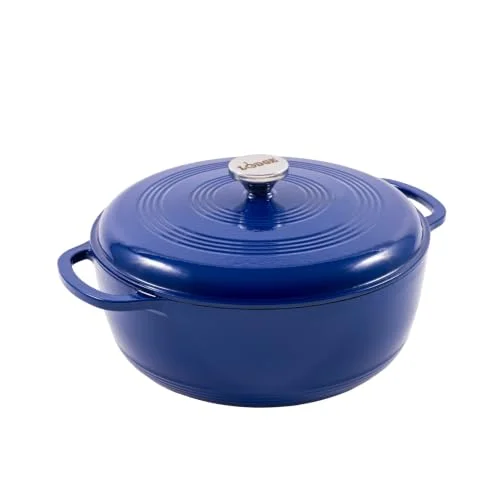
Lodge Essential Enamel Cast Iron Dutch Oven, 7.5 Quart, Indigo

Best for most households that need the extra size

7.5 quarts·Indigo enamel·No seasoning·Made by Lodge

At $83.99, this is the half-step past a standard six-quart pot rather than a leap into the territory the Staub occupies, and that makes it the pot most households landing on this page should actually buy. Lodge has cast iron in Tennessee since 1896, and the Essential Enamel line extends that heritage to a size built for feeding a genuine crowd without asking you to spend three hundred dollars to do it. 7.5 quarts gives you real headroom over the 7-quart pots on this page — useful if your "crowd" meal is a holiday roast with a lot of vegetables packed around it. Neither Lodge's listing nor ours can tell you the filled weight or the exact handle dimensions, so plan the lift out of the oven as a two-handed job regardless.

The size upgrade for a household that has outgrown six quarts, without the price upgrade to match.

Lodge Essential Enamel cast iron Dutch oven, 7.5 quart, indigo
Price
$83.99
Check price →
02Best budget large

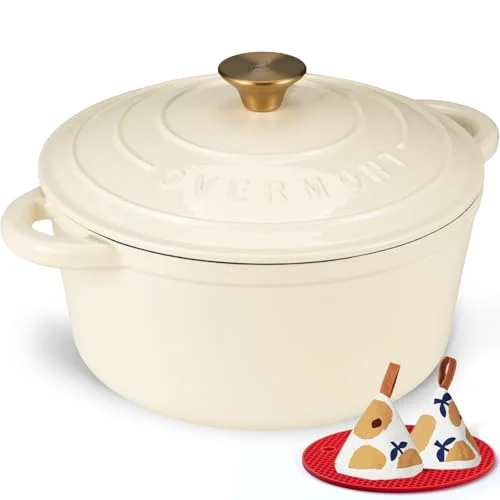
Overmont Enameled Cast Iron Dutch Oven, 7QT, Cream White

Best for feeding five to eight on the tightest budget

7 quarts·Thick-walled cast iron·Cookbook included·Cotton potholders included

Seven quarts for $62.99 is the lowest entry price into this capacity tier by a wide margin, and Overmont builds it with thick walls specifically to even out hot spots across the wide base a pot this size needs. The included cotton potholders are the detail worth noticing: a brand bundling grip protection with a pot this size is implicitly acknowledging what this guide keeps returning to — that a full seven-quart pot is genuinely heavy, and standard oven mitts may not be enough on their own. The included cookbook is a nice-to-have, not a reason to buy, but the price-to-capacity ratio here is the real draw.

The cheapest honest way into seven-quart capacity, with the brand itself hinting that you'll want the extra grip.

Overmont enameled cast iron Dutch oven, 7 quart, cream white
Price
$62.99
Check price →
03Best for long braises

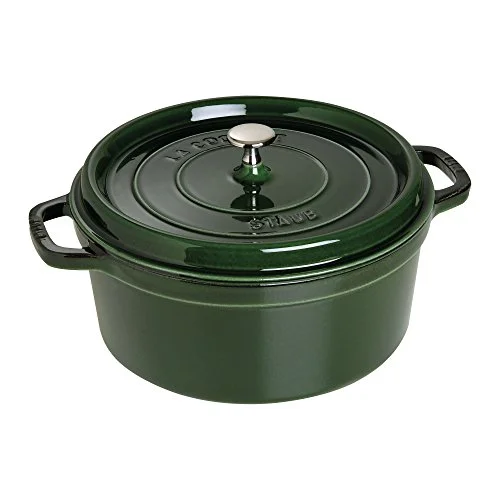
Staub Cast Iron 7-qt Round Cocotte, Basil

Best if you braise often and intend to keep the pot for decades

7 quarts·Made in France·Spiked self-basting lid·Heavy, tight-fitting

Staub casts spikes into the underside of this cocotte's lid specifically to collect condensation and return it to the food — a genuine design choice for long, slow braises, not a decorative flourish, and it is the clearest reason to pay roughly three times what the Overmont costs at the same 7-quart capacity. The lid's weight and tight fit are part of the same design: they hold moisture in during a four-hour braise that would dry out in a looser-lidded pot. At seven quarts, full, this is also the heaviest lift of the three picks here, between the iron itself and the dense, heavy lid Staub builds specifically to seal in steam.

Buy it for the braises you actually cook, not for the size alone — the Overmont matches the capacity for a third of the price.

Staub cast iron 7-quart round cocotte, basil
Price
$299.95
Check price →
The honest counterpoint

When two smaller pots beat one large one

A seven-quart-and-up pot is the right answer to a specific question — "how do I cook one large batch for a lot of people at once" — and the wrong answer to a related but different one: "how do I cook more flexibly." If your week looks more like a five-quart braise on Tuesday and a small side dish simmering alongside it on Thursday than one giant pot feeding eight people on a single occasion, two mid-sized pots, say a 5 to 6-quart alongside something smaller, will serve you better day to day than one pot sized for a banquet. Our under-$100 roundup and sizing guide both cover the 5 to 6-quart range this comparison is against.

The case for two pots over one large one comes down to three practical points. First, storage: a seven-quart-and-up pot with its lid is a large, heavy, oddly-shaped object, and most kitchens have exactly one cabinet that fits it; two smaller pots are each easier to store and, combined, often take up a similar or smaller footprint stacked rather than nested around one giant bowl. Second, heat-up time and energy: a smaller pot full of food reaches temperature faster than a large pot with the same food spread thin across a wider base, which matters on an ordinary weeknight when you are not actually cooking for eight. Third, and most practically, weight: every point made above about lifting a full seven-quart pot out of a hot oven simply doesn't apply to a five-quart pot, which is lighter, easier to maneuver, and more forgiving if your grip slips for a half-second.

The case for one large pot instead is just as real, and it's the audience this guide is written for: households that regularly cook in batches this size, host often enough that borrowing or scaling down isn't practical, or specifically want the option of a single large braise without doing it in two rounds in a smaller pot. If that's your kitchen, the extra size and weight are a fair trade for the capacity. If it isn't — if you're buying seven quarts "just in case" for an occasion that happens twice a year — you are very likely better served by a six-quart pot you'll actually lift comfortably every week, and a cheap second pot or a borrowed one on the rare day you need more room.

Our method

How we compared

What we did

Specs and current prices, cross-checked

We compared the published specifications and current Amazon prices for the Overmont 7QT, the Lodge Essential 7.5 Quart and the Staub 7-qt Round Cocotte, limiting every claim in this article to what each manufacturer actually states: capacity, included accessories, country of manufacture, and lid design where it is described. Where a specification such as filled weight, handle dimensions, or oven interior clearance is not published for a given pot, we say so plainly and tell you how to check it yourself rather than estimate it from a similar-looking product.

What we didn’t

We don’t run a testing lab

We do not physically test these pots, we do not own them, and we have no star ratings or review counts for these specific listings to report, so we don’t publish any. Questions like exactly how heavy a pot feels fully loaded, or precisely how it balances in an oven mitt, cannot be answered honestly from a fortnight with a pot, by us or by anyone else claiming to have tested it. What we can do is read the categorical, well-established facts about how large cast-iron cookware behaves — its density, its heat retention, its handling demands — and report those plainly. See more on the About page.

FAQ

Common questions

How many people does a 7-quart Dutch oven actually feed?

Manufacturer copy in this category typically describes 7-quart pots as serving five to eight people, and that's a reasonable planning number for a braise, chili, or roast with vegetables. Think in terms of batches of browned meat or servings rather than raw liquid volume — the wide base at this size is as useful for browning in fewer rounds as the depth is for holding more food.

How much does a full 7-quart Dutch oven weigh?

None of the manufacturers in this guide publish a filled weight, which is typical for this category. What's certain is that an empty pot at this size is already a two-hand object for most people, and adding ten to fifteen pounds of food and liquid makes the filled pot substantially heavier. Plan every lift out of a hot oven as slow and two-handed, regardless of how strong you are.

What should I look for in the handles on a large Dutch oven?

Look at how far the handle stands away from the pot's body in the product photos — a handle sitting flush against the pot leaves a mitted hand nowhere to grip that isn't also hot. Look for handles large enough to fit a gloved hand fully underneath. The Overmont 7QT ships with cotton potholders included, which is itself a hint about how much grip help the brand expects you'll want at this size.

When should I buy two smaller pots instead of one large one?

If your week looks more like one mid-sized braise at a time than one giant batch feeding eight people, two 5 to 6-quart pots are typically easier to store, heat up faster, and are significantly lighter to lift than a single 7-quart-and-up pot. Buy large only if you regularly cook in batches this size or host often enough that scaling down isn't practical.

Keep reading

More from Best Dutch Ovens