Best Dutch Ovens
Buying Guide · 0.25-Quart Cocottes

Mini Cocottes: What a 0.25-Quart Dutch Oven Is Actually Good For

A quarter-quart cocotte looks like a Dutch oven that someone put in the dryer. It is not a small version of the pot you braise a chicken in — it is a different object entirely, sized for one plate, one portion, one person at the table. We compared the published specifications of the two 0.25-quart Staub cocottes currently listed, to work out exactly what a pot this size is for, what it cannot do no matter how good the cast iron is, and whether it earns its price over the ceramic ramekin sitting in the same cupboard.

By Ilane Tall · Updated November 23, 2026 · Research-based.

Affiliate disclosure: we may earn a commission if you buy through the Amazon links on this page, at no extra cost to you.

Two miniature cast iron cocottes, one matte black and one cherry red, set on a table for individual servings
The number on the box

A quarter quart, translated into actual food

A quart is four cups, so a 0.25-quart cocotte holds one cup — about 236 milliliters, before you account for the curve of the walls eating into that figure. That is the entire usable interior. Compare it to the six-quart pot that anchors most households' cookware: a six-quart Dutch oven holds twenty-four times as much as this one. These two numbers are not the same category of object simply shrunk down; a quarter-quart cocotte is sized to hold one person's portion of one dish, full stop, and every buying decision about it should start from that fact rather than from the word "Dutch oven" in its name.

In practical terms, one cup is roughly two large eggs with a little room for cream or a splash of stock, or a single, generous scoop of a starch-and-sauce dish like mac and cheese, or one individual portion of a baked dessert such as a bread pudding or a small crumble. It is not enough room for two people to share comfortably, and it is nowhere near enough for a main course that needs sauce, vegetables and protein all in the same dish. If you are picturing feeding more than one person per cocotte, you need a larger format entirely — this size exists specifically so that math never has to happen.

The two products we found in this size, the Staub Mini Round Cocotte in matte black and the same cocotte in cherry, are both listed at 0.25 quart. Staub states the matte black version at 10 centimeters across; the cherry listing gives the capacity but not a diameter figure, so we will not assume the two are identical in every dimension — check the current listing for the exact measurement before you buy, especially if you are trying to match a specific plate or tray.

What it is actually for

Baked eggs, one gratin, one portion of mac and cheese

The dishes a mini cocotte handles well share one trait: they are baked, not cooked on a stovetop, and they are meant to be eaten directly out of the vessel they were baked in. Oeufs en cocotte — baked eggs, usually with a little cream and whatever herbs or cheese you like, run in a 325–350°F oven for twelve to fifteen minutes — is close to the textbook use case for this exact size. The dish needs almost no room: two eggs and a tablespoon of cream fill the interior without crowding, the thick cast-iron walls bring the oven's heat up evenly rather than scorching the bottom first, and the pot comes straight from the oven to the breakfast table looking like something a restaurant plated, because functionally it is the same vessel a restaurant would use.

An individual gratin — a scaled-down dauphinois, or a single-portion vegetable gratin with a cheese crust — works the same way: enough capacity for one person's portion, enough thermal mass to hold the surface at a steady simmer under the broiler long enough to brown the top without drying out the inside. A single portion of baked mac and cheese behaves identically; the cocotte is doing the job a small casserole dish does, just with better heat retention once it is out of the oven.

None of this requires two cocottes of different sizes or a matching lid technique for different dishes. What it requires is accepting that the format is a single-portion baking dish first, and only incidentally shares a name and a silhouette with the pot you braise short ribs in.

What it cannot do

Searing, braising, and anything that needs real mass

Heat retention in cast iron is a function of mass. A six- or seven-quart Dutch oven holds its temperature through a sear because there are several pounds of iron absorbing and re-radiating heat; a quarter-quart cocotte has a small fraction of that mass, so it loses heat the moment you open the oven door or set it on a cold counter, in a way a full-size pot simply does not. That makes searing a poor fit twice over: there is barely room for a single piece of protein without it touching every wall of the pot, and the pot does not carry enough stored heat to keep a sear going once the food itself starts cooling the surface.

Braising fails for a related but distinct reason. A braise needs headroom for liquid, time for that liquid to reduce and concentrate, and a lid heavy enough to trap steam over hours, not minutes. A cup of total volume leaves no room for the liquid a braise requires once you account for the solid ingredients, and the dish would either boil dry well before the collagen in any tough cut had a chance to break down, or it would simply be a different, much smaller dish than a braise — more like the baked egg preparations above. If long, slow cooking with a sauce that needs to reduce is the goal, that is squarely the job of the larger end of this category, not the smaller one.

The general rule: anything that depends on the pot itself holding and releasing a large, steady reserve of heat — a sear, a long braise, a loaf of bread that needs a hot, heavy lid trapping steam — needs mass this format does not have. Anything that depends on a small, even oven environment around a single portion is exactly what it is built for.

The actual selling point

Oven to table is the whole pitch

It is worth being plain about why anyone buys a pot this small when a ramekin exists: the selling point is not cooking performance, it is what happens after the oven. Cast iron holds heat far longer than ceramic once it leaves a hot oven, so a baked egg or an individual gratin served in a mini cocotte is still audibly, visibly hot by the time it reaches the table, and stays that way through most of the meal rather than cooling in the three or four minutes it takes to plate and serve a ceramic dish. That is a genuinely different eating experience for a dish meant to be eaten slowly, like a shared breakfast or a dinner-party starter.

This is also, functionally, a presentation object. A matte black or cherry-red cocotte set directly on a place mat or a small tray looks deliberate in a way an oven-to-table ceramic ramekin usually does not; it reads as a specific, chosen piece of cookware rather than incidental bakeware. If you host dinners where the plating matters as much as the food, that visual signal is a real part of what you are paying for, even though it has nothing to do with how the egg cooks.

The honest caveat: a cocotte straight from a 350°F oven stays hot enough to burn a hand or a tablecloth for longer than a diner expects, precisely because it holds heat so well. Warn guests, set it on a trivet or a folded napkin rather than directly on a finished wood table, and treat the handles — which on a piece this small are close to the body — as hot until proven otherwise.

The real decision

Buying one versus buying a set for a dinner party

Neither of the two products in this guide is sold as a multi-pack, so "buying a set" in practice means buying several of the same single-portion cocotte — typically one per guest. At $66.71 each for the matte black version, outfitting a table of four runs to roughly $287; a table of six is closer to $430. That is a meaningful outlay for cookware that, outside of baked eggs and individual gratins, mostly sits in a cupboard. Before buying four or six of anything this specialized, be honest about how often you actually host sit-down dinners where an individual starter course makes sense, versus how often a single cocotte for weekday breakfasts would get more real use.

Buying one makes sense if the use case is personal: a daily or weekly baked-egg breakfast, a single dessert portion, a dish you want to reheat and eat straight from the oven without transferring it to a plate. Buying several of the same color makes sense specifically for a dinner party where a matching row of identical cocottes across the table is part of the presentation — and here the two colors available matter: the cherry version gives you a warmer, more traditional French-bistro look, while matte black reads more modern and is more forgiving of the inevitable scuffs from stacking and storage. Mixing the two colors across one table is a legitimate aesthetic choice, but it is a choice, not a default, so decide on purpose rather than by whatever happens to be in stock when you order the third one.

What you should not do is treat a set of mini cocottes as a substitute for a proper serving-size Dutch oven. If the dinner party dish is a shared braise or a communal gratin, a single larger pot brought to the table and served from is both cheaper per guest and more in keeping with what cast iron cookware is actually built to do at that scale.

Side by side

The two, compared

CocotteBest forCapacityMade byNotablePriceGet it
Staub Mini Round Cocotte — Matte Black Daily single portions 0.25 qt Staub 10 cm, matte black finish $66.71 Get it
Staub Mini Round Cocotte — Cherry Dinner-party presentation 0.25 qt Staub, Made in France Cherry finish $99.99 Get it
The picks

Our picks, and who each one is for

01Best overall

Staub Cast Iron 0.25-Qt Mini Round Cocotte — Matte Black

Best for regular single-portion use

0.25 quart·10 cm·Matte black·Made by Staub

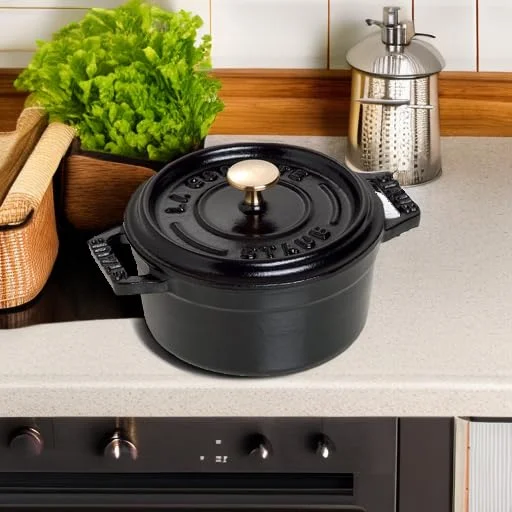
At $66.71, this is the lower-priced of the two listings and the more practical color for a pot that is going to live on a counter or get stacked in a cupboard between uses — matte black does not show the small scuffs that a lighter or glossier finish would. The 10-centimeter diameter Staub publishes gives you an actual measurement to check against a baking tray or a breakfast table setting before buying, which the cherry listing does not. If the use case is a baked-egg breakfast on repeat, or a single dessert portion, this is the one to buy first and decide from there whether a second or third makes sense.

Buy this one to find out whether you'll actually use the format before buying a matching set.

Staub 0.25-quart mini round cocotte in matte black
Price
$66.71
Check price →
02Best for the table

Staub Cast Iron 0.25-Qt Mini Round Cocotte — Cherry, Made in France

Best for dinner-party presentation

0.25 quart·Cherry finish·Made in France·Made by Staub

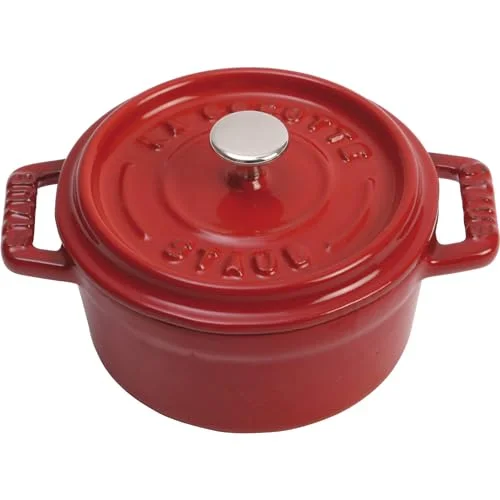
At $99.99, this is the pricier of the two and the one that reads as a deliberate tabletop object rather than a kitchen tool. Cherry is the color most associated with classic French bistro cocottes, and the listing specifies Made in France, which matters if provenance is part of what you are paying a premium for. It is the same 0.25-quart capacity as the matte black version, so the cooking it is good for — baked eggs, one gratin, one dessert — is identical; the difference is entirely how it looks set down in front of a guest.

The cooking is the same as the black one. You are paying for how it looks on the table, and that is a legitimate thing to pay for.

Staub 0.25-quart mini round cocotte in cherry, made in France
Price
$99.99
Check price →
The honest comparison

Does a ramekin do the same job for less?

For baking, a ceramic ramekin does a large part of this job, and it does it for a fraction of the price of either cocotte in this guide. Ceramic heats evenly enough for baked eggs, individual gratins and single-portion desserts, it is oven-safe to the temperatures those dishes need, and it is a fraction of the weight of a cast-iron equivalent — easier to lift from a hot oven, easier to store in quantity, easier to replace if one breaks. If the only goal is getting a single-portion dish cooked and onto a plate, a ramekin is the more rational purchase, and nothing about cast iron changes the chemistry of a baked egg.

What the ramekin does not do is the thing this whole format is actually sold on: holding heat at the table. Ceramic loses its warmth within a few minutes of leaving the oven, which is exactly adequate if the dish is being plated and served immediately, and exactly inadequate if the point is a dish that is still gently cooking and visibly hot ten minutes into a meal. A ramekin also will not take the same abuse — a dropped ramekin shatters, a dropped cast-iron cocotte dents the floor. And a ramekin, by design, is not meant to go anywhere near a stovetop or a grill, where a small enameled cast-iron piece at least has the option, within the manufacturer's stated limits.

So the honest answer is: buy a ramekin if the goal is simply cooking a single-portion baked dish as cheaply as possible, and buy the cast-iron cocotte if the goal includes serving it, keeping it hot through a meal, and having a piece of cookware that is also, frankly, nicer to look at on a table. Those are two different jobs wearing a similar shape, and the price difference between them is the price of the second job.

Our method

How we compared

What we did

Specs, prices, and what Staub publishes

We compared the published specifications and current Amazon prices for the two 0.25-quart Staub Mini Round Cocottes available in the US — capacity, diameter where it is given, finish, and country of manufacture where the listing states it — and limited every claim in this guide to what each listing actually publishes. Where a measurement, such as the cherry version's diameter, is not published, we say so rather than assume it matches its matte black sibling.

What we didn’t

We don’t run a testing lab

We do not physically test these cocottes, we do not own them, and we have no star ratings or review counts for these specific listings to report, so we publish none. What we can do honestly is reason from the physics of cast-iron mass and heat retention, which does not change by brand or by color, and say plainly where a specification simply is not published. See more about our approach on the About page.

FAQ

Common questions

How many servings does a 0.25-quart cocotte actually hold?

One. A quarter quart is one cup, about 236 milliliters, before the curve of the walls eats into that figure — enough for two large eggs with a little cream, one portion of baked mac and cheese, or a single individual gratin or dessert. It is not sized for two people to share, and it is not a smaller version of a family-size Dutch oven in any meaningful sense.

Can you sear or braise in a mini cocotte?

Not realistically. Searing needs thermal mass to hold its temperature once food touches the surface, and a 0.25-quart pot has only a small fraction of the iron that a full-size Dutch oven has, so it cools too quickly. Braising needs headroom for liquid to reduce over hours, and a cup of total volume does not leave room for that once you account for solid ingredients. Both jobs belong to larger, heavier pots built specifically for sustained heat.

Is a mini cocotte basically a fancy ramekin?

For baking alone, a ceramic ramekin does most of the same job for far less money, and it is lighter and more oven-to-stovetop limited by design. What the ramekin cannot do is hold heat at the table the way cast iron does — a dish served in a mini cocotte stays visibly hot well into a meal, while a ramekin cools within a few minutes. The cocotte is paying for that table performance and the presentation, not for better baking.

Should I buy one mini cocotte or a matching set for a dinner party?

Buy one first if you are not sure how often you will actually use the format — a single cocotte covers a regular breakfast or dessert habit. Buy a matching set, typically one per guest, only once you know you host dinners where an individual starter or dessert course and a uniform table presentation are worth the cost; four of the matte black version runs close to $287, and six closer to $430.

Keep reading

More from Best Dutch Ovens