Best Dutch Ovens
Buying Guide · Lid Design

What a Dutch Oven Lid Is Actually Doing

Staub casts a ring of spikes into the underside of its cocotte lids to rain condensation back onto the food. That is a deliberate culinary decision, not a styling flourish, and it only pays off in certain kinds of cooking. We compared the published lid, knob and capacity details across three Dutch ovens to work out what a lid is actually doing at every stage of a cook, and when that design earns you anything at all.

By Ilane Tall · Updated October 19, 2026 · Research-based.

Affiliate disclosure: we may earn a commission if you buy through the Amazon links on this page, at no extra cost to you.

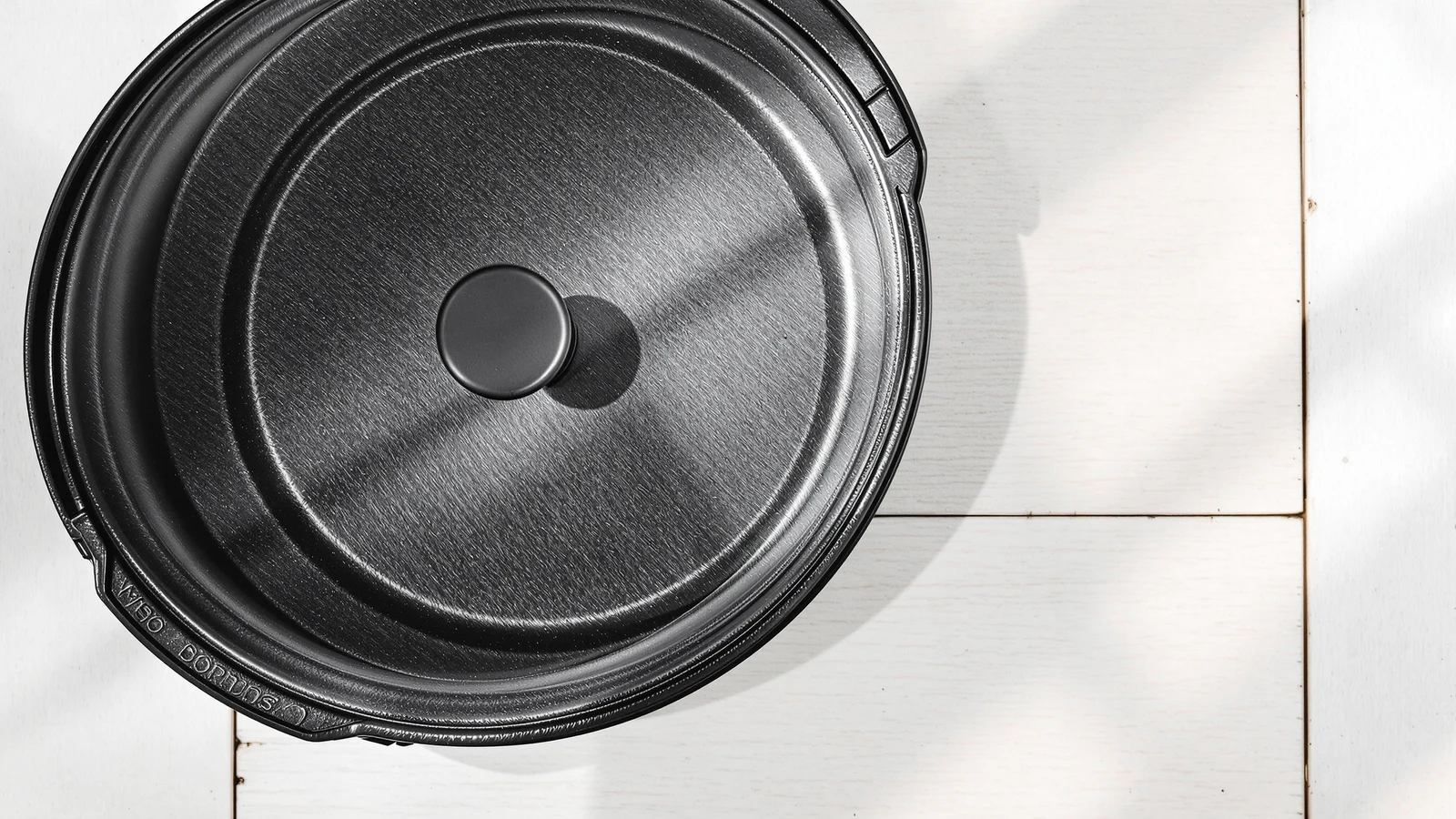
The lid of a cast iron Dutch oven lifted away from the pot, showing the underside and the knob on a kitchen counter
Where it starts

What a Tight Lid Actually Does to a Braise

A Dutch oven lid is not primarily there to keep dust out of your stew. Once a pot is on the heat and the liquid inside starts to simmer, a close-fitting cast iron lid turns the whole vessel into a small, mostly closed loop: steam rises off the braising liquid, hits the underside of the lid, cools against the iron faster than the air above it would cool it, and condenses back into liquid. That condensed water either drips straight back down into the pot or runs along the underside of the lid before falling, and either way it stays inside the loop rather than escaping into your kitchen the way it would from an open pan or a loosely covered one.

The practical effect of keeping that moisture circulating is a cooking environment that stays close to 212°F and close to saturated with moisture for hours at a time, which is exactly the slow, even, humid heat a tough cut of meat needs to break down its connective tissue into something tender rather than drying out on top while the bottom half sits in liquid. A loose-fitting lid, or a lid propped slightly open to vent, lets a meaningful amount of that steam escape instead of recirculating, which is why braising instructions so consistently specify a tight-fitting lid rather than just "a lid."

None of this requires anything exotic. Any heavy cast iron Dutch oven with a flat, well-machined rim does the basic version of this job, regardless of brand or price. What separates one lid from another is how much of that condensed water comes back down evenly across the food, rather than running straight to the rim and down the outside wall of the pot — and that is a genuine design choice some manufacturers make and others don't.

The detail worth explaining

Self-Basting Spikes: The Rain-Forest Effect, Explained

Staub casts a grid of small spikes into the underside of the lid on its cast iron cocottes, including the 7-qt Round Cocotte compared in this guide. The spikes aren't decorative: they multiply the number of cool surfaces steam can condense against, and they break up what would otherwise be a smooth underside where water collects into a few larger drops and runs straight to the rim. Instead, condensation beads on dozens of individual points spread across the entire underside of the lid, and as those beads grow heavy enough to fall, they drip down more or less evenly over the whole pot rather than concentrating at the edges. Staub markets this as a self-basting effect, and the nickname that's stuck in cooking circles — the rain-forest effect — describes the same thing: a steady, distributed drizzle back onto the food through the whole cook, instead of one damp ring around the inside wall.

A smooth-lidded pot still generates condensation; the physics of hot, moist air hitting cooler cast iron doesn't change because the lid is flat. What changes is where the water goes once it forms. On a flat or gently domed underside, droplets tend to merge and travel along the surface until they reach the rim or the knob post, then fall in a concentrated spot rather than scattering across the food below. For a large piece of meat that sits partly above the liquid line — a pot roast, a whole chicken, short ribs stacked higher than the braising liquid — that difference decides whether the exposed top surface stays basted through a multi-hour cook or slowly dries out while the submerged half stays fine.

This is also the detail that separates a self-basting claim from a marketing phrase. The mechanism is simple metal geometry — more nucleation points, more evenly spread drip — not a special coating or a sealed chamber, and it's checkable just by looking at the underside of a lid in the product photos before you buy.

Being honest about it

When It Matters, and When It Earns You Nothing

Self-basting spikes do real work on one specific category of dish: something large and only partly submerged, cooked for a long time, where the exposed top surface would otherwise dry out before the rest finishes braising. A short rib braise, a whole chicken nested in liquid up to about its thighs, a pot roast surrounded by but not fully covered in stock — these are the dishes where a lid that rains condensation back down evenly actually changes the result at the top of the pot.

They earn you nothing on a dish that's already fully submerged. A pot of chili, a bean soup, a stock, anything where every ingredient sits under the liquid line the whole time it cooks, doesn't need basting from above because nothing above the liquid is at risk of drying out in the first place. The spikes aren't doing anything useful there that a flat lid wouldn't also do, since the food was never exposed to dry heat to begin with.

They can work against you on bread. A sourdough loaf baked under a Dutch oven lid wants trapped steam for the first part of the bake, to keep the crust from setting too early and to help the loaf expand — but it wants that steam to stop circulating and the crust to dry out and set in the second half, which is why most sourdough methods call for removing the lid for the final stretch regardless of what the underside of that lid looks like. A design built to keep basting food indefinitely is solving a problem bread doesn't have during the half of the bake where a dry, hardening crust is the goal. For more on how pot size and lid behavior interact with a loaf specifically, see our guide to the best Dutch ovens for sourdough bread.

The part that does the sealing

Lid Weight and the Seal

A Dutch oven lid has no gasket, no rubber ring, no latch — unlike a pressure cooker, the entire seal is just a flat, machined rim of enameled cast iron resting under its own weight on a matching flat rim on the pot itself. There's nothing clamping it down. The seal that keeps steam circulating instead of escaping around the edge comes entirely from how heavy the lid is and how precisely its mating surface matches the pot's rim, enamel against enamel, with gravity doing all the work a gasket would do in another kind of cookware.

This is why lid weight isn't a trivial spec. A heavier lid presses down harder on the same contact area, closing microscopic gaps that a lighter lid of the same diameter would leave open, and it's part of why cast iron Dutch ovens seal more effectively over a long braise than lighter stainless steel pots with thin, stamped lids. It's also why the largest pot in any lineup tends to carry the most assertive seal: more capacity generally means more iron in the lid as well as the body, and a 7-quart lid like the one on the Staub Cocotte in this guide is proportionally heavier than a 5.5-quart lid, simply because there's more cast iron in it. Our guide to Le Creuset vs. Lodge covers how that same weight difference shows up, and what it costs, across two very different price tiers.

None of the three products in this guide publish an exact lid weight in isolation from the pot's total weight, so we won't invent a number for one piece that isn't broken out in the listing. What's worth checking yourself, in the product photos or the current listing, is how flat and finished the rim looks where lid meets pot — that contact surface, not the handle or the knob, is doing the actual sealing.

The part that limits the oven

The Knob, and the Oven Temperature It Limits

Cast iron and the vitreous enamel fused to it can both handle oven heat far beyond anything a home kitchen ever reaches. In practice, the part of a Dutch oven that actually sets the ceiling on oven-safe temperature is almost never the pot body — it's the knob on top of the lid. A knob molded from plastic or phenolic resin is rated to a specific, usually lower temperature than the iron it's screwed into, and pushing a pot past that figure under a broiler or in a very hot oven risks damaging the knob long before the pot itself is in any danger.

This is why knob material is worth checking before you assume a pot's oven-safe limit, rather than assuming the pot body's rating applies to the whole lid. Staub ships this cocotte with an all-metal knob rather than the black phenolic style common elsewhere in the category, specifically so the lid can go into a hotter oven without the knob being the weak point. Le Creuset's lids have historically shipped with a phenolic knob rated below the pot body, though the exact material and rating varies by line and has changed over time. Mueller's listing for the DuraCast doesn't break out a separate knob rating in the specifications we have on file for it. In all three cases, the honest move is the same: check the current listing for the specific oven-safe figure for the lid, not just the pot, before you run any of them hotter than 450°F or under a broiler.

The upside of knowing this is practical: a knob rating, unlike a lid's basting behavior, is usually printed plainly on the listing or in the manual, and some brands sell a stainless steel replacement knob specifically so an older pot with a lower-rated original knob can be pushed harder. If a listing is silent on the number, treat that silence as a reason to ask rather than a reason to assume the pot can take anything the body can.

Side by side

The three lids, compared

PotBest forCapacityLid designPriceGet it
Staub 7-qt Round Cocotte Long braises, self-basting 7 qt Spiked underside, metal knob $299.95 Get it
Le Creuset 5.5 Qt, Flame Roasts, everyday versatility 5.5 qt Smooth domed lid $349.99 Get it
Mueller DuraCast 6 Quart Everyday stews, budget entry 6 qt Flat lid, standard knob $49.27 Get it
The picks

The Picks, by What You Cook

If the dish is large, partly above the liquid line, and cooking for hours, lid design is worth paying for. If it's fully submerged, or a quick weeknight job, it isn't. Here's where to put your money depending on which column your cooking actually falls into, including the size-and-weight case we cover in more depth in our guide to the best large Dutch ovens at 7 quarts and up.

01Best for long braises

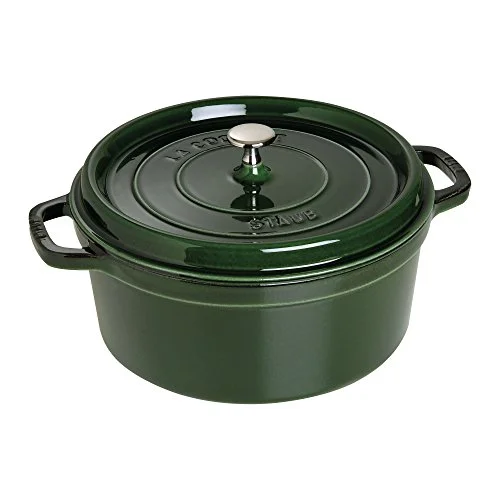
Staub Cast Iron 7-qt Round Cocotte, Basil

Best if you regularly braise something large for hours

7 quarts·Self-basting spiked lid·Made in France·Metal knob

At $299.95, this is the pot in this guide where lid design is the actual product, not an afterthought. The spiked underside is built specifically for the job described above — a short rib braise, a whole chicken, a pot roast sitting partly above the braising liquid — where an evenly distributed drip back onto the food over several hours keeps the exposed top from drying out while the rest of the dish finishes. Seven quarts also gives a long braise the headroom below the lid that a smaller pot doesn't, so the liquid has room to simmer gently without crowding the seal.

Buy the spikes because you cook the dish they were designed for, not because they sound clever on the box.

Staub cast iron 7-qt round cocotte, basil, with spiked self-basting lid
Price
$299.95
Check price →
02Best for roasts & everyday use

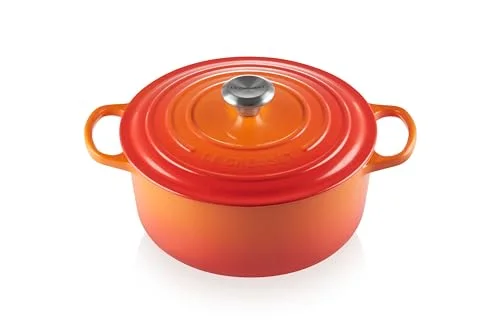
Le Creuset Enameled Cast Iron Round Dutch Oven, 5.5 qt., Flame

Best if most of your cooking doesn't need self-basting

5.5 quarts·Smooth domed lid·Enameled cast iron·Round, flame

At $349.99, this is the pot for a kitchen where braises partly above the liquid line are the exception rather than the weekly routine. The lid's heavy, flat-rimmed design still seals well enough under its own weight to hold in steam for a stew, a soup, or a roast, the same way any well-machined cast iron lid does — it simply doesn't add the spiked underside that's purpose-built for one narrow category of long, partly-submerged braises. For soups, stocks, chilis and most weeknight cooking, that distinction never comes up, because the food is fully covered in liquid regardless of what the lid's underside looks like.

The seal comes from the weight and the fit, not from a spike pattern you'll rarely need outside one specific kind of braise.

Le Creuset enameled cast iron round Dutch oven, 5.5 quart, flame
Price
$349.99
Check price →
03Best budget entry

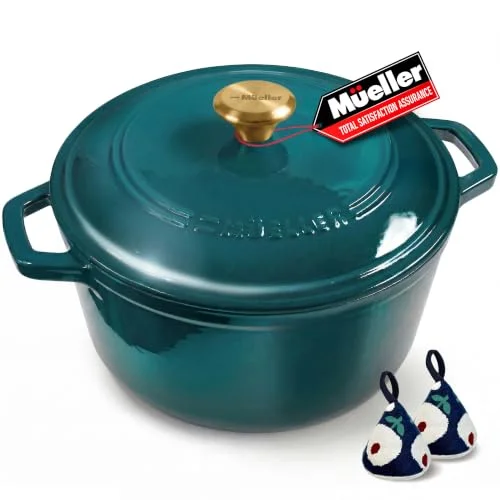
Mueller DuraCast 6 Quart Enameled Cast Iron Dutch Oven Pot with Lid

Best if you want the basic seal without paying for lid engineering

6 quarts·Enameled cast iron·Flat lid·Round

At $49.27, this pot does the fundamental job every cast iron lid does: it sits flat on a matching rim and holds its own weight down, which traps steam for an ordinary stew, chili, or braise the same way the two pricier pots do at the basic level. There's no spiked underside and no stated knob material in the specifications we have on file for it, which simply means this isn't the pot to reach for if a single large, partly-submerged roast basted evenly over four hours is the specific job — and for most weeknight cooking, it was never going to be that job anyway.

A flat lid on a heavy pot still does ninety percent of what any lid does. The spikes are the last ten percent, for a specific kind of cook.

Mueller DuraCast 6 quart enameled cast iron Dutch oven pot with lid
Price
$49.27
Check price →
Our method

How we compared

What we did

Published lid design, material science, and price

We compared the published capacity, lid design and current Amazon price for the Staub 7-qt Round Cocotte, the Le Creuset 5.5 qt Flame and the Mueller DuraCast 6 Quart, and explained the general mechanics of condensation, sealing and oven-safe temperature using the well-established physics of cast iron and vitreous enamel — not brand marketing or secondhand anecdote. Where a specification such as knob material or lid weight isn't published for a given listing, we say so rather than infer it from a similar-looking product. For more on how this site approaches comparisons generally, see our guide to enameled versus bare cast iron.

What we didn’t

We don’t run a testing lab

We do not physically test these pots, we do not own all three, and we have no star ratings, review counts, or paraphrased owner sentiment for these specific listings, so we don't publish any. How evenly a given lid actually bastes a four-hour braise can't be answered honestly from a single trial by us or by anyone claiming to have tested it once. We can describe what is chemically and physically true of condensation, weight and sealing across the category, and we do, rather than invent product-specific sentiment we don't have. See more on the About page.

FAQ

Common questions

Does every Dutch oven lid self-baste?

No. Self-basting specifically refers to a textured or spiked underside, like the one Staub casts into its cocotte lids, that's designed to spread condensation evenly back over the food. A smooth or flat lid, like the ones on the Le Creuset and Mueller pots in this guide, still traps steam and seals the pot under its own weight, but condensation tends to run to the rim rather than drip evenly across the center.

Does lid design matter for soup or chili?

Not much. Self-basting spikes and a tight seal matter most for food that sits partly above the liquid line during a long cook, like a pot roast or a whole chicken. In a soup, stock, or chili, everything is already submerged in liquid the whole time, so there's nothing exposed above the liquid for a lid's underside design to protect from drying out.

What actually limits a Dutch oven's oven-safe temperature?

Usually the knob, not the pot. Cast iron and the enamel fused to it can handle oven heat far beyond what a home oven reaches, but a plastic or phenolic knob is typically rated to a lower ceiling than the pot body. Check the current listing for the specific knob material and rated temperature before running any Dutch oven hotter than 450°F or under a broiler.

Is a spiked lid worth paying for if I mostly cook stews?

Probably not. The spiked, self-basting design on a pot like the Staub Cocotte earns its keep on large, partly-submerged braises cooked for hours. A stew, where everything sits under the liquid the whole time, gets the same result from a flat, heavy lid like the one on the Mueller DuraCast, since there's no exposed food above the liquid line for the spikes to protect.

Keep reading

More from Best Dutch Ovens