Best Dutch Ovens
Comparison · Enameled vs Bare Cast Iron

Enameled or Bare Cast Iron: Which Should You Buy?

One needs seasoning and resents tomatoes. The other is ready out of the box and chips if you are careless with it. Both are cast iron, which means both hold heat the same way — the difference is entirely in what sits on top of the metal, and in how much ritual you are willing to keep up for the rest of the time you own the pot.

By Ilane Tall · Updated October 16, 2026 · Research-based.

Affiliate disclosure: we may earn a commission if you buy through the Amazon links on this page, at no extra cost to you.

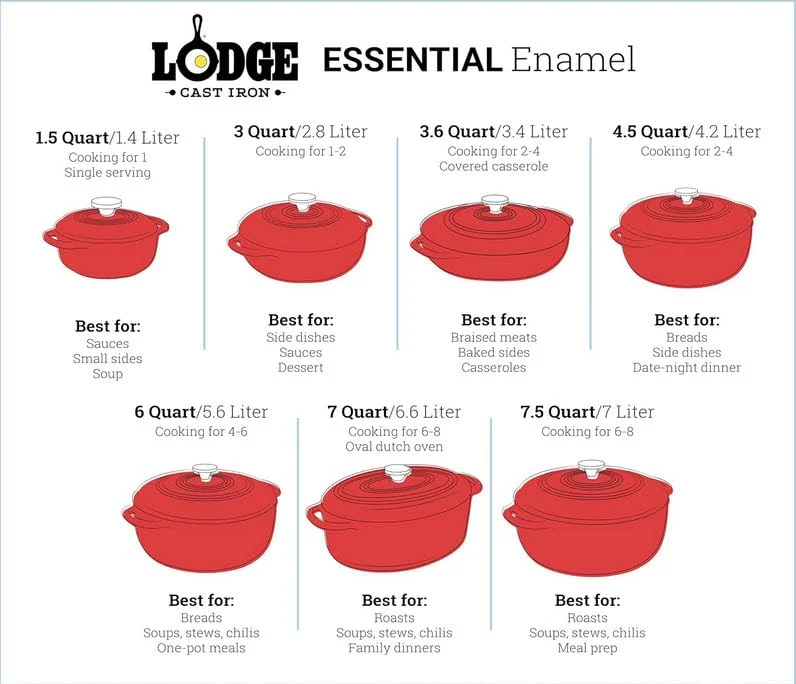
An enameled cast iron Dutch oven beside a bare cast iron pot on a kitchen counter
Where it starts

What seasoning is, and what it is not

Seasoning is a thin, baked-on layer of polymerized oil that bonds to bare cast iron's naturally porous surface. You build it by rubbing a light coat of oil into the metal and heating it past the oil's smoke point, over and over, until a dark, slightly glossy layer forms across the inside of the pot. That layer does two jobs: it fills in the microscopic pores in the iron so food does not fuse to the surface, and it forms a barrier between the iron and the air, which is the only thing standing between bare cast iron and rust. It is not a coating applied at the factory in any permanent sense, and it is not a one-time task you finish and forget. Seasoning is a maintained condition, closer to a callus than a paint job — it thins with hard scrubbing, with acidic food, with time spent sitting wet, and it needs periodic renewal for the life of the pot.

This is the part the folklore gets backwards. Seasoning is not what makes cast iron "nonstick" in the way a Teflon pan is nonstick. It makes bare cast iron usable without food welding itself to raw metal, and it buys the pot a working defense against moisture. Neither job has anything to do with flavor, and a well-seasoned pot does not season your food — a claim that shows up in marketing far more often than it shows up in chemistry. What seasoning actually is: a maintenance habit. What it is not: a finish you buy and are done with.

Enameled cast iron skips this step entirely, by design. A layer of glass is fused to the iron at the factory under industrial heat, and that glass is both the nonstick-ish surface and the rust barrier, permanently, without your involvement. That is the single biggest practical difference between the two categories, and nearly everything else in this guide follows from it.

The tomato question

Acidity, answered properly

Here is the actual mechanism, not the shorthand version. Bare cast iron's seasoning layer is a thin coat of polymerized oil sitting on top of reactive iron. Acidic ingredients — tomatoes, wine, vinegar, citrus, most braising liquids worth making — can slowly break down that oil layer over a long cook, and once the seasoning thins in a spot, the acid reaches bare iron underneath. The iron itself can leach a metallic taste into a long-simmered acidic sauce and, more importantly for the pot's future, that exposed spot is now vulnerable to rust the next time it sits wet. None of this happens in the first ten minutes. It is a cumulative risk that scales with how acidic the dish is and how long it simmers, which is why the common advice is "avoid long-simmered tomato sauces in bare cast iron," not "never let a tomato touch it."

Enamel has no equivalent weakness. Glass does not react with acid in any meaningful way at cooking temperatures, which is exactly why enameled Dutch ovens are the default recommendation for braises built on wine, tomatoes, or vinegar-forward marinades. A six-hour short rib braise with a bottle of red wine and a can of crushed tomatoes is a textbook use case for an enameled pot like the Lodge Essential 6 Quart and a textbook case for leaving a bare cast iron Dutch oven in the cupboard.

The honest nuance: a quick tomato-based pan sauce, in and out in fifteen minutes, is not going to ruin a well-seasoned bare cast iron pan. It is slow acid exposure over a long simmer that does the damage, not contact. If your cooking leans heavily toward braises, stews, and sauces that spend hours on the stove or in the oven, that tilts the decision toward enamel regardless of anything else in this guide.

The part nobody mentions

Rust, drying, and the maintenance nobody mentions

Bare cast iron's maintenance routine is not difficult, but it is non-optional, and it is the part that gets glossed over in enthusiastic cast-iron evangelism. After washing — by hand, with minimal soap, never left to soak — the pot has to be dried completely and immediately. Not air-dried on a rack, which gives water time to sit in corners and start rust before the surface fully dries. Dried with a towel, then usually set back on a burner for a minute or two of direct heat to drive off any trace moisture the towel missed. Skip that step on a humid night and it is entirely possible to find a faint orange bloom of rust on the pot the next morning, especially on a newer or thinner-seasoned piece. Rust is fixable — a scrub with steel wool and a reseasoning session undoes it — but it is a repeated small chore that compounds over the life of a bare iron pot, not a one-time inconvenience.

Enameled cast iron has none of this. You wash it, you dry it on a rack or just leave it, and nothing happens, because there is no bare iron for moisture to reach. This is the actual root of "enameled is low-maintenance" — not that it is more durable in every sense, but that the daily, weekly chore of drying-and-oiling simply does not exist for it. For a lot of home cooks, that alone settles the question: the enamel removes a recurring task, not just a onetime seasoning session.

What enamel asks for instead is gentler handling in the moment rather than ongoing ritual: hand-washing is still the standard advice even on enamel marketed as dishwasher-safe, metal utensils should generally be avoided in favor of wood or silicone, and a hot enameled pot should not go straight into cold water, which brings us to the failure mode that replaces rust.

What enamel breaks instead

Chipping: the failure mode enamel has instead

Bare cast iron does not chip — there is no coating to chip off, just the iron itself, which can rust but will not fracture under normal use. Enamel is glass, and glass is hard but not flexible, so its failure mode is entirely different: a sharp impact or a hard scrape can chip it, usually at the rim where the pot meets the lid, or along the interior base where a metal spoon has been dragged repeatedly in the same spot. A dropped lid, a pot knocked against a faucet edge while being washed, a metal whisk used aggressively for years — these are the events that chip enamel, and once a chip exposes the cast iron underneath, that exposed spot can rust just like bare iron would, inside an otherwise enameled pot.

This is the trade in one sentence: bare cast iron's vulnerability is chronic and preventable with a routine (dry it, every time); enamel's vulnerability is acute and preventable with care (do not bang it, do not scrape it hard with metal). Neither pot is fragile in ordinary use. A Dutch oven from either category, used reasonably, will outlast the average kitchen gadget by decades. But if you are the kind of cook who reaches for a metal spatula without thinking and occasionally sets a hot pot down harder than you meant to, that habit costs bare iron nothing and costs enamel a slow accumulation of small chips at the rim.

None of the three products referenced in this guide publish a chip-resistance figure, and no manufacturer in this category does — it is not a number that gets tested and printed, at any price tier. What is consistent across the category, regardless of brand, is that wooden or silicone utensils and gentle handling at the sink measurably slow enamel wear, the same way careful drying slows bare iron's rust.

At the stove

Searing, and whether the surface changes it

Underneath either surface is the same cast iron, and cast iron's actual superpower for searing is heat retention, not the finish on top: once the pot is hot, it stays hot even when a cold steak hits it, so the pan does not dip in temperature the way a thin stainless or nonstick pan can. That property is identical in a bare pot and an enameled one, because it comes from the iron's mass, not from the surface treatment.

Where the surfaces genuinely diverge is the fond — the browned bits that stick to the bottom of the pot during a sear and that you later deglaze into a sauce. A well-seasoned bare cast iron surface develops a natural patina that some cooks find releases a sear slightly more cleanly over time, though this depends heavily on how seasoned the specific pot is and is more a lived impression among bare-iron cooks than a measured difference. Enamel is a smoother, harder surface from day one, and a light interior enamel — where the manufacturer uses one — has a real, practical advantage that has nothing to do with sticking: you can actually see the fond darken and watch a sauce reduce, which is difficult to judge on dark bare iron or dark enamel by eye alone.

The honest answer to "does the surface change the sear" is: not meaningfully, for the sear itself. Both surfaces get hot, stay hot, and brown meat well, because that is a function of mass and conductivity, which the glass or the seasoning layer barely affects. What changes is maintenance after the sear — a bare iron pan with stuck-on fond gets a hot water scrub and immediate drying; an enameled pot can take a slightly longer soak without the rust risk, though a sudden plunge of a very hot enameled pot into cold water is still something to avoid regardless of surface.

The real decision

The picks, by how much ritual you want

This guide only covers enameled cast iron products with verified specifications on file, because that is the category where we can name real products at real prices without guessing at a bare-iron pot's seasoning history or finish. If the maintenance picture above points you toward enamel — no drying ritual, no rust risk, safe with acidic braises — here is where to start, organized by how much you are willing to spend for enamel that resists chipping longer.

01Lowest ritual, lowest price

Nuovva Enamelled Cast Iron Dutch Oven Pot with Lid, 6.4 Quart

Best if you want enamel's zero-maintenance case at the lowest entry price

6.4 quarts·Enameled, non-stick interior·Oven safe to 500°F·28cm, dark blue

At $49.99, this is the cheapest route into everything enamel removes from your routine: no seasoning before first use, no drying-and-oiling after every wash, no second-guessing a tomato braise. It is sold at 6.4 quarts, slightly above the common 6-quart default, which gives a little extra headroom for a big batch of chili or a whole chicken with vegetables around it. The published 500°F oven-safe figure covers effectively every braise, roast, or bread bake a home kitchen runs. This is the pot for someone who has read the seasoning-and-drying routine above and decided, reasonably, that they do not want it.

The whole case for enamel distilled into fifty dollars: nothing to season, nothing to dry, nothing to avoid putting in it.
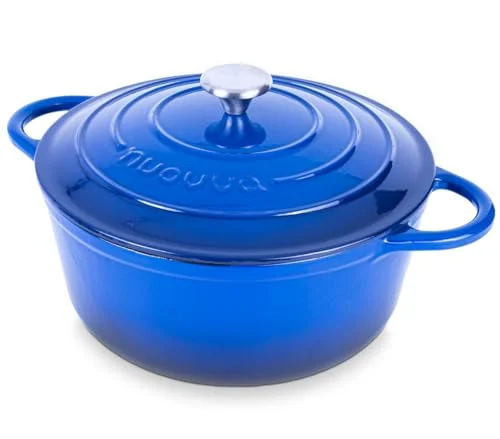
Nuovva enameled cast iron Dutch oven, 6.4 quart, dark blue
Price
$49.99
Check price →
02Most capacity for the enamel case

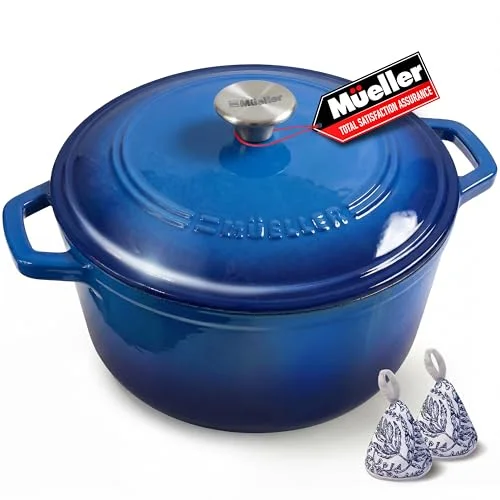
Mueller 6qt Enameled Cast Iron Dutch Oven with Lid and Knob

Best if you want the standard 6-quart size with enamel's full hands-off case

6 quarts·Enameled cast iron·Safe for all cooktops·Round, aqua blue

At $59.97, this sits at the six-quart size that most comparisons on this site treat as the household default, rather than Nuovva's slightly larger 6.4 quarts. Mueller states it is safe for all cooktops, which matters if your kitchen has gone to induction and you are specifically ruling out pots that cannot be used there. Like any enameled pot, it arrives ready to cook in — no seasoning, no curing, straight from the box to a tomato-heavy braise on day one, which is the entire argument of the acidity section above put into practice.

The standard size, the standard case for enamel: you are buying an end to the drying routine, not a different kind of heat.

Mueller enameled cast iron Dutch oven, 6 quart, aqua blue
Price
$59.97
Check price →
03Enamel built to outlast a careless scrape

Lodge Essential Enamel Cast Iron Dutch Oven, 6 Quart, Oyster White

Best if you want enamel from a foundry with a reputation to protect

6 quarts·Oyster white enamel·No seasoning·Made by Lodge

At $69.99, this is the pick for someone who has decided on enamel for the maintenance reasons above but still wants to minimize the chipping risk that comes with the territory. Lodge has cast iron in Tennessee since 1896, and the light oyster-white interior is specifically useful for the searing question discussed earlier — a pale interior makes it genuinely easier to watch a fond develop or a sauce reduce by eye, rather than guessing in a dark pot. It carries no star rating or review count in our database, so we are not claiming either; what we can say is that it is the pot on this page from the manufacturer with the longest continuous foundry history, which is a real, checkable fact rather than a sentiment.

If your real worry about enamel is chipping, not price, this is the one with the longest track record behind it.

Lodge Essential Enamel cast iron Dutch oven, 6 quart, oyster white
Price
$69.99
Check price →
Side by side

The three enameled picks, compared

PotBest forCapacityMade byNotablePriceGet it
Nuovva 6.4 Quart Lowest ritual, lowest price 6.4 qt Nuovva Oven safe to 500°F $49.99 Get it
Mueller 6qt Standard size, all cooktops 6 qt Mueller Safe for all cooktops $59.97 Get it
Lodge Essential Enamel Longest foundry track record 6 qt Lodge No seasoning needed, casting since 1896 $69.99 Get it
Our method

How we compared

What we did

Published specs and material science, not folklore

We compared the published specifications and current Amazon prices for the Nuovva, Mueller, and Lodge pots named in this guide, and anchored every general claim about seasoning, acidity, rust, chipping, and searing in the well-established chemistry and physics of cast iron and vitreous enamel — not in brand marketing or secondhand anecdote. Where a specification such as an interior color or a chip-resistance figure is not published for a given product, we say so rather than infer it from a similar-looking listing.

What we didn’t

We don’t run a testing lab

We do not physically test these pots, we do not own them, and we have no star ratings, review counts, or paraphrased owner sentiment for these specific listings, so we do not publish any. How enamel actually chips after years of real use, or how quickly a specific seasoning routine protects against rust, cannot be answered honestly from a brief trial by us or by anyone claiming to have tested it in a week. We can describe what is chemically and physically true of the two categories, and we do, rather than invent product-specific sentiment we do not have. See more on the About page.

FAQ

Common questions

Can I cook tomato sauce in bare cast iron at all?

A quick pan sauce, in and out in fifteen minutes, will not meaningfully harm a well-seasoned pot. The real risk is a long simmer — hours of acidic liquid slowly breaking down the seasoning layer and exposing bare iron underneath, which can both taste metallic and start rusting later. For anything that simmers for an extended period, like a tomato-based braise, enameled cast iron has no equivalent limitation at all.

Does enameled cast iron ever need seasoning?

No. The enamel is a layer of glass fused to the iron at the factory, and it is the permanent barrier that bare iron's seasoning has to recreate through maintenance. An enameled pot is ready to use straight out of the box and stays that way for its working life; there is no equivalent ritual to maintain.

What actually causes enamel to chip?

Hard impacts and aggressive scraping, not ordinary cooking. A dropped lid, a pot knocked against a faucet edge while washing, or years of a metal utensil dragged repeatedly across the same spot are the typical causes. Using wood or silicone utensils and handling the pot gently at the sink noticeably slows this across the category, regardless of brand or price.

Which should I buy if I am undecided?

If you are not sure you will keep up a drying-and-oiling routine every time you cook, choose enameled — the Nuovva 6.4 Quart at $49.99 is the lowest-cost way to find out whether a Dutch oven earns a permanent place in your kitchen without taking on bare iron's maintenance at the same time. If you already season and dry cast iron skillets without thinking about it, that same habit transfers directly to a bare iron Dutch oven.

Keep reading

More from Best Dutch Ovens