Best Dutch Ovens
Comparison · Shape, Not Just Size

Round or Oval Dutch Oven?

The shape question gets skipped past in most buying guides, and it shouldn’t be. A round pot and an oval pot of the same stated capacity solve different problems: one sits squarely over a burner's heat, the other sits squarely under a pork shoulder or a whole fish. We compared how each shape behaves on a hob, in an oven, and in a cupboard, using the published specifications for three enameled cast-iron pots, to work out which shape actually earns its place in a one-pot kitchen.

By Ilane Tall · Updated October 21, 2026 · Research-based.

Affiliate disclosure: we may earn a commission if you buy through the Amazon links on this page, at no extra cost to you.

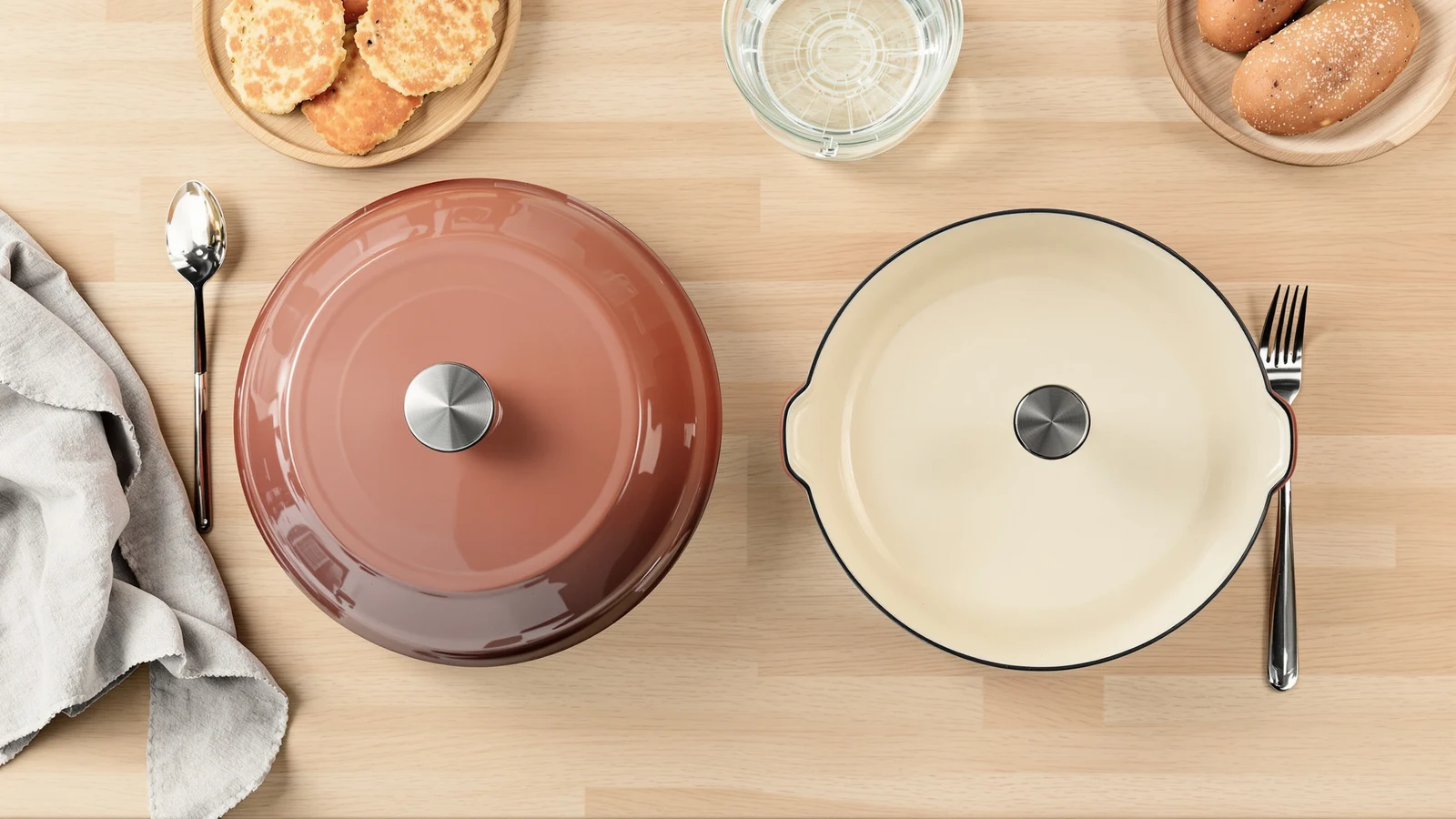
A round enameled cast iron Dutch oven and an oval enameled cast iron Dutch oven side by side on a kitchen counter
On the hob

How a burner heats a round base, and why an oval one disagrees with it

A gas or electric burner is round. That single fact decides more about shape than anything printed on a box. A round Dutch oven base sits concentrically over the flame or the element, so the heat radiates outward from the center in a pattern that roughly matches the pot’s own geometry — the base heats evenly, the sides climb at roughly the same rate all the way around, and a sauce reducing in the middle of the pot behaves the same as one near the edge. This is why a round pot like the Overmont 5.5 Quart or the larger 7 Quart version is the default recommendation for stovetop work: searing a roast, reducing a sauce, or simmering a soup all depend on the base making full, even contact with a circular heat source.

An oval pot breaks that symmetry on purpose, and the trade only pays off once the dish stops being about the burner. The Lodge 7 Quart Oval sits on a burner the same way a rectangle sits on a circle: the two long ends of the base extend past the ring of direct heat, and the two short ends sit closer to the center than they would on a round pot of equivalent volume. On an electric coil or a gas ring sized for a round pot, that means the ends of an oval base run cooler than the middle — not dramatically, but enough that a thin sauce reduced on the stovetop in an oval pot can show more browning in the center than at the ends, while the same sauce in a round pot of the same capacity browns more uniformly. None of the three products here publish a burner-compatibility spec, because none of them need to — this is simple geometry, not a manufacturer claim, and it applies to any oval cookware on any round burner.

Once the pot goes into the oven, this stops mattering almost entirely. Oven heat surrounds the pot from every direction rather than concentrating under the base, so a braise finished in the oven in an oval Dutch oven cooks about as evenly as the same braise in a round one. The shape penalty is specifically a stovetop phenomenon, which is why the honest framing is not "oval is worse" but "oval wastes some of a burner’s heat and makes it up once the oven door closes."

What the shape actually buys you

What fits in an oval pot that will not fit in a round one

The entire case for oval comes down to one word: length. A round pot of any stated capacity has a base that is, by definition, the same width in every direction, which caps the longest single item you can lay flat inside it at the pot’s diameter. An oval pot of the same capacity takes that same volume and stretches it along one axis, which means the long dimension of the Lodge 7 Quart Oval is meaningfully longer than the diameter of a round 7-quart pot, even though both hold the same amount by volume.

That extra length is the whole point if your cooking runs toward whole proteins rather than stews. A whole chicken is roughly round and sits happily in either shape, but a pork shoulder, a leg of lamb, a whole fish, or a rack of ribs laid flat are all long, narrow cuts that a round pot forces you to curl, cut in half, or stand on end to fit. An oval pot built for this, like the Lodge 7 Quart, lets a long cut lie flat with its full surface in contact with the base and the braising liquid — which matters because a cut that is folded or propped up cooks unevenly, with the parts touching the liquid finishing differently from the parts that are not.

The flip side is honest too: if your cooking is mostly soups, stews, chilis, rice, or anything that is already liquid or roughly round, that extra length buys you nothing. A round pot is not a worse container for a stew; it is simply not optimized for a shape of food that round cooking rarely produces. The question to ask before choosing oval is not "do I want more capacity" but "do I regularly cook something long."

Baking

Bread, and why round wins outright

Sourdough and other boule-style loaves are the one case where shape is not a trade-off at all — round is simply correct. A standard home sourdough loaf is shaped into a round or near-round mass before it goes into the pot, because that is the shape a basic banneton proofing basket produces and the shape that bakes most evenly from the outside in. Put that round loaf into a round Dutch oven like the Overmont 5.5 Quart and the dough sits centered, with roughly equal clearance on every side to the pot wall, which means steam released during the bake circulates evenly around the entire loaf and the crust browns at close to the same rate all the way around.

Put the same round loaf into an oval pot and it sits off-center along the long axis by default, with a lot of empty space at the two ends and comparatively little clearance where the loaf’s curve meets the pot’s shorter width. That uneven clearance means uneven steam distribution: the ends of the oval trap less of the loaf’s own humidity because there is more air volume for it to disperse into, while the sides can run tighter than ideal. The practical result, consistent with how covered-pot bread baking works generally, is a crust that can brown less predictably around the loaf’s circumference in an oval pot than in a round one sized to the loaf.

This is also a capacity question, not just a shape one. A loaf needs a pot close to its own size to trap steam effectively — too much extra headroom in any direction lets steam escape upward and sideways before it has done its job on the crust. A 5.5-quart round pot, sized to a standard boule, gets this right in a way that a larger oval pot, built for a cut of meat rather than a loaf, generally does not. If baking bread is a primary reason you own a Dutch oven, round is not a matter of preference.

Living with it

Oven shelf space and cupboard storage

An oval pot's long dimension has to go somewhere, and in most kitchens that somewhere is a standard oven shelf or a cupboard shelf designed around round or square cookware. A 7-quart oval pot like the Lodge takes up noticeably more shelf length front-to-back or side-to-side than a round 7-quart pot of the same volume, which can be the difference between fitting alongside a second shelf item and needing the shelf to itself. If your oven is a narrow apartment-size unit, or your cupboard shelving was built for round pots stacked or set beside each other, measure the oval pot's long dimension against that specific space before buying — volume on a spec sheet does not tell you whether the shape clears your shelf.

Round pots have the opposite, more forgiving property: a round footprint is the same in every direction, so it nests predictably next to other round cookware and rotates in a cupboard without needing to be oriented a particular way. The Overmont 5.5 Quart and 7 Quart, both round, store the way most Dutch ovens in most US kitchens already do, which is one less thing to plan around when you are working with limited cupboard real estate.

None of this is a reason to avoid oval if you need the length for what you cook. It is a reason to check your own shelf and cupboard dimensions against the pot’s stated footprint — listed on the Amazon product page for each pot — rather than assume that "7 quarts" means the same physical space regardless of shape.

Side by side

The three, compared

PotShapeBest forCapacityMade byPriceGet it
Overmont 5.5QT Round Burner work, bread, everyday cooking 5.5 qt Overmont $45.99 Get it
Overmont 7QT Round Feeding a crowd, stews, soups 7 qt Overmont $62.99 Get it
Lodge Oval Dutch Oven Oval Whole proteins, long cuts, braising 7 qt Lodge $83.99 Get it
The picks

Our picks, and who each one is for

01Best for the hob

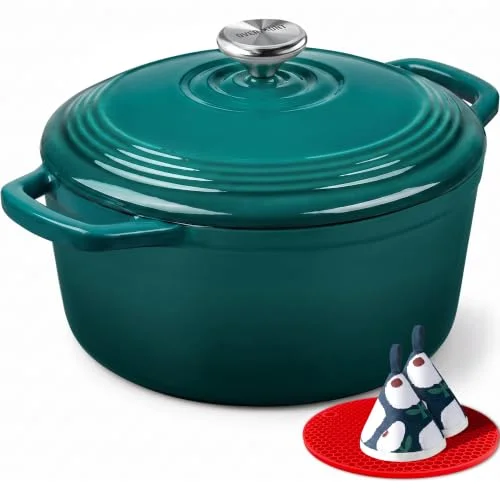
Overmont Enameled Cast Iron Dutch Oven, 5.5QT, with Lid & Cookbook

Best for stovetop cooking and bread

5.5 quarts·Round·Cookbook included·Lid included

At $45.99, this is the pot to buy if your cooking leans toward the stovetop rather than the oven — sauces, soups, searing, and sourdough. Five and a half quarts is close to the size that suits a standard boule, and the round shape sits concentrically over any home burner, gas or electric, so heat climbs the sides at roughly the same rate all the way around. It ships with a cookbook, a small but genuinely useful nudge for anyone buying their first Dutch oven and unsure what to cook in it.

If you are not sure whether you will cook a pork shoulder or a pot of soup more often this year, this is the safer first purchase.

Overmont enameled cast iron Dutch oven, 5.5 quart, round, with lid and cookbook
Price
$45.99
Check price →
02Best round, large

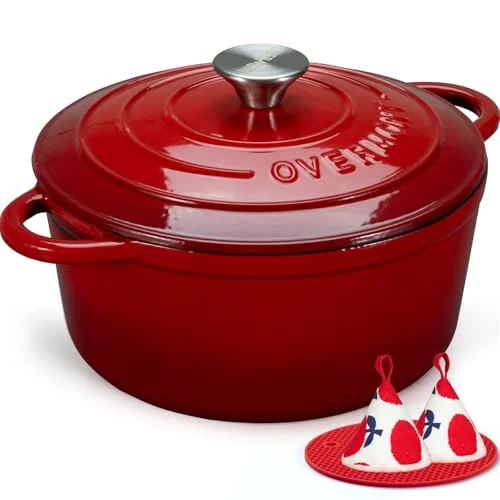
Overmont Enameled Cast Iron Dutch Oven, 7QT, with Lid, Cookbook & Cotton Potholders

Best for round cooking at a larger scale

7 quarts·Round·Cotton potholders included·Heavy-duty, for braising, stews, roasting, sourdough

Seven quarts in round form, for $62.99, and the product listing itself frames it around braising, stews, roasting and sourdough baking — all tasks a round base handles well, either because they are liquid-based and don’t care about shape, or because round is specifically correct for them, as with bread. It ships with cotton potholders in addition to the cookbook, which is not a gimmick once you have lifted a full seven-quart pot out of a hot oven. Choose this over the oval Lodge if your seven-quart cooking is mostly stews, soups and bread rather than whole cuts of meat.

More capacity, same shape logic as the 5.5 quart — round, for round food.

Overmont enameled cast iron Dutch oven, 7 quart, round, red, with lid, cookbook and cotton potholders
Price
$62.99
Check price →
03Best for long cuts

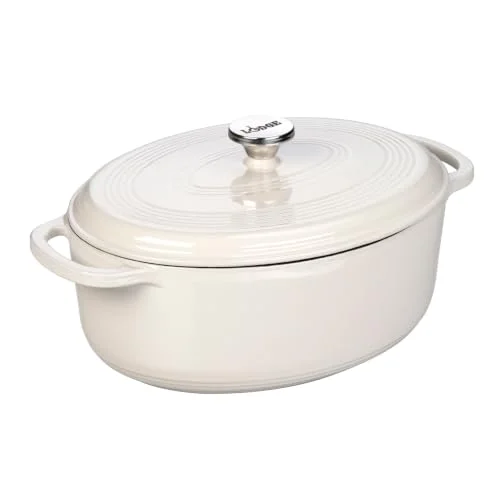
Lodge Enameled Cast Iron Oval Dutch Oven with Lid, 7 Quart, Oyster White

Best for whole proteins and long braises

7 quarts·Oval·Made by Lodge·Oyster white enamel

At $83.99, this is the pot on this page built for a specific job: laying a long cut flat. A pork shoulder, a leg of lamb or a whole fish fits an oval base in a way it cannot fit a round one at the same volume, because the oval shape stretches the same seven quarts along one axis instead of distributing it evenly in a circle. On a stovetop it gives up some even heating at the two ends compared to a round pot of the same capacity, which is the honest trade — but once it goes into the oven for the braise itself, that stops mattering and the extra length is pure upside.

Buy oval because you cook something long, not because seven quarts sounded like the number to get.

Lodge enameled cast iron oval Dutch oven, 7 quart, oyster white
Price
$83.99
Check price →
If you only buy one

Which shape to buy first if you will only own one

Round. For almost every household buying a single Dutch oven, round is the shape that covers more of what actually gets cooked in one: stews, soups, chilis, sauces, a whole chicken, and bread, all of which either prefer round or are indifferent to shape. Oval only pulls ahead for a specific, recurring need — a pork shoulder, a leg of lamb, ribs laid flat — and if that is not a dish your household makes more than occasionally, the oval pot spends most of its life in the cupboard doing a round pot’s job less conveniently on the stovetop.

The exception is straightforward: if you already know you cook whole roasts or long cuts regularly, and you know a round pot would mean folding or cutting that cut to fit, buy oval first and accept the small stovetop trade-off described above. That is not a hedge; it is matching the pot to a cooking pattern you already have, which is the entire point of choosing a shape deliberately instead of defaulting to whichever one is cheapest at the moment you shop.

For everyone else, especially a first Dutch oven or a household unsure what it will cook most, round is the lower-risk purchase. It does bread correctly, it heats evenly on every burner type, it stores predictably, and it loses nothing meaningful on the stews and soups that make up most Dutch oven cooking in practice. The right size matters more at that point than the shape does.

Our method

How we compared

What we did

Geometry, published specs and current prices

We compared the published capacity, shape and price for the Overmont 5.5QT, the Overmont 7QT and the Lodge 7 Quart Oval, and reasoned from basic, well-established facts about how round burners, ovens and proofed bread dough behave — facts that do not change by brand or price. Where a claim depends on a specific product spec, such as capacity or included accessories, we limit it to what that manufacturer actually publishes.

What we didn’t

We don’t run a testing lab

We do not physically test these pots, we do not own them, and we have no star ratings or review counts for these specific listings, so none appear here. The question of exactly how many degrees cooler the ends of an oval pot run on a given burner cannot be answered honestly without lab equipment neither we nor most buying guides have; what we can do is explain the geometry correctly and let you weigh it against what you actually cook.

FAQ

Common questions

Is an oval Dutch oven worse than a round one?

Not worse, different. An oval pot gives up some even heating at its two ends when used directly on a round burner, since the base extends past the ring of direct heat. In the oven, where heat surrounds the pot from every side, that difference largely disappears. What oval buys you is length — room to lay a pork shoulder, a leg of lamb or a whole fish flat, which a round pot of the same volume cannot do.

Can I bake sourdough bread in an oval Dutch oven?

You can, but round is genuinely better for it. A standard sourdough loaf is shaped round, and a round pot gives it even clearance and even steam distribution on every side. In an oval pot the loaf sits off-center with uneven clearance to the walls, which can mean less even browning around the crust. If bread is a primary reason you own a Dutch oven, choose a round pot sized close to your loaf, such as the Overmont 5.5QT.

Does shape affect how much a Dutch oven can hold?

Not directly — a 7-quart round pot and a 7-quart oval pot hold the same volume by definition. What changes is the shape of the space: oval stretches that volume along one axis, which is why a long cut of meat fits an oval base and not a round one of the same capacity, even though both technically hold 7 quarts.

Which shape should I buy if I only want one Dutch oven?

Round, for most households. It handles stews, soups, sauces, roasted chicken and bread well, which covers most of what a single Dutch oven is actually asked to do. Buy oval instead only if you already know you cook whole proteins or long cuts — a pork shoulder, a leg of lamb, ribs laid flat — often enough that a round pot would mean folding or cutting them to fit.

Keep reading

More from Best Dutch Ovens