Best Dutch Ovens
Honest take · Staub 4-Quart Cocotte, Two Lids

Staub's Glass-Lid Cocotte: Worth It, or Just a Window?

Staub sells the same 4-quart round cocotte two ways: with its usual cast-iron lid, or with a glass one so you can watch whatever is happening underneath without lifting the lid and losing the steam. The glass version costs $199.95. The cast-iron version, in the identical cherry color and the identical 4-quart capacity, costs $149.95 — fifty dollars less. That is the opposite of what most buyers assume walking in, and it is worth working out why before you pick one.

By Ilane Tall · Updated November 27, 2026 · Research-based.

Affiliate disclosure: we may earn a commission if you buy through the Amazon links on this page, at no extra cost to you.

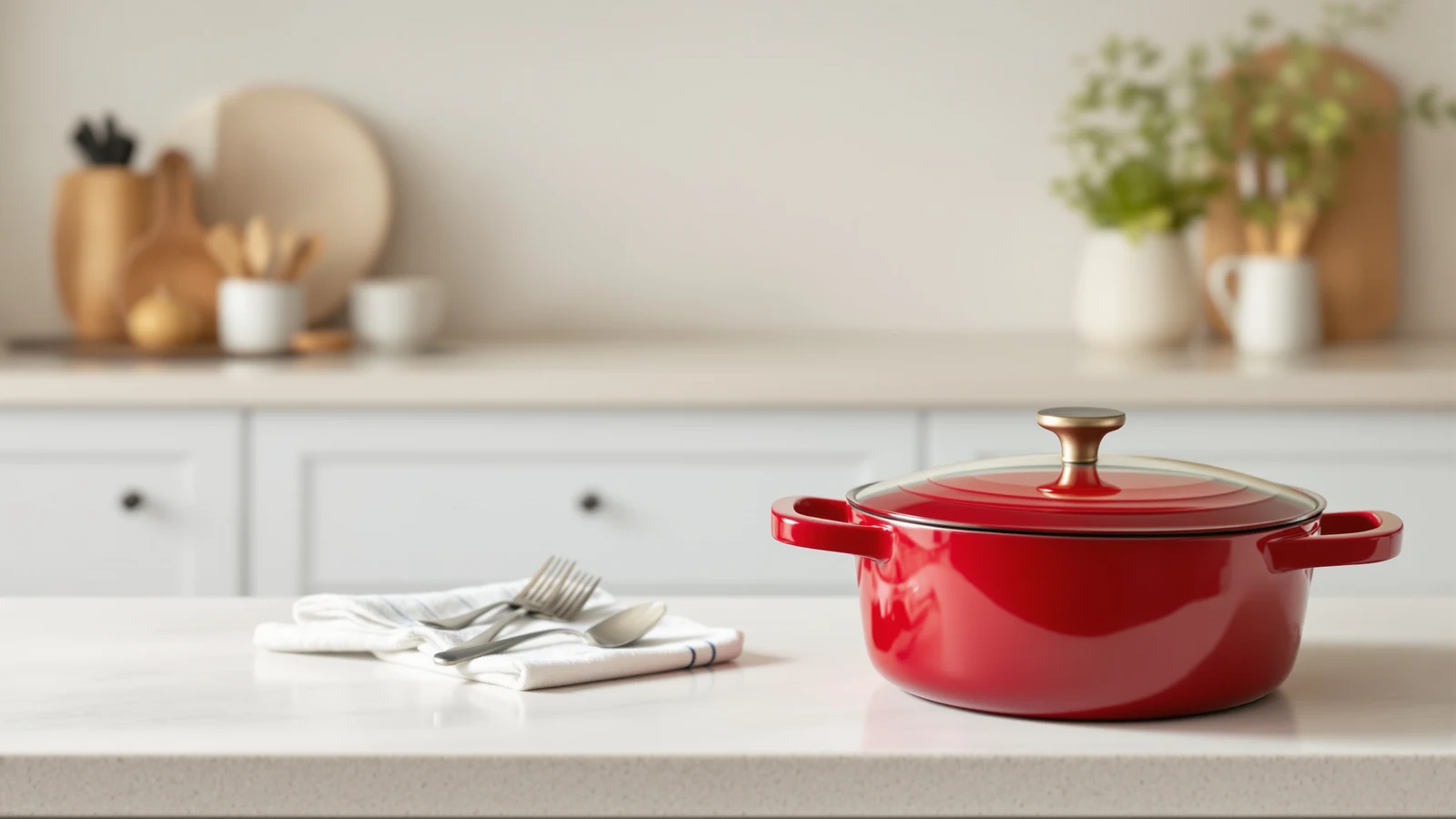
Two Staub cherry-red cast iron cocottes side by side, one fitted with a cast iron lid and one fitted with a glass lid, on a kitchen counter
Where they're identical

The same pot, two lids, two prices

Set the lid question aside for a moment and the two Staub cocottes we're comparing here are the same object. Both are the cast iron round cocotte, made in France, in cherry, in the 4-quart size, listed as serving 3-4 people. The base, the walls, the enamel, the handles, the oven performance you'd get from the pot itself — none of that changes between the two listings. What changes is a single component bolted on top: a solid cast-iron lid on one, a lid with a glass insert on the other.

The cast-iron version (ASIN B003G65YQ0) is $149.95. The glass-lid version (ASIN B095Z4WVWH) is $199.95. That's a $50.00 difference — roughly a third more for the glass-lid cocotte over the otherwise identical cast-iron one. If you walked in assuming glass would be the budget option because it feels like a lighter, simpler material than cast iron, the pricing runs the other way. Staub is charging a premium for the window, not a discount for it.

That is the whole shape of this decision. You are not choosing between a premium pot and a cheap one. You are choosing between the standard cocotte and a $50 add-on that changes exactly one thing about how you cook with it: whether you can see inside without opening it.

What you lose

What a cast-iron lid's self-basting nodes do that glass can't

Staub's cast-iron lids are known for a specific design detail: the underside is cast with small, blunt spikes rather than left smooth. As steam rises off a braise and hits the cooler lid, it condenses on those spikes and drips back down onto the food in a steady rain, rather than running down the inside wall of the pot and pooling at the edges. Staub calls this a self-basting effect, and it is a real mechanical consequence of that textured cast-iron surface — it is also the signature feature that separates Staub's lid design from a flat one.

A glass lid cannot physically replicate that texture. Glass that is cast or molded with a spiked underside would be harder to manufacture, more fragile at the spike tips, and would defeat the entire point of using glass, which is to stay smooth and transparent so you can see through it. So the trade is specific and real: the cast-iron lid is actively redistributing moisture back onto your braise throughout the cook, while the glass lid is a passive window that lets steam condense and run wherever gravity takes it, same as any ordinary glass pot lid would.

For a quick sauté or a simmer you're stirring every few minutes anyway, this difference barely registers — you're already managing moisture by hand. For a four-hour pot roast you intend to leave alone, the self-basting lid is doing real work the entire time you're not in the kitchen. That is the single clearest mechanical argument for paying less and keeping the cast-iron lid, not more for the glass one.

The habit it changes

Watching a braise versus trusting the clock

Every cast-iron-lidded Dutch oven asks you to cook partly on faith. You season the meat, sear it, add the liquid, put the lid on, and from that point forward you are mostly going on the recipe's timing and your own sense of how the kitchen smells. Checking means lifting a heavy lid, which releases the steam you've been trying to trap, and resetting whatever timing assumption that steam loss just invalidated. Most people check less than they'd like to, specifically because checking has a cost.

A glass lid removes that cost for the one thing you can actually see: is it bubbling, is the liquid level dropping, has something started to catch at the edges. You can glance at a glass-lidded cocotte the way you'd glance at a stovetop pan, without opening anything or losing a gram of steam. That is a genuinely different cooking experience for anyone who finds themselves nervous about an unseen pot, or who is still learning how a particular cut of meat behaves and wants the feedback.

What it does not give you is more information than a thermometer or a timer would. You can see that the braise is simmering, not whether the collagen has broken down enough, and you can see the liquid level, not the internal temperature. The glass lid satisfies a specific anxiety — not knowing what's happening in there — more than it improves the actual outcome of the dish. If you already cook by time and trust the process, that anxiety isn't costing you anything, and the window is solving a problem you don't have.

The physics of it

Heat loss through glass, and whether it matters

Cast iron and glass behave differently as materials: cast iron is dense and holds a large amount of heat for its size, which is the entire reason cast-iron cookware exists, while glass is lighter and generally a less effective insulator against temperature swings. On a lid-for-lid basis, a glass lid could reasonably be expected to shed a bit more ambient heat than an equally sized cast-iron one, and to let you see a slightly earlier dip in surface simmer if the kitchen is cold.

In practice, the lid is a small fraction of the thermal mass of the whole cocotte. The bulk of the heat retention in any Staub cast-iron pot comes from the thick walls and base, which is the part that doesn't change between these two listings — both pots have the identical cast-iron body. A lid sheds some heat regardless of what it's made of, since it's the thinnest part of the vessel and the part most exposed to room-temperature air above the stovetop or outside the oven. The marginal difference between a cast-iron lid and a glass one sits on top of that baseline, not instead of it.

For a low, slow braise in an oven with the door shut, that marginal difference is unlikely to change your result in any way you'd notice without a thermometer running the whole time. For a dish you're simmering on the stovetop with the lid ajar or loosely seated, any lid material loses heat quickly regardless, and the glass-versus-iron question becomes largely academic. The honest summary: glass probably loses a little more heat than cast iron, lid for lid, and the body of the pot is doing most of the work either way.

The number that surprises people

Why the glass-lid version costs more, not less

It would be reasonable to expect the glass-lid cocotte to be the cheaper of the two. Glass sounds like a lighter, simpler substitute for a solid cast-iron casting, and in a lot of cookware categories, a glass lid is in fact the basic, low-cost option bundled with an inexpensive pot. That intuition doesn't hold here. The glass-lid Staub cocotte is $199.95 against $149.95 for the cast-iron-lidded one in the same color and size — fifty dollars more, not less.

The likely reason is that this isn't a simple swap of materials at equal cost. A Staub glass lid has to be engineered to seal against the same enameled cast-iron rim, survive oven heat, and ship without arriving cracked — a tempered or reinforced glass insert built to those tolerances isn't automatically cheaper than a casting from the same foundry that already makes the rest of the pot. Staub is also selling the glass lid as a feature, not a cost-cutting measure: the ability to watch a braise is the entire marketed benefit of the variant, and it's priced accordingly, as an upgrade rather than a substitution.

Whatever the manufacturing reasoning, the practical takeaway for a buyer is simple: don't assume the glass-lid cocotte is the value pick because glass feels like the plainer material. On the current pricing, it is the premium option, and the cast-iron lid — with the self-basting spikes included — is both the cheaper pot and the one doing more work during a long cook.

Side by side

The two lids, and the color alternative

CocotteBest forLidColorCapacityPriceGet it
Staub 4-Qt Round Cocotte, Cherry Long braises, lowest price Cast iron, self-basting spikes Cherry 4 qt, serves 3-4 $149.95 Get it
Staub 4-Qt Round Cocotte, Glass Lid Watching the braise Glass insert Cherry 4 qt, serves 3-4 $199.95 Get it
Staub 4-Qt Round Cocotte, Graphite Grey Cast iron in a different color Cast iron, self-basting spikes Graphite Grey 4 qt, serves 4-6 $149.95 Get it

The graphite grey listing states "serves 4-6" against the cherry cast-iron listing's "serves 3-4" at the identical 4-quart capacity — a difference in how the two listings describe servings, not a difference in how much the pot actually holds. Check the current listing for the figure you want to rely on.

The picks

The picks, by whether you actually lift the lid to check

01Best if you trust the clock

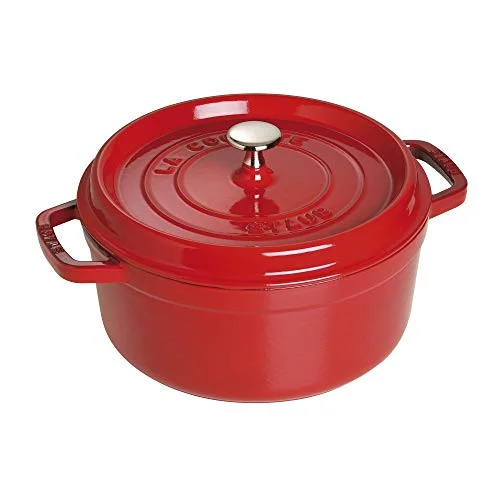
Staub Cast Iron Dutch Oven 4-Qt Round Cocotte, Cherry

Best for cooks who set a timer and walk away

4 quarts·Made in France·Self-basting cast-iron lid·Serves 3-4

At $149.95 this is both the cheaper of the two lid options and the one doing active work during a long braise: the spiked underside of the lid collects condensation and returns it to the food instead of letting it run to the edges. If you cook the kind of dish you put in the oven and don't touch for two or three hours — a pot roast, a bean stew, a whole braised chicken — this is the pot built for exactly that, and you save fifty dollars for choosing the option better suited to the job.

You don't need to see it simmering if you trust the timing. This is the lid that keeps working while you're not watching.

Staub cast iron cocotte with lid, cherry red
Price
$149.95
Check price →
02Best if you check constantly

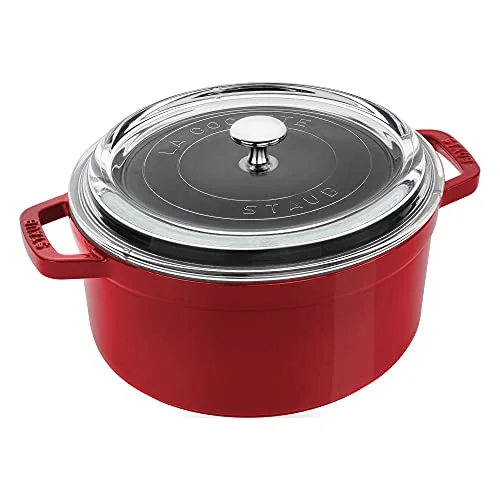
Staub Cast Iron Dutch Oven 4-Qt Round Cocotte with Glass Lid, Cherry

Best for cooks who want to see, not guess

4 quarts·Made in France·Glass lid·Serves 3-4

At $199.95, this is the same cocotte with the one change that matters to a specific kind of cook: the lid is glass, so you can watch the liquid level and the simmer without lifting it and losing steam. It gives up the self-basting spikes and, by the general behavior of the two materials, probably loses marginally more heat through the lid than the cast-iron version — a small trade against the much larger thermal mass of the pot body, which is identical either way. Worth the $50 premium specifically if not seeing inside the pot is the thing that bothers you while cooking.

You're paying fifty dollars to stop wondering, not to cook anything better.

Staub cast iron cocotte with glass lid, cherry red
Price
$199.95
Check price →
03Best if cherry isn't your kitchen

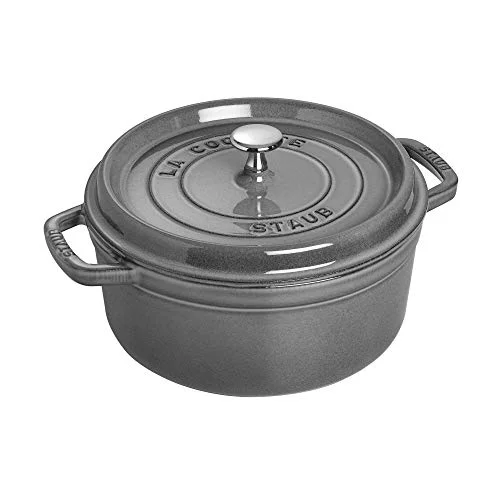
Staub Cast Iron Round Dutch Oven, Graphite Grey, 4-Qt

Best for the self-basting lid in a different color

4 quarts·Made in France·Self-basting cast-iron lid·Serves 4-6 per listing

Same price as the cherry cast-iron cocotte, $149.95, and the same self-basting lid design — the only real difference is the graphite grey finish instead of cherry red, which matters if you're matching existing cookware or just prefer a neutral color on the stovetop. The listing describes it as serving 4-6 rather than 3-4 at the identical 4-quart capacity, which looks like a difference in how the two listings are written rather than a difference in what the pot holds; check the current listing if the serving count matters to your decision.

If the glass window was never the appeal and cherry just isn't your color, this gets you the same lid design for the same money.

Staub cast iron cocotte with lid, graphite grey
Price
$149.95
Check price →
Putting it together

So which one is actually worth it?

Strip away the marketing framing and this comes down to a single honest question: do you lift the lid to check, or do you trust the clock? If you're the kind of cook who sets a braise going and checks it twice in four hours out of habit more than necessity, the cast-iron lid isn't costing you anything by staying opaque, and it's quietly doing more for the dish while it's closed. That's the $149.95 pick, and it's also the cheaper one, which makes it an easy default.

If you genuinely find yourself anxious about an unseen pot — worried about a boil-over, wanting to watch a sauce reduce, teaching someone to cook and wanting them to see what "simmering" looks like — the glass lid is solving a real problem for you, and $50 for that peace of mind is a reasonable trade, even though it costs you the self-basting effect and a small amount of extra heat retention. Neither choice is wrong. What would be wrong is buying the glass lid on the assumption that it's the cheaper, simpler option, when on the current pricing it's priced the other way around.

One more honest note, the kind we try to include whenever a listing differs in a way that's easy to overlook: the graphite grey cast-iron cocotte and the cherry cast-iron cocotte are priced identically and share the same lid design, so that choice is pure color preference. It's only the glass-lid variant that changes the fundamentals of how the pot behaves during a long cook, which is exactly why it's the one decision on this page worth thinking through rather than defaulting to.

Our method

How we compared

What we did

Specs and current prices, matched product to product

We compared the published specifications and current Amazon prices for Staub's 4-quart round cocotte across its cast-iron-lid and glass-lid listings, matching the cherry cast-iron pot against the cherry glass-lid pot specifically because they share color and capacity, which makes them the closest real comparison available. The graphite grey cast-iron listing is included as a color alternative at the same price point. Every claim about lid design, price, and capacity in this guide comes directly from what each listing states.

What we didn’t

We don’t run a testing lab

We do not physically test these pots, we do not own them, and we have no verified rating or review data for these specific listings to report, so we don’t publish any. The heat-loss comparison in this guide is reasoned from well-established, general differences between cast iron and glass as materials, not from a measurement we took ourselves — and we say so rather than present it as something we timed with a thermometer. See more about our approach on the About page.

FAQ

Common questions

Does the glass-lid Staub cocotte cost more or less than the cast-iron version?

More. The glass-lid 4-quart cocotte is $199.95, against $149.95 for the cast-iron-lid version in the identical cherry color and 4-quart size — a $50 premium for the glass lid, not a discount. If you expected glass to be the budget option, the pricing runs the opposite way.

Does a glass lid lose more heat than a cast-iron lid?

Likely a small amount more, lid for lid, since glass is generally a less effective insulator than dense cast iron. In practice the lid is a small fraction of the cocotte's total thermal mass — the thick cast-iron body, which is identical in both versions, does most of the heat retention regardless of which lid sits on top.

Does the Staub glass lid have the self-basting spikes?

No. The self-basting effect comes from small spikes cast into the underside of Staub's cast-iron lids, which collect condensation and drip it back onto the food. A glass lid is smooth on the underside so you can see through it, which means it cannot reproduce that effect — condensation on a glass lid simply runs down to the edges instead.

What color options come with the cast-iron lid?

The listings covered in this guide include cherry and graphite grey, both at $149.95 for the 4-quart round cocotte with the standard cast-iron, self-basting lid. The two colors are priced identically; the choice between them is cosmetic.

Keep reading

More from Best Dutch Ovens