WOKINS, NSIRONS and Other Unfamiliar Dutch Oven Brands: What to Check First
Search "Dutch oven" on Amazon today and the first page is not dominated by Lodge, Le Creuset or Staub. It is dominated by names most American kitchens have never heard of — WOKINS, NSIRONS, Miereirl, and a rotating cast of others that look nearly identical in the thumbnail. That is not automatically a red flag. It is also not automatically fine. We compared what three of these listings actually publish — price, capacity, oven-safe rating, seller terms — against what a shopper usually assumes a brand name is vouching for, to build a checklist that works regardless of whether you recognize the name on the box.
By Ilane Tall · Updated November 29, 2026 · Research-based.
Affiliate disclosure: we may earn a commission if you buy through the Amazon links on this page, at no extra cost to you.
How the search page works
Why unfamiliar names outrank Lodge in this category
Amazon's search ranking rewards the same things regardless of who is selling: a complete, keyword-matched listing, current stock, competitive price, and freshness. A brand like WOKINS or NSIRONS that lists aggressively — "7QT," "Dual Handles," "PFAS free," "oven Safe 500°F," "sourdough Bread," all stacked into the title — is simply matching more of what a shopper types into the search box than a legacy brand's shorter, more restrained title does. Lodge has been casting iron in Tennessee since 1896 and does not need its product title to do the convincing; a newer Amazon-native brand does, so it writes a title that reads like a specification sheet because that is also what the algorithm rewards.
There is also a simpler, less interesting reason: there are more of these listings than there are legacy brands, and enameled cast iron is cheap enough to manufacture at scale that dozens of similarly-specced pots compete for the same search terms. A newer name ranking well is not evidence of anything about quality one way or the other — it is evidence that the listing is well optimized and the price is competitive. Those are two different questions, and conflating them is exactly how a shopper ends up either overpaying for a familiar name or underpaying for something that was never actually a Dutch oven in the first place.
None of this means an unfamiliar brand is a worse pot. The cast iron itself is commodity material whoever casts it, and the enamel-over-iron construction is the same basic process at every price point. What it means is that the brand name on the listing is not doing the verification work a shopper might assume it is doing. You have to do that work yourself, from the parts of the listing that actually carry information: the published specs, the seller terms, and the photographs.
Read the spec, not the logo
What a published oven-safe temperature tells you, brand or not
The WOKINS 7QT listing states oven safe to 500°F. That is the single most useful line in the entire listing, and it has nothing to do with whether WOKINS is a company you have heard of. A 500-degree rating covers every braise, roast and bread recipe a home cook is likely to run, which is the same ceiling the better-known brands publish for their enameled lines. The number is checkable, specific, and either true or not — unlike a brand reputation, which you cannot verify from a product page at all.
This is the broader principle worth carrying into every unfamiliar listing: a number is worth more than a name. A seller who publishes an oven-safe figure, a quart capacity, and a material callout like PFAS-free enamel is giving you something to check against the physical pot when it arrives. A seller who leans entirely on lifestyle photography and adjectives is not. The Miereirl 6 Quart and NSIRONS 7 QT listings in this guide both state their capacity plainly and describe dual handles and enamel coating — exactly the specifics you want present regardless of whose name is on the box.
As with any Dutch oven, remember that the number that actually limits oven use is often not the pot body at all but the lid knob. A phenolic or plastic knob is typically rated lower than the cast iron and enamel underneath it. None of the three listings here give us a separate knob-specific rating, so if you intend to push a pot toward its stated ceiling for a long roast, check the current listing's Q&A section and photos for what the knob is made of before you do.
What actually protects you
Return window and seller rating, not brand history
A hundred-year-old foundry name is a proxy for trust, but it is a proxy you cannot verify from the listing page itself. What you can verify, every time, in under a minute, are two things Amazon surfaces for any seller regardless of brand age: the return window and the seller's own rating and order-defect history, both visible before you click buy. A 30-day return window with a straightforward process protects you from a cracked pot, a mis-measured capacity, or enamel that looks different in person than in the listing photos — and it protects you identically whether the brand has existed for five years or a hundred and thirty.
This matters more, not less, for a newer name, because a legacy brand's history is at least evidence it has survived years of returns and reviews across many products. A newer brand hasn't accumulated that evidence yet, which is exactly why the return terms and current seller metrics are doing more of the protective work for you on a WOKINS or NSIRONS purchase than they would on a Lodge purchase. Read the specific return policy attached to the listing, not Amazon's general policy from memory — third-party sellers can and do set narrower windows than Amazon's own retail arm.
If you want the version of this decision with more of that history already built in, the Dutch ovens under $100 guide covers three pots, including a Lodge, that trade almost no price for a century-plus of returns and reviews behind them. That is a legitimate reason to pay slightly more. It is just a different trade-off than the one this guide is examining, not a verdict against the newer names.
The listing photos are a data source
Reading the photos for welds, overspray and enamel pooling
On an unfamiliar-brand listing, the product photography is doing double duty as marketing and as your only pre-purchase inspection of the actual object. Zoom into the close-up shots, not just the hero image, and look specifically for three things. First, the rim where the lid meets the pot: enamel should end in a clean, even line at the unglazed cast-iron rim that most enameled Dutch ovens leave bare for direct metal-on-metal contact with the lid; a ragged or inconsistent line there suggests inconsistent application. Second, overspray or pooling — enamel that has run and thickened unevenly in a corner, or visibly thinned patches near the handles, both signs of a rushed coating process rather than a defective unit, since it shows up across the whole production batch in the same photo.
Third, the handle welds and the handle-to-body transition. A well-made dual-handle pot has a handle that reads as a continuous casting or a clean, flush weld; a poor one shows a visible seam, uneven gap, or paint bridging a joint that should be bare iron. None of this requires any special expertise — it requires zooming in on photos the seller chose to include, on the assumption that most shoppers won't look that closely. For the WOKINS and NSIRONS listings referenced in this guide, both show full-pot and lid-detail shots; use those images exactly this way before you buy, rather than relying on the thumbnail.
This is also where a legacy brand's photography habits differ in a way worth noticing: established manufacturers more often show the interior cooking surface and a plain, unstyled shot of the bare pot, because they are less dependent on lifestyle staging to make the sale. A listing with only styled, distant, or heavily filtered photos and no clean interior shot is giving you less to inspect, and that absence is itself worth weighing against the price.
New is not the same as risky
When "no reviews yet" just means new, not risky
A listing with zero reviews reads, to most shoppers, as a warning sign. Often it just means the listing is recent. Amazon's enameled Dutch oven category turns over constantly — sellers launch new color variants, new sizes, and near-identical listings under slightly different brand names on a regular basis, and every one of those starts at zero reviews regardless of whether the underlying product and factory are the same ones behind an established, well-reviewed listing. A brand-new ASIN from a seller who has other, reviewed products in the same category is a materially different situation from a brand-new seller account with a brand-new product and nothing else to check.
What actually separates "new" from "risky" is checkable without any reviews at all: does the seller have other listings, and what do those look like; is the listing's specification set complete and specific rather than vague; does the price sit in a plausible range for the stated capacity and materials, rather than suspiciously far below every comparable pot. A dual-handle 7-quart enameled cast iron pot priced dramatically under the roughly $45 to $65 range that competent budget pots in this category occupy is a reason to slow down, independent of review count. Priced in line with that range, a zero-review listing from a seller with an otherwise normal storefront is simply new, not inherently a worse purchase.
We are not going to paraphrase review sentiment for any of the three products named in this guide, because we don't have verified review data to paraphrase honestly for them — that would be inventing a signal we don't have, which is the same offense as inventing a star rating. What we can tell you is to treat review count as one input competing with several others, not the only one.
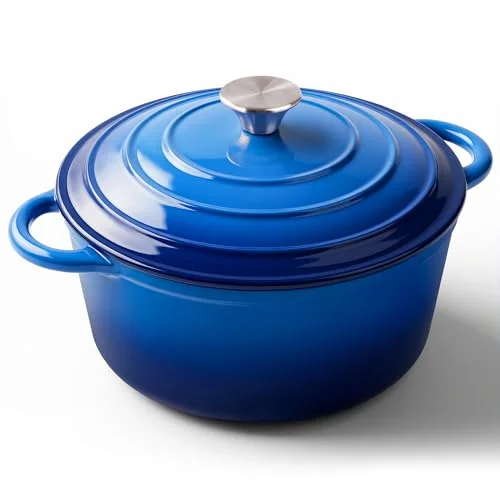
At $45.99, this is the cheapest of the three pots in this guide and the one with the shortest, plainest listing title — no stacked keyword list, just capacity, construction and intended uses: bread baking, cooking, with dual handles for carrying. What convinced us on paper is exactly that restraint: the specification set is small but specific rather than padded, and six quarts is a genuinely useful, broadly applicable size rather than an oversized number chosen to look impressive. The listing does not publish an oven-safe temperature figure, which is the one gap to close yourself by checking the current page before buying, not a disqualifier on its own.
The lowest price on this page and still a complete-enough spec sheet to check it against.
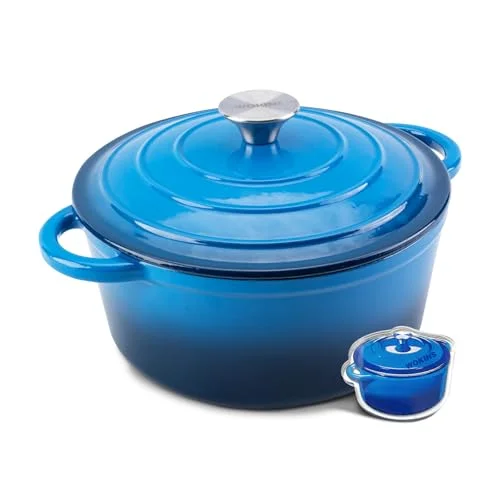
WOKINS Enameled Cast Iron Round Dutch Oven, 7QT, Blue
Best if a published temperature ceiling matters to you
7 quarts·Oven Safe 500°F·PFAS free·$52.99
WOKINS earns its spot here on one line in the listing: oven safe to 500°F, stated outright rather than left for a shopper to guess. Combined with a PFAS-free callout on the enamel and dual handles at seven quarts, this is the most completely specified of the three listings — capacity, temperature ceiling, and a material claim all stated in the title itself, which is unusual restraint for a listing that is otherwise keyword-dense. Seven quarts is a genuinely large pot, worth it mainly if you cook for five or more; smaller households are better served by the 6-quart Miereirl above.
The one of the three that actually tells you, in writing, how hot you can run it.
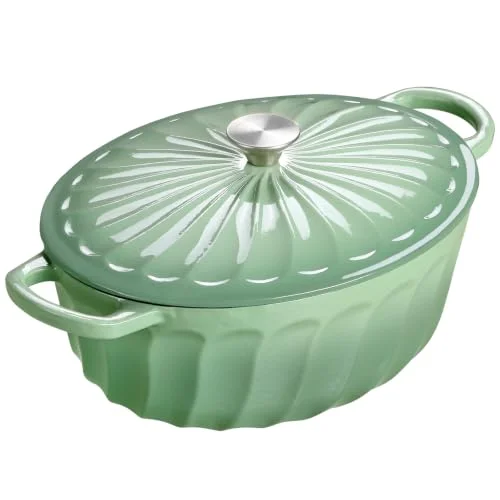
The highest price of the three at $56.99, and the only one of them built oval rather than round — a real functional difference, since an oval pot suits a whole fish or a long roast that a round pot wastes space around, not just a styling choice. The listing states capacity, shape and dual-handle construction plainly, which is what we are weighing it on; it does not state an oven-safe temperature in the specifications we have on file, so treat that the same way as the Miereirl above and check the current listing before pushing it toward a high-heat roast. If shape is what you are shopping for, this is the only oval option among the three.
The only oval pot on this page, priced at the top of a narrow $12 range between all three.
We compared the published specifications and current Amazon prices for the Miereirl 6 Quart, WOKINS 7QT and NSIRONS 7 QT, limiting every claim in this guide to what each listing actually states: capacity, shape, oven-safe temperature where given, handle configuration, and enamel material claims. Where a listing does not publish a figure — an oven-safe temperature, a handle measurement — we say so plainly rather than estimate it from a similarly priced pot. We also weighed the general, checkable factors that apply to any unfamiliar-brand listing on Amazon regardless of these three specific products: return window, seller history, and what the product photography does or doesn't show.
What we didn’t
We don’t run a testing lab
We do not physically test these pots, we do not own them, and we have no verified star ratings or review counts for these specific listings to report, so we don’t invent any. Whether a given unfamiliar brand's enamel holds up over years of use is a question nobody can answer honestly from a few weeks with one unit, including anyone claiming to have personally put a pot this cheap and this new to market through years of use already. What we can do is read every specification these sellers actually publish, compare them against each other and against the better-known brands covered elsewhere on this site, and tell you plainly where the information runs out. See more on the About page.
FAQ
Common questions
Are unfamiliar Dutch oven brands on Amazon safe to buy?
Often, yes, judged on the same basis you would judge any kitchen purchase: a complete specification set, a reasonable price for the stated capacity and materials, a workable return window, and a seller with an otherwise normal storefront. The brand name itself is not a safety mechanism one way or the other — a published oven-safe temperature and a 30-day return window protect you regardless of whether the name is WOKINS or Le Creuset.
Why do brands like WOKINS and NSIRONS outrank Lodge in search?
Mostly listing optimization and price competition, not quality. Amazon's search ranking rewards keyword-complete titles, competitive pricing, and listing freshness. A newer brand's title reads like a specification sheet because that is what both shoppers searching by keyword and the ranking algorithm respond to; an established brand like Lodge relies more on existing reputation and does not need to over-stuff its title to convert a sale.
What should I check before buying an unfamiliar-brand Dutch oven?
In order: whether the listing states a specific oven-safe temperature, the seller's return window and current rating, the production photos zoomed in for enamel evenness and clean handle welds, and whether the price sits in a plausible range for the stated capacity rather than suspiciously low. Review count matters less than these four, especially for a recently listed product.
Does "no reviews yet" mean a product is risky?
Not by itself. Amazon's enameled Dutch oven category sees constant new listings, including color variants and near-duplicate products from sellers with other, already-reviewed items. A zero-review listing from a seller with a normal storefront and a plausibly priced, fully specified product is usually just new. A zero-review listing priced far below every comparable pot, from a seller with no other visible history, is the combination worth treating as risky.