Roundup · Enameled Cast Iron Under (and Just Over) $50
Cheap Dutch Ovens That Are Still Worth Buying
Above about ninety dollars, you are choosing between Lodge, Le Creuset and Staub — names with foundries and decades behind them. Below fifty, the names change: CAROTE, Parmedu, a second and unrelated Amazon Basics listing. The iron inside is still iron. What changes is how much the manufacturer bothers to publish about it. We compared the specifications and current prices for three enameled cast-iron pots at the bottom of the market, to find out which ones still tell you enough to buy with confidence.
By Ilane Tall · Updated October 24, 2026 · Research-based.
Affiliate disclosure: we may earn a commission if you buy through the Amazon links on this page, at no extra cost to you.
Where the corners get cut
What Disappears First Below $50
The first thing that disappears below fifty dollars is not quality you can see in a photograph. It is documentation. A Lodge or an Amazon Basics pot sold near the $90 mark tends to come with a specific, printed oven-safe temperature, because the manufacturer has the confidence — or the legal incentive — to state one. Of the three pots in this guide, only the CAROTE 5QT and the Amazon Basics 6-Quart sold under ASIN B0G1LKBYK7 give us a capacity and a build description in their listing titles; neither gives us a specific degree figure in what we have on file, which is a different situation from the pricier Amazon Basics listing this site has reviewed elsewhere, where 500°F is printed outright. Two products from the same store brand, two different levels of disclosure — that is the pattern to expect under $50, and it is worth reading the current listing yourself before you put any of these pots under a broiler, rather than assuming a number nobody has committed to in writing.
Shape disappears next. All three pots here are round. At this price tier you will struggle to find an oval option with a published provenance, because the tooling for an oval casting is more expensive to run and the brands competing at $35.99 are optimizing for the lowest number on the box, not for a roast that needs the extra length of an oval. If the shape of the pot matters to how you cook, that is a reason to look above this price band, not a flaw specific to any one of these three.
Brand history disappears too, and that is a real trade rather than a marketing one. Lodge can point to a foundry running in Tennessee since 1896. CAROTE and Parmedu are newer names without that kind of public track record, and we have no independent lab data, rating, or review history for either of them to lean on. That does not make either brand's cookware bad — cast iron is a commodity material and enamel-on-iron is a well-understood process that smaller manufacturers can execute competently — but it does mean the purchase decision has to rest on what is actually printed in the listing: capacity, finish, included lid, stated purpose. Where that information is missing, we say so plainly rather than fill the gap with a guess.
What a lower price buys, and doesn't
The Enamel at This Price: What to Expect
We have no verified review data tied to these three specific listings, and we are not going to invent any — no paraphrased owner sentiment, no star rating pulled from thin air, nothing attributed to a buyer we cannot point to. What we can describe honestly is how enamel-on-cast-iron behaves as a category, because the chemistry does not change based on what a pot costs. Enamel is glass fused to iron at high heat. Glass is hard and largely inert — it will not rust, and it will not react with an acidic tomato sauce the way bare iron can — but it is not flexible, and its most common failure mode across every brand, expensive or cheap, is chipping at the rim or the interior base from a metal spoon, a hard knock against a faucet, or a sudden swing in temperature.
None of the three pots here publish an independent figure for chip resistance, and that is not unusual: almost nobody does, at any price, including the $300 French brands compared elsewhere on this site. What a higher price more reliably buys is a warranty and a manufacturer willing to put its name behind a specific claim about durability. At $35.99 to $39.99, none of these three listings make that kind of claim, which is simply honest: a newer or smaller brand has less incentive and less data to back a multi-decade promise the way a 130-year-old foundry does.
The interior color is the one enamel detail each listing does state. CAROTE's pot is cream white, Parmedu's is white, and the Amazon Basics 6-Quart is linen gray. A lighter interior lets you watch a sauce reduce or a fond develop, which is a genuine cooking convenience and not just an aesthetic choice — it is also the same logic premium brands use when they default to a pale interior. At this price, you are getting that visual benefit without the warranty that usually comes attached to it. Caring for the enamel the same way you would on a $300 pot — wood or silicone utensils, no cold water on a hot surface, hand washing when you can manage it — is the one lever within your control, regardless of brand.
Read the listing, not the price
The Specifications Still Worth Demanding
Even at the bottom of the market, a handful of specifications separate a pot worth buying from one you are guessing about. Capacity is the first and most reliable: all three pots here state it plainly, in quarts, and all three numbers check out against the size the pot is marketed for — 5 quarts for the CAROTE, 6.0 quarts for the Amazon Basics, 5.5 quarts for the Parmedu. A listing that is vague about capacity, or states it only in liters with no quart conversion, is a listing worth skipping regardless of price.
The lid is the second. None of these three publish anything about spiked or self-basting lid geometry — that is a design feature specific to premium brands like Staub, built for long braises, and it genuinely is not present at this price. What you can still confirm is that a lid is included and that it is described as fitting snugly; a loose-fitting lid lets moisture escape during a long braise regardless of what the pot costs.
Stated purpose is the third, and it is the one place a budget listing can actually beat a generic one. The Parmedu 5.5QT is sold specifically for sourdough bread, which tells you the manufacturer sized and marketed the pot around one well-understood use case: trapping the steam a loaf releases in its first fifteen minutes to produce a bakery-style crust. The Amazon Basics 6-Quart states dual handles and a heavy-duty, round build intended for stews, roasting and baking in its own title — a general-purpose claim, but a stated one. When a listing names its purpose outright, take it at its word; when it doesn't, don't assume one.
What none of these three state is a handle measurement in inches or a specific maximum oven temperature. We will not estimate either figure for you. If a 400-degree roast or a tight cupboard clearance matters to your kitchen, open the current Amazon listing and look for photographs that show scale, or message the seller directly, rather than relying on a number this article does not have.
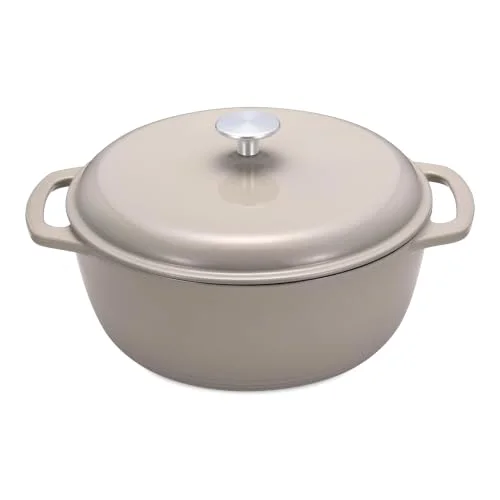
Amazon Basics Enameled Cast Iron Dutch Oven Pot With Lid, 6-Quart, Round, Dual Handles, Heavy-Duty, Linen Gray
Best overall under $50
6.0 Qt·Dual handles·Linen gray enamel·Round
At $47.49, this is a full six-quart pot — the size most households actually reach for — for roughly half of what the better-documented six-quart Lodge on this site costs. Dual handles are named outright in the listing title, which matters more than it sounds: a full pot of stew coming out of a hot oven in thick mitts is exactly where a single small handle becomes a real problem, and this one is built with two. The honest gap is temperature: this particular listing does not give us a specific oven-safe figure the way Amazon's own costlier 6-quart pot does, so confirm the current number on the listing before pushing it into a high-heat roast or broil.
Full capacity, two handles, no ceremony. Check the oven-safe figure on the listing before you push it hard.
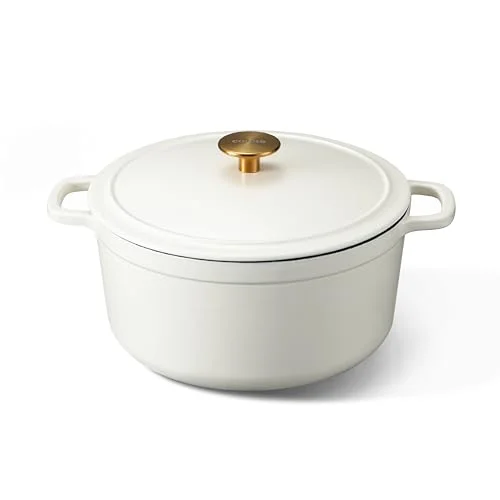
CAROTE 5QT Cream White Enameled Cast Iron Dutch Oven Pot with Lid
Best for the tightest budget
5 quart·Cream white enamel·Lid included·Round
Thirty-six dollars and nine cents is the floor of this roundup, and five quarts is a sensible size for two to three people rather than a compromise — it fits a standard oven shelf with room to spare and is genuinely easier to lift full than a six- or seven-quart pot. CAROTE is a newer name than Lodge or Amazon Basics and we have no independent rating or review history to cite for it, so this is a purchase to make on the published specification — capacity, finish, lid — rather than on brand reputation, which simply does not exist yet at the length Lodge's does.
The cream white finish echoes the premium brands. The thirty-six-dollar price tag does not pretend to.
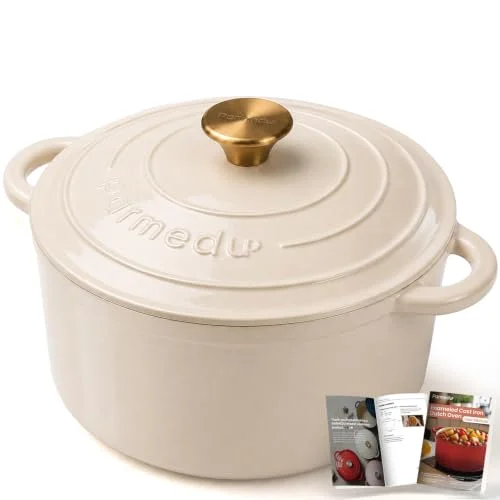
Parmedu 5.5QT Enameled Cast Iron Dutch Oven for Sourdough Bread, White
Best if bread is the reason you want one
5.5 quart·Sold for sourdough·White enamel·$39.99
This is the one pot in the guide that crosses fifty dollars, by ten, and it earns the crossing by being built and marketed around a single job rather than a general one. Trapping the steam a loaf of sourdough releases in its first fifteen minutes is what gives a home oven the kind of crust a bakery gets from a steam-injected deck, and any heavy, well-lidded cast-iron pot does this — Parmedu has simply sized and priced one specifically for it, at 5.5 quarts, which suits a standard boule. If baking bread is the actual reason you are shopping for a Dutch oven, it is worth the extra cost over the two pots above; if you mainly braise and roast, either of the first two picks does that job for less.
Ten dollars over the line for a pot that was actually built around one specific job.
The iron underneath any of these three pots is not the part that wears out. Cast iron, once cast, does not meaningfully degrade from ordinary stovetop and oven use regardless of what the pot cost; the failure point across the whole enameled category is the glass layer on top of it, and specifically the rim and the interior base, where a metal spoon or a hard knock against a faucet does the actual damage. That physics is identical whether the pot is a $35.99 CAROTE or a $300 French import, which is the honest version of "you get what you pay for" at this price point: you are not buying worse iron, you are buying less certainty about how the glass on top of it was applied and how long it has been tested in the field.
With the basic care routine — wood or silicone utensils, no cold water shocked onto a hot surface, and a hand wash when you can manage it instead of a dishwasher cycle — enameled cast iron routinely stays usable for a decade or more across the category, including the budget tier. What a newer brand like CAROTE or Parmedu cannot offer, simply because the company and the product are both younger, is a long public track record or a multi-decade warranty the way Lodge or the French brands can. That is a real gap, and the honest way to close it is to treat any enamel gently from the first use rather than assume thirty-nine dollars buys a pot you can be careless with.
None of the three listings here publish a warranty term we can report, so we are not going to guess at one. If a specific warranty period matters to your decision, it is worth reading the current Amazon listing or the manufacturer's own page directly — that information changes more often than a capacity figure does, and we would rather point you to the source than print a number that might already be out of date.
A deliberate strategy, not a compromise
Buying Cheap First, Deliberately
There is a real argument for starting here rather than treating a budget pot as a placeholder until you can afford something better. A Dutch oven is a specific kind of commitment — it is heavy, it takes up a dedicated piece of cupboard space, and plenty of people buy one with good intentions and then use it twice a year. Forty dollars is a reasonable price to pay to find that out about your own kitchen. If a six-month stretch with the Amazon Basics 6-Quart or the CAROTE 5QT tells you that you braise and bake constantly, that is useful information bought cheaply, and it makes the eventual case for a larger or more expensive pot a decision based on actual habit rather than a guess made in a kitchen showroom.
The opposite mistake is just as common: spending $300 on a pot that sits in a cupboard because the kitchen reality turned out to be a once-a-month stew rather than a weekly braise. Buying cheap first is not settling for less — it is sequencing the spend to match the evidence you actually have. None of the three pots in this guide are a downgrade from a $300 pot in the sense that matters for most cooking: the iron holds heat the same way, the enamel is ready to use with no seasoning, and all three are genuinely capable of a Tuesday-night braise.
What you give up by buying cheap, deliberately, is the documentation and the warranty, not the cooking. That is a fair trade for someone who is still finding out how much they will use a Dutch oven, and a bad one for someone who already cooks in cast iron every week and would rather pay once for a pot they will not think about again.
Our method
How we compared
What we did
Specs and current prices, nothing assumed
We compared the published specifications and current Amazon prices for the CAROTE 5QT, the Amazon Basics 6-Quart (ASIN B0G1LKBYK7) and the Parmedu 5.5QT, limiting every claim in this article to what each listing actually states — capacity, finish, included lid, stated purpose, and price. Where a figure such as an oven-safe temperature or a handle measurement is not published for a given pot, we say so directly rather than borrow a number from a similar-looking product or a different listing from the same brand.
What we didn’t
We don’t run a testing lab
We do not physically test these pots, we do not own them, and we have no star ratings or review counts for these specific listings, so we report none. The questions that actually decide whether a cheap Dutch oven was worth it — how the enamel chips after two years of real cooking — cannot be answered honestly by anyone with a pot for a fortnight, us included. What we can do is read the categorical, well-established facts about how enameled cast iron ages and report those plainly, rather than invent product-specific sentiment we do not have. More on our approach on the About page.
FAQ
Common questions
Are Dutch ovens under $50 actually enameled cast iron, or something else?
Based on their published listings, yes — the CAROTE 5QT and the Amazon Basics 6-Quart (B0G1LKBYK7) are both described as enameled cast iron, the same material used by the premium brands compared elsewhere on this site. The casting process and the glass-fused-to-iron enamel are not simplified or substituted at this price; what changes is how much the manufacturer documents about build quality, warranty and oven-safe limits, not the underlying material.
Which of these three should I buy?
The Amazon Basics 6-Quart at $47.49 is the safest default: a full six-quart capacity with dual handles named outright, for close to half the price of better-documented six-quart pots. Choose the CAROTE 5QT at $35.99 if your household is two to three people and you want the lowest price in this guide. Choose the Parmedu 5.5QT at $39.99 if baking sourdough bread is specifically why you want a Dutch oven — it is the only one of the three built and marketed around that one job.
Do unfamiliar brands like CAROTE or Parmedu need to be treated differently from Lodge or Amazon Basics?
Mainly in how you evaluate the purchase, not in how you use the pot once it arrives. Lodge can point to a foundry history stretching back to 1896 and a long public track record; CAROTE and Parmedu are newer names without that history, and we have no independent rating or review data to cite for either. That means basing the decision on the published specification — capacity, finish, included lid, stated purpose — rather than on brand reputation, and treating the enamel with the same gentle care you would use on any enameled pot regardless of price.
Is $39.99 still "cheap" for a Dutch oven?
Relative to the $90 to $340 range most of this site compares, yes — $39.99 is still well under the price of a Lodge Essential or any French brand. We included the Parmedu 5.5QT at that price specifically because it is the only one of the three pots built and sold around a single stated purpose, sourdough bread, and that specificity is worth paying more than the two pots priced under fifty. If fifty dollars is a hard ceiling, the CAROTE 5QT and the Amazon Basics 6-Quart both stay under it.