Best Dutch Ovens
Roundup · Small-Capacity Dutch Ovens

The Best Small Dutch Ovens for Tiny Kitchens and Small Ovens

Four quarts fits where six will not: a studio oven, an RV cooktop, a single gas burner that can't support the weight of a full-size pot. We compared published specs and current prices on three small Dutch ovens, from a $29 basic to a $395 designer cocotte, to find out exactly what a smaller pot gives you and what it quietly takes away.

By Ilane Tall · Updated October 26, 2026 · Research-based.

Affiliate disclosure: we may earn a commission if you buy through the Amazon links on this page, at no extra cost to you.

Small enameled cast iron Dutch ovens on a compact kitchen counter next to a narrow oven
Start here

Who actually needs four quarts instead of six

Most Dutch oven advice assumes a full-size kitchen: a 30-inch range, a family of four, a pantry shelf with room for a nine-pound pot. That is not everyone's kitchen. A small Dutch oven in the 4-quart range earns its place for a specific, recognizable set of situations, not as a lesser version of a bigger pot but as the correctly-sized tool for a smaller job. If you live alone or as a couple, braise for one or two people most nights, and only occasionally cook for a crowd, a six or seven-quart pot spends most of its life mostly empty — and a mostly-empty Dutch oven on the stovetop just means more exposed cast iron losing heat around the food instead of holding it in.

The clearest case for going small is physical space. A studio apartment oven, an RV or camper oven, a dorm-style combination unit, or a narrow 20-inch range all have cavities that a 6 to 7-quart oval or round Dutch oven may not clear with its handles attached. A 4-quart pot, by contrast, is sized closer to a stockpot you already own, which means it is far more likely to fit a shallow or narrow oven cavity, a cramped lower cabinet, or a shelf with 10 inches of clearance rather than 14.

The second case is weight and strength. Cast iron is dense, and a full six-quart enameled pot with a lid and a braise inside it can run past 15 pounds. For anyone managing a wrist or shoulder injury, an older cook, or simply someone who does not want to wrestle a hot, heavy pot out of the oven one-handed, a 4-quart pot loaded with dinner for two is meaningfully lighter and easier to control safely. The two Amazon Basics pots in this guide, both at 4.3 quarts, sit in exactly this lighter, easier-to-handle category, and the lid and knob you are lifting matters just as much on a small pot as a large one.

The third case is simply portion honesty. If you consistently cook for one or two people, a 4-quart pot holds roughly the right amount of a stew, a braised chicken thigh dinner, or a small loaf of bread without leaving two-thirds of the pot's interior surface unused — and an oversized pot for a small portion is also an oversized pot to scrub afterward.
Measure twice

What fits in a small oven, and what does not

None of the three products in this guide publish exterior diameter in the specifications available to us, which is a real limitation and one we are not going to paper over with a guess. What we can tell you, honestly, is how to think about the fit problem before you buy, because the math is the same regardless of brand. A Dutch oven's footprint is not just its base diameter; it is the base diameter plus however far the two side handles stick out past the body on each side, plus a little clearance so you can actually get your mitted hands in to grip them. A pot described as "4.3-quart, round, dual handles" is very likely narrower overall than any 6 or 7-quart round pot, simply because volume scales with the cube of the radius — a modest reduction in diameter removes a disproportionate amount of capacity, which is exactly why a 4-quart pot clears space problems that a 6-quart pot cannot.

The practical step, for any small-oven buyer, is to measure your own oven's interior width, depth and height with the racks set at the position you intend to use, and separately check the current Amazon listing for that specific pot's exterior dimensions, since listed dimensions are kept more current there than in any specification sheet we could reproduce here. Do this before ordering, not after, because repackaging a nine-pound cast iron pot for a return is its own small chore.

One more detail worth knowing: a smaller pot does not need a smaller oven to be the right choice. Plenty of small-oven buyers have a perfectly standard 30-inch range and choose a 4-quart pot anyway, for the weight and portion reasons above. The oven-fit case and the household-size case are separate arguments that happen to point at the same pots.

The daily use case

Searing a weeknight dinner for one or two

The single most common thing a small Dutch oven actually does, night after night, is not a holiday braise — it is browning two chicken thighs or a pound of ground meat on the stovetop, deglazing, and finishing in the oven for thirty to forty minutes. A 4-quart pot is well matched to this job specifically because its base is smaller: the same burner heat is concentrated over less surface area, so a stovetop sear comes up to temperature with less preheating than it would in a wide six-quart base built to feed six. Enameled cast iron, at any size, holds that heat evenly once it arrives, which is the entire point of choosing cast iron over a thin stainless pot for this step.

Dual handles, which both Amazon Basics 4.3-Quart pots in this guide specifically advertise, matter more on a smaller pot in daily use than people expect: a round dual-handle pot moves from stovetop to oven and back to a trivet on the counter several times in one dinner, and a symmetrical two-handed grip is the safer way to make each of those short trips, especially one-handed-feeling moves like tilting the pot to plate a sauce. None of the three listings here publish a lid-knob material, so if you plan to finish a sear under a broiler or push past 450°F, check the current listing for that detail rather than assume it matches a sibling product, the same caution that applies on any Dutch oven, large or small.

The Le Creuset Signature Pumpkin Cocotte at 4 quarts does the identical job — sear, deglaze, braise — with the same physics, since it is also enameled cast iron. What that pot adds is not better browning; it is a different interior enamel formulation the brand markets as more resistant to staining and scratching over time, a published lid-knob rated for higher oven heat, and a design the brand backs with a long warranty. Whether that is worth roughly ten times the price of the Amazon Basics pots is a question we answer honestly further down this page.

The honest tradeoff

Where a small pot runs out of room

Four quarts is not a universal size, and pretending otherwise would be dishonest. The first place a small pot runs out of room is a whole roasting chicken: a 3 to 4-pound bird plus vegetables routinely needs 5.5 to 7 quarts of interior volume to close the lid without crowding, and forcing it into a 4-quart pot means either a smaller bird, fewer vegetables, or a lid that does not seal properly against the rim — which defeats the moisture-retaining point of braising in the first place. The second is batch cooking: if you make a double batch of chili or stock specifically to freeze half, a 4-quart pot caps that batch at roughly half of what a 6-quart pot would hold, every time.

The third, less obvious limit is bread. A no-knead Dutch oven loaf needs headroom above the dough for it to rise and expand against steam trapped under the lid; a tight 4-quart interior can crowd a standard 1.5-pound loaf recipe more than a 6-quart one would, though a scaled-down half loaf fits comfortably. And the fourth is simply entertaining: if you host six people for dinner even occasionally, a 4-quart pot means either cooking two batches or borrowing a bigger pot for that one night a year, which is exactly the tradeoff worth deciding on honestly before you buy rather than discovering it at Thanksgiving. Readers who expect to hit any of these ceilings regularly should look at our guide to large Dutch ovens, seven quarts and up instead, and readers unsure which capacity fits their household should start with how to choose a Dutch oven.

Side by side

The three, compared

PotBest forCapacityMade byNotablePriceGet it
Amazon Basics 4.3-Quart, Linen Gray Tightest budget, first small pot 4.3 qt Amazon Basics Dual handles, round, heavy-duty $23.78 Get it
Amazon Basics 4.3-Quart, Blue Same pot, color preference 4.3 qt Amazon Basics Dual handles, round, heavy-duty $33.89 Get it
Le Creuset Signature Pumpkin Cocotte, 4 qt. Enamel confidence, gifting 4 qt Le Creuset Pumpkin-shaped cocotte, Persimmon enamel $394.95 Get it
The picks

Our picks, and who each one is for

01Best value

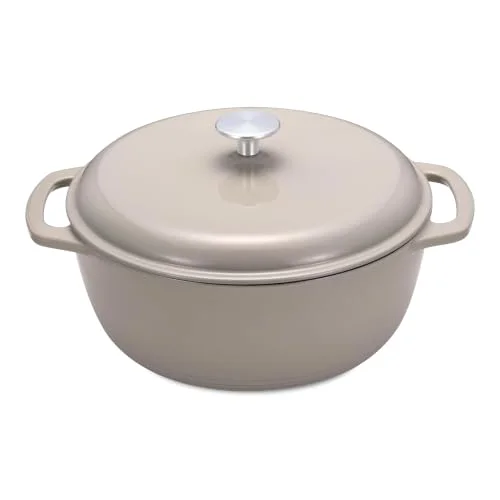
Amazon Basics Enameled Cast Iron Dutch Oven Pot With Lid, 4.3-Quart, Round, Dual Handles, Linen Gray

Best for a first small pot on a tight budget

4.3 quarts·Dual handles·Round·Oven safe, heavy-duty

At $23.78, this is the least expensive way into a genuinely small, genuinely cast-iron pot. The 4.3-quart round body with dual handles is sized for a studio kitchen, a single burner, or a dinner for one or two, and the construction is described as heavy-duty, the same baseline claim the brand makes across its larger pots. There is no foundry story and no included extras, and the listing does not publish an oven-safe temperature figure the way some Amazon Basics pots do at other sizes — check the current listing for that number before pushing it past 450°F. What you do get is a small, enameled, dual-handled pot built for stews, roasting and baking at a price that makes it easy to find out whether a small Dutch oven earns a permanent spot on your stovetop.

If you are not sure a small pot is worth owning, this is the cheapest way to find out.

Amazon Basics enameled cast iron Dutch oven, 4.3 quart, linen gray
Price
$23.78
Check price →
02Same pot, a color

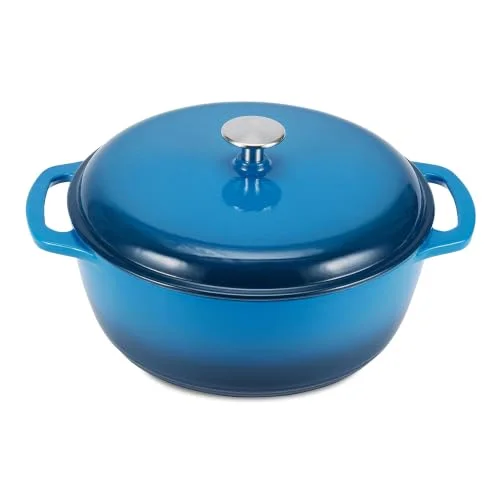
Amazon Basics Enameled Cast Iron Dutch Oven Pot With Lid, 4.3-Quart, Round, Dual Handles, Blue

Best if you want this exact pot in blue

4.3 quarts·Dual handles·Round·Oven safe, heavy-duty

This is the same 4.3-quart round, dual-handle, heavy-duty construction as the Linen Gray pick above, at $33.89. The price difference between the two colorways is not a difference in materials or capacity that we have evidence for — it is simply a different enamel color at a different current price point, and prices on both can shift. If gray and blue are both acceptable to you, compare the live prices on both listings before buying, since the gap between them changes over time and either one gets you the identical 4.3-quart small-kitchen pot.

Same pot, same handles, same capacity — pick the color, then check which one costs less today.

Amazon Basics enameled cast iron Dutch oven, 4.3 quart, blue
Price
$33.89
Check price →
03Best for enamel confidence

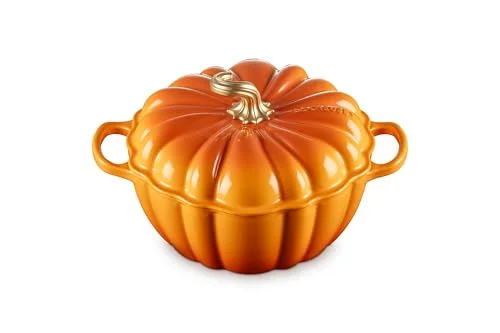
Le Creuset Enameled Cast Iron Signature Pumpkin Cocotte, 4 qt., Persimmon

Best for gifting, and for buyers who want a known enamel brand at a small size

4 quarts·Persimmon enamel·Pumpkin-shaped cocotte·Made by Le Creuset

At $394.95, this is a 4-quart pot built around the same heat-holding cast iron as the two Amazon Basics pots above, dressed in a pumpkin-shaped cocotte design and the Persimmon colorway Le Creuset specifically names for this piece. The decorative shape is the point here as much as the cooking: a pumpkin cocotte is designed to go from oven to table and double as a centerpiece, which is a different job than the plain round pots above are trying to do. We do not have a published oven-safe figure or lid-knob material for this specific listing in the data available to us, so confirm that detail on the current listing before a high-heat roast or broil.

You are not paying ten times more for better heat retention; you are paying for the shape, the enamel brand's reputation, and a piece that looks the part on a table.

Le Creuset Signature Pumpkin Cocotte, 4 quart, Persimmon
Price
$394.95
Check price →
The real question

Is a tiny Le Creuset worth it, or just a tiny Lodge-style pot

Scaled down to 4 quarts, the gap between a designer French cocotte and a basic enameled pot does not close — but it also does not widen into something the cooking itself can show you. The cast iron inside the Le Creuset Signature Pumpkin Cocotte and the cast iron inside either Amazon Basics 4.3-Quart pot does the same job at this size that it does at six quarts: it heats slowly, holds that heat evenly, and sears, braises or bakes according to the same physics regardless of what the listing costs. A 4-quart braise started in either pot, at the same oven temperature, for the same time, will come out close to identical on day one.

What the roughly tenfold price difference actually buys, at this size as at any size, comes down to three things, none of which is "cooks better." First, the pumpkin shape and Persimmon color are a design choice entirely unrelated to performance — you are buying a specific look for a table centerpiece, not a better braise. Second, Le Creuset stakes its brand reputation on enamel durability and backs that with its own warranty terms, a real signal even without an independent lab figure to cite. Third, a small premium pot is simply a more traditional gift: nobody unwraps a $29 pot on a holiday and feels the occasion marked, which is a real, if non-culinary, reason the cocotte exists in this guide at all. If you are deciding where a small Dutch oven lives in your kitchen, our buying guide and our round versus oval breakdown cover the shape and size questions that apply at every price.

Our honest read: if the pot is for daily weeknight use in a small kitchen, buy the Amazon Basics 4.3-Quart and put the roughly $360 you save toward literally anything else, including a second small pot in a different capacity. Buy the Le Creuset cocotte specifically if the shape and the gift-table moment matter to you, or if you already know you are the kind of cook who is rough on cookware and want the brand's enamel reputation and warranty behind a piece you'll use for decades. Neither choice is the "wrong" one; they are answering different questions.

Our method

How we compared

What we did

Specs and current prices, cross-checked

We compared the published specifications and current Amazon prices for the Amazon Basics 4.3-Quart in Linen Gray, the Amazon Basics 4.3-Quart in Blue, and the Le Creuset Signature Pumpkin Cocotte at 4 quarts, limiting every claim in this article to what each listing actually states — capacity, handle configuration, color and materials. Where a specification such as exterior diameter, oven-safe temperature, or lid-knob material is not published for a given pot, we say so plainly rather than estimate it from a similar-looking product at a different size.

What we didn’t

We don’t run a testing lab

We do not physically test these pots, we do not own them, and we have no star ratings or review counts for these specific listings to report, so we don’t publish any. How a small pot actually fits a specific oven cavity, or how its enamel wears after years of weeknight dinners, cannot be answered honestly by us or by anyone else claiming to have tested it. We can read the categorical, well-established facts about how enameled cast iron behaves at any size, and we do, rather than invent product-specific sentiment we don’t have. See more about our approach on the About page.

FAQ

Common questions

What size Dutch oven is best for a small kitchen?

Four quarts is the size this guide focuses on, and it fits most studio ovens, RV ovens, and narrow ranges where a 6 to 7-quart pot's handles may not clear the cavity. Both Amazon Basics pots here are 4.3 quarts and the Le Creuset cocotte is 4 quarts — close enough in capacity that the real choice between them is budget and finish, not size. If you regularly cook for more than two or host dinners for a crowd, a larger pot from our large Dutch oven guide fits better.

Will a 4-quart Dutch oven fit in a small or narrow oven?

Most likely, better than a 6-quart pot, because volume scales with the cube of the radius — a modest reduction in diameter removes a disproportionate amount of capacity, so a 4-quart pot's overall footprint, handles included, tends to be meaningfully smaller than a larger pot's. None of the listings in this guide publish exterior dimensions, so measure your oven's interior clearance and check the current Amazon listing's dimensions before buying.

Is the Le Creuset Pumpkin Cocotte worth the price over a basic small Dutch oven?

Not for cooking performance alone — the cast iron in the $394.95 Le Creuset and the $23.78 Amazon Basics pot heats and holds temperature the same way at this size. The Le Creuset's price buys its specific pumpkin shape and Persimmon color, the brand's enamel-durability reputation and warranty, and a piece suited to gifting or a table centerpiece. Buy it for those reasons specifically, not because it braises better.

Can a small Dutch oven handle a whole roasting chicken or a double batch of chili?

Generally no, not comfortably. A 3 to 4-pound chicken with vegetables typically needs 5.5 to 7 quarts to close the lid without crowding, and a double batch sized for freezing leftovers needs more room than a 4-quart pot provides. For either job, see our large Dutch oven guide instead.

Keep reading

More from Best Dutch Ovens