Best Dutch Ovens
Buying Guide · How to Choose

How to Choose a Dutch Oven

Most buying guides start with the brand. Start there and you will end up justifying a $300 pot you didn’t need, or a $50 one that is wrong for your stove and your family. Ask five questions in the right order instead — what you cook, how many you feed, the shape of your burner, how long you expect to keep it, and how carefully you actually treat cookware — and the shortlist writes itself before the brand ever comes up.

By Ilane Tall · Updated October 25, 2026 · Research-based.

Affiliate disclosure: we may earn a commission if you buy through the Amazon links on this page, at no extra cost to you.

Enameled cast iron Dutch oven on a kitchen counter, representing the buying decision between size, shape and brand
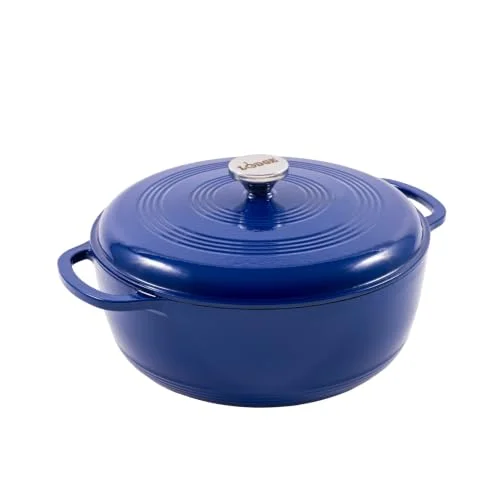
Start here

The order that matters

Every Dutch oven sold today is some version of the same object: a heavy, lidded pot, almost always enameled cast iron, that holds a slow and even heat. Because the underlying material barely changes, the differences that actually decide whether a specific pot suits you are not about the iron at all — they are about your kitchen and your habits. That is why this guide puts the brand last. Answer the five questions below in order and you will already know, before you open a single product page, roughly what capacity, shape and price range you are shopping in.

  1. What will you cook in it most weeks? A weeknight braise, a pot of rice and beans, or a loaf of sourdough asks for a different shape and size than a holiday roast you cook twice a year.
  2. How many people are you feeding? Capacity should match your normal Tuesday, not your biggest Thanksgiving.
  3. Round or oval? Your burner layout and your most-cooked protein shape decide this, not preference alone.
  4. How long do you keep cookware? A pot you plan to own for thirty years is a different purchase than one you are buying to find out if you’ll use it at all.
  5. How gently will you treat it, honestly? Metal spoons and a dishwasher wear enamel faster than wood, hand-washing, and a careful lift out of the oven.

We’ll walk through each question, then end with three shortlists built from the answers — not a single "best" pot, because the honest answer to "which Dutch oven should I buy" depends entirely on what you just told us.

Question one

What will you cook in it most weeks?

This is the question that should come before any other, because it changes everything downstream of it. A Dutch oven bought for a weekly pot of chili or braised chicken thighs wants to be easy to lift, easy to clean, and sized for a normal weeknight portion — something in the 5 to 7 quart range that you are comfortable pulling out without ceremony. A Dutch oven bought primarily for bread wants a tight-fitting, heavy lid that traps the steam a loaf releases in its first fifteen minutes, since that trapped steam is what gives a home oven the kind of crust a bakery gets from a steam-injected deck oven. A Dutch oven bought for long braises — a pot roast that goes into the oven at noon and comes out at six — wants a lid engineered specifically to return condensation to the food rather than let it escape, which is a genuine design difference between manufacturers, not a marketing flourish. We go deeper on exactly what that lid is doing in our explainer on Dutch oven lid design, and on the braising case specifically in our picks for long, slow braises.

If your honest answer is "a bit of everything" — soup some weeks, a roast on Sundays, bread occasionally — that is the most common answer, and it points you toward a mid-size round pot rather than anything specialized. The Lodge Essential Enamel Cast Iron Dutch Oven, 6 Quart, Oyster White at $69.99 is built as exactly that kind of generalist: no seasoning required, enameled for acidity, and sized for the dishes most households actually cook on a normal week rather than the one dish they cook once a year.

Question two

How many people are you feeding?

Think in people, not quarts, because quarts alone are an abstraction until you translate them. As a rough guide: 4 to 5 quarts suits one or two people with leftovers, or a couple cooking simply. 6 quarts is the size that fits a whole chicken, a loaf, or a stew for four to six, and it is the size most households that cook regularly end up reaching for by default. 7 quarts and above is built for feeding a crowd — five to eight people, batch cooking, or holiday volumes — and it comes with a real cost: a full 7-quart pot of stew is genuinely heavy to lift out of a hot oven, a two-handed job in oven mitts rather than a one-handed one.

The Overmont Enameled Cast Iron Dutch Oven, 7QT Pot with Lid Cookbook at $62.99 is sized specifically for that larger end: a 7 quart capacity meant for feeding more people per pot than a 6 quart model manages, at a price that undercuts most other pots of comparable size. If your household is smaller, sizing up "to be safe" mostly buys you a heavier pot that takes longer to preheat and is more awkward to store — buy for the Tuesday dinner you actually cook, not the holiday you host once. We cover this sizing math in more detail, including where oval sizing changes the picture, in our guide to large Dutch ovens, 7 quarts and up.

Question three

Round or oval?

This decision is more practical than it looks, and it is decided by two things: your burner, and what you cook most. A round Dutch oven sits centered and stable on a round gas or electric burner, which means the heat rises evenly up the sides — this matters for bread, soups, and anything simmered rather than roasted. An oval Dutch oven is shaped to fit a long cut of meat, like a whole chicken, a pork shoulder, or a leg of lamb, without curling it to fit a circle. The trade-off is that an oval pot on a round burner wastes heat at the two narrow ends, where the pot overhangs the flame and that heat simply doesn’t transfer into the food as efficiently.

Every pot named specifically in this guide — the Lodge Essential 6 Quart, the Overmont 7QT, and the Lodge Essential 7.5 Quart in Indigo — is sold as a round pot, which tracks with round being the more common and more versatile default for a first or only Dutch oven; it handles soups, bread, and stews equally well and sits naturally on a standard burner. If you know you cook whole roasts and joints more often than soups, that is reason enough to go shopping specifically for an oval model elsewhere. We lay out the full case, including the specific dishes each shape handles better, in Round or Oval Dutch Oven? — worth reading in full before you commit either way, since the shape is far harder to change your mind about after the pot arrives than the size or the color.

Question four

How long do you keep cookware?

Be honest with yourself here, because it changes the math on price entirely. If you keep pots for decades — if the pan you use most is older than some of your appliances — then a Dutch oven is a long-horizon purchase, and a few hundred dollars amortized over thirty years of weekly use is a different number than it looks like on the day you spend it. If you tend to replace cookware every few years as your kitchen or your cooking habits change, or if you are buying your first Dutch oven specifically to find out whether you’ll use one at all, that same spending logic argues for starting cheaper.

This is also where it is worth remembering that the iron itself is not the variable. A $60 pot and a $300 pot are both, fundamentally, cast iron with a glass enamel coating fused onto it, and the iron holds heat the same way in both. What a longer-horizon purchase buys is mostly the enamel’s durability over years of real use and the manufacturer’s own confidence in it, not a better braise on day one. If "a long time" is your honest answer, that is still not necessarily a reason to spend $300 immediately — it is a reason to buy something you are confident you will actually use first. The Lodge Essential Enamel Cast Iron Dutch Oven, 7.5 Quart, Indigo at $83.99 sits in exactly that middle ground: a known foundry, enameled for longevity, and priced low enough that committing to it doesn’t require being certain yet. If budget is the real constraint rather than longevity, our guide to cheap Dutch ovens that are still worth buying covers what you give up, and don’t, under $50.

Question five

How gently will you treat it, honestly?

This is the question people answer wrong most often, usually in the optimistic direction. Enamel is glass fused to iron, and glass is hard but not flexible — it chips and dulls under specific, predictable kinds of abuse: metal spoons and whisks scraping against the interior, a dishwasher cycle after a dishwasher cycle even on pots marketed as dishwasher-safe, a hot pot plunged straight into cold water, or simply banging the rim against a faucet while washing up. None of that is specific to one brand; it is simply what enamel does, on any Dutch oven, under that treatment, regardless of price.

If you know you reach for whatever utensil is nearest, run things through the dishwasher by habit, and are not going to change that — that is a completely normal way to cook, and it is useful information. It argues for a pot where a chip or two feels inconsequential rather than a tragedy, which is one real argument for buying something like the Overmont 7QT over a pot you’d feel obligated to baby. If you already hand-wash carefully, use wood and silicone utensils, and let a pot cool before washing it, your enamel will simply last longer at any price point, and spending more buys you a longer head start on top of care you were already going to give it. Either way, nobody publishes a chip-resistance number for these pots, at any price, so we won’t pretend to know how one specific listing performs after five years — only how enamel behaves as a category, which is the same for all of them. For the oven-heat side of "how roughly can I treat it," including the one part that usually fails before the pot does, see how hot a Dutch oven can actually go, and for the day-to-day care habits that extend any enamel, how to keep an enameled Dutch oven looking new.

The answers, applied

Three shortlists, by the answers

You don’t need a single "best" Dutch oven, because the honest answer depends entirely on what you just told us above. Here is how the five questions sort toward the three real products we can speak to directly, by published specification and current price.

01The generalist

Lodge Essential Enamel Cast Iron Dutch Oven, 6 Quart, Oyster White

If you cook a bit of everything, feed four to six, and keep cookware a long time

6 quarts·Round·No seasoning·Made by Lodge

This is where most households land once they answer the five questions honestly: a mid-size round pot from a foundry that has cast iron in Tennessee since 1896, at $69.99. It covers a weeknight braise, a stew for the table, and a loaf of bread without being specialized toward any one of them, which is exactly the point if your answer to "what will you cook most weeks" was "it varies."
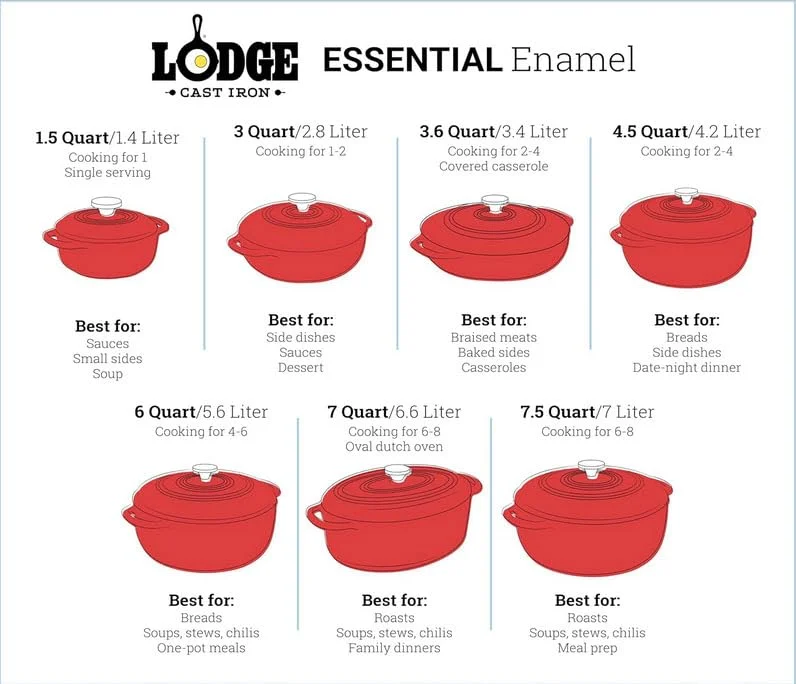
Lodge Essential Enamel cast iron Dutch oven, 6 quart, oyster white
Price
$69.99
Check price →
02The crowd pot

Overmont Enameled Cast Iron Dutch Oven, 7QT Pot with Lid Cookbook

If you regularly feed five or more, or you treat cookware roughly

7 quarts·Round·Cookbook included·Made by Overmont

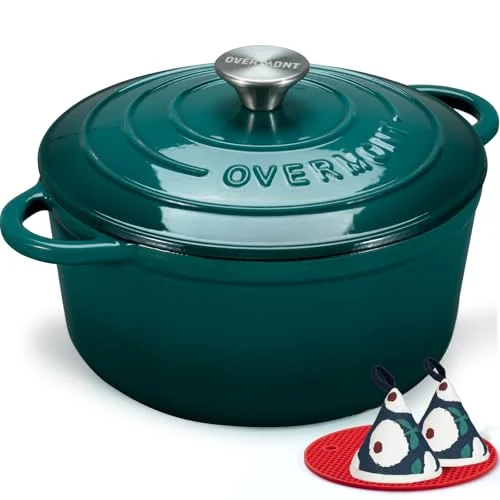
Seven quarts at $62.99 is the most capacity for the money of the three pots in this guide, which makes sense if your answer to the "how many people" question was "more than four" or your honest answer to the care question was "I am not going to baby it." It ships with a cookbook, a nod toward the fact that a bigger pot often means bigger, less familiar recipes.

Overmont enameled cast iron Dutch oven, 7 quart, with lid and cookbook
Price
$62.99
Check price →
03The step up

Lodge Essential Enamel Cast Iron Dutch Oven, 7.5 Quart, Indigo

If you feed a larger table but still want Lodge’s enamel track record

7.5 quarts·Round·No seasoning·Indigo

At $83.99, this is the Lodge generalist sized up a size and a half: for households whose honest answer to "how many people" is closer to six to eight than four to six, but who still want the same foundry-backed enamel as the 6 quart pick above rather than switching brands entirely for the extra volume.

Lodge Essential Enamel cast iron Dutch oven, 7.5 quart, indigo
Price
$83.99
Check price →
Side by side

The three, compared

PotBest forCapacityMade byNotablePriceGet it
Lodge Essential Enamel 6 Quart A bit of everything 6 qt Lodge No seasoning needed, Tennessee foundry since 1896 $69.99 Get it
Overmont 7QT Feeding a crowd 7 qt Overmont Ships with lid and cookbook $62.99 Get it
Lodge Essential Enamel 7.5 Quart Larger tables, same brand 7.5 qt Lodge Indigo enamel, no seasoning $83.99 Get it
Our method

How we compared

What we did

Specs and current prices, cross-checked

We compared the published specifications and current Amazon prices for the Lodge Essential 6 Quart, the Overmont 7QT, and the Lodge Essential 7.5 Quart, and built this guide around the five questions a buyer needs answered before any of those three pots — or any other Dutch oven — makes sense for them specifically. Every capacity, shape, and material claim in this article comes from what each manufacturer states on its own listing; where a spec such as a chip-resistance figure simply isn’t published, we say so rather than estimate it.

What we didn’t

We don’t run a testing lab

We do not physically test these pots, we do not own them, and we have no star ratings or review counts for these specific listings to report, so we publish none. How a pot’s enamel actually looks after five years of your particular habits cannot be answered honestly by anyone with a pot for a fortnight, including anyone telling you otherwise with a number out of ten. What we can do is lay out the well-established, category-wide facts about how enameled cast iron behaves and let you match them against your own answers above. See more about our approach on the About page.

FAQ

Common questions

What size Dutch oven should I buy first?

Six quarts, if you are unsure. It is the capacity that fits a whole chicken, a loaf of bread, or a stew for four to six, and it is the size most households that cook regularly end up using by default. Size up to 7 quarts and above only once you know you are regularly feeding five or more people, since a full large pot is genuinely heavy to lift out of a hot oven.

Is round or oval the better default?

Round, for a first or only Dutch oven. It sits centered on a standard round burner so heat rises evenly up the sides, which suits soups, bread, and stews equally well. Oval is worth seeking out specifically if you know you cook whole roasts or long cuts of meat more often than you simmer things, since the shape fits those cuts without curling them to fit a circle.

Do I need to spend more if I plan to keep it for decades?

Not necessarily, and not immediately. The iron inside every enameled Dutch oven behaves the same regardless of price, so a longer ownership horizon mostly argues for paying attention to enamel durability and your own care habits over years, not for spending the most money on day one. If you are not yet certain you will use a Dutch oven weekly, a lower-priced pot like the ones in this guide is a reasonable way to find out before committing further.

How much does how I treat it actually matter?

More than the brand does. Enamel chips and dulls from metal utensils, repeated dishwasher cycles, and sudden temperature changes like plunging a hot pot into cold water — this is true of every enameled Dutch oven, at every price. Hand-washing, using wood or silicone utensils, and letting a pot cool before washing it will extend any of the pots named in this guide well beyond what price alone would predict.

Keep reading

More from Best Dutch Ovens