Best Dutch Ovens
Honest Take · Color & Finish

Does Dutch Oven Color Actually Change Anything?

Sage green, grey, red — scroll through any Dutch oven listing page and the color swatches multiply faster than the actual product differences do. Underneath every one of those swatches is the same cast iron, poured the same way, from the same mold. We compared three enameled cast-iron pots from a single maker, Umite Chef, sold in three different colors and sizes, to find out exactly what the pigment changes, what it doesn't, and the one situation where picking by color alone is the right call.

By Ilane Tall · Updated November 6, 2026 · Research-based.

Affiliate disclosure: we may earn a commission if you buy through the Amazon links on this page, at no extra cost to you.

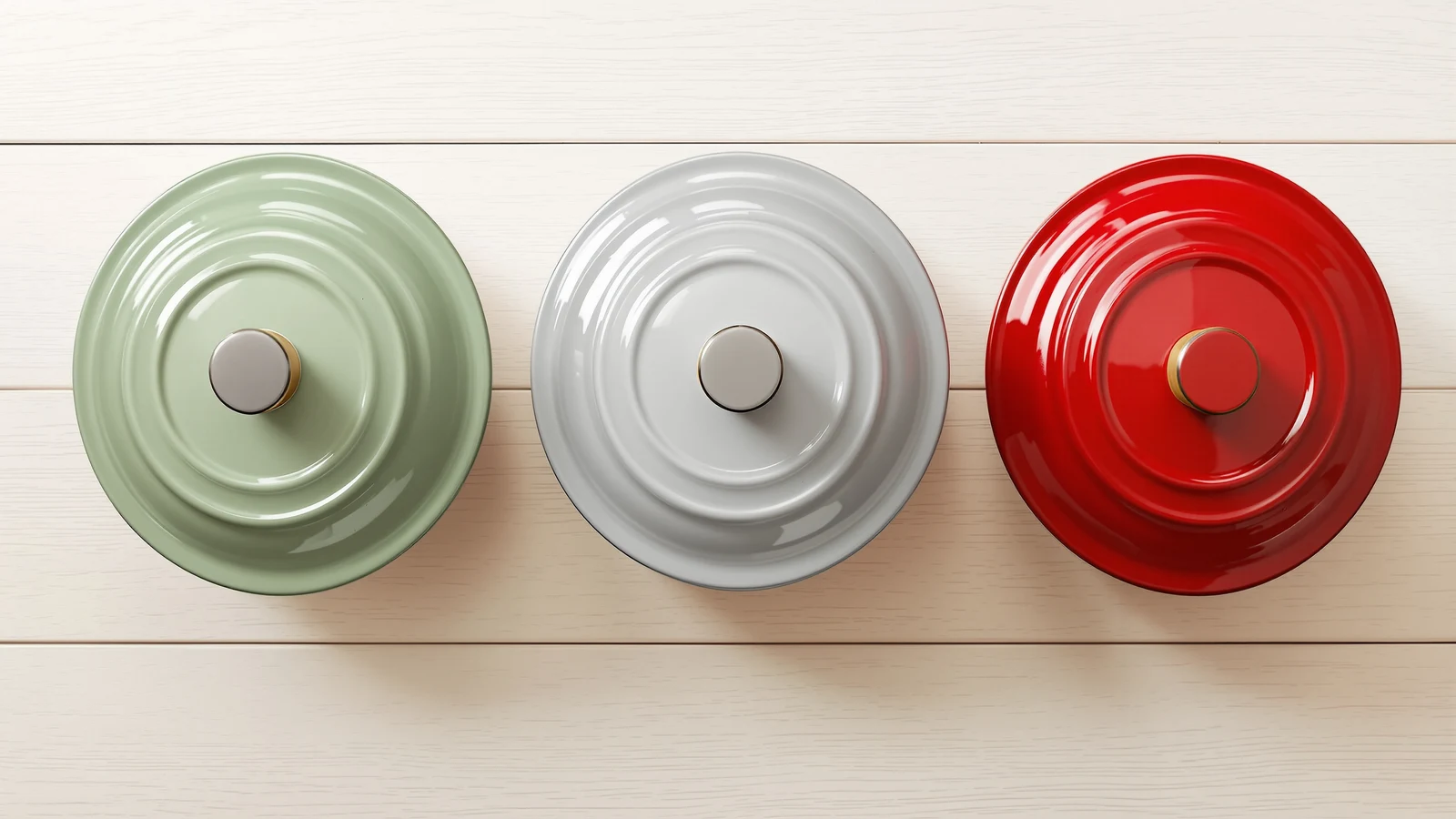
Three enameled cast iron Dutch ovens in red, grey and sage green arranged side by side on a kitchen counter
What you're actually buying

The color is glass. The pot underneath is not.

A Dutch oven's color lives entirely in a thin layer of porcelain enamel — glass, essentially, in powder form, dusted or sprayed onto the cast iron and then fused to it at high heat until it melts into a continuous, glossy coating. The pigment that makes one pot sage green and another red is mixed into that glass before firing, the same way stained glass gets its color from metal oxides added to molten silica. Once the enamel is fired on, the color is not a paint job sitting on top of the metal; it is the surface itself, chemically bonded to the iron beneath it.

That iron, separately, is a commodity. It is melted, poured into a mold shaped like a pot, and cooled, and nothing about that process cares what color enamel gets applied afterward. The three pots in this guide make the point plainly: the Umite Chef 5QT in red, the Umite Chef 6QT in grey, and the Umite Chef 7QT in sage green are the same cookware line, from the same manufacturer, differing in capacity and color — not in the cast iron itself, which is identical across every color Umite Chef sells in a given size. A red 5-quart pot heats, holds, and releases heat exactly the way a grey 5-quart pot from the same line would, because the thing doing the work of heat retention is the iron, and the iron doesn't know what color it's wearing.

This is worth stating plainly because color is so often used, in marketing photography and in buyer psychology both, as a stand-in for quality. A deep, saturated glaze photographs as "premium" more easily than a plain one does. None of that photographic impression changes the mass of iron inside the pot, its wall thickness, or how evenly it distributes heat across a burner. If you are choosing between two colorways of the same model, from the same brand, you are choosing a finish, not a different pot.

The practical question

Does a dark finish really hide scorch marks better?

Yes, generally, and the reason is simple contrast, not anything chemical about darker enamel resisting staining better. A browned-on bit of fond, a splash of tomato sauce that dried before you noticed, a faint ring from a pan lid set down on the lid's rim — these marks are discoloration against a background, and discoloration is far less visible against a background that's already dark and saturated than against one that's pale. A deep red exterior, like the Umite Chef 5QT in this guide, absorbs a lot of visual noise that a pale cream or white exterior would show immediately. A mid-tone like the 6QT's grey or the 7QT's sage green sits in between: still considerably more forgiving than white, though not quite as camouflaging as a fully saturated red.

What doesn't change, regardless of color, is how the enamel actually ages underneath that pigment. Enamel is glass fused to iron, and the most common real damage — chipping at the rim or the interior base from a metal spoon, a pot knocked against a faucet, or sudden temperature shock from a hot pot hitting cold water — happens at the exact same rate no matter what shade the glaze is tinted. Color only affects how visible the cosmetic residue is day to day; it has no bearing on the structural question of whether the enamel is holding up, which is a matter of how you use metal utensils and a dishwasher, not which colorway you bought. A warranty, where one exists, covers that structural question — chips and manufacturing defects — and it does not read differently by color, because the manufacturer isn't measuring stain visibility either.

The interior enamel is a separate, and arguably more useful, color decision than the exterior. A lighter interior lets you actually watch a sauce reduce or a fond brown in real time, which is a genuine cooking advantage independent of exterior hue. None of the three listings in this guide specify a different interior shade by exterior color — if that detail matters to you, it's worth checking the current listing's photos directly rather than assuming the interior color follows the exterior one.

Beyond your own kitchen

Resale and gift perception, by color

We have no resale-price data tied to these three specific listings, and we're not going to invent a dollar figure to fill that gap. What we can say, based on how the secondhand cookware market generally behaves, is that neutral colors tend to move faster and attract a wider pool of buyers than saturated or trend-driven ones. A grey or cream pot reads as "goes with any kitchen" to a stranger browsing a resale listing; a bright red or a trend-forward green narrows the pool to buyers who specifically want that color, which can mean a longer wait, even if the eventual price isn't meaningfully different once a buyer who wants that shade shows up.

Gift-giving runs almost the opposite direction. A distinctive, currently fashionable color — sage green has been one of the most searched kitchenware colors for several seasons running — reads as a more deliberate, considered gift than a safe neutral, precisely because it signals the giver put some thought into matching a kitchen's aesthetic rather than defaulting to whatever was cheapest or most available. If you're buying someone their first Dutch oven, that perception gap is real: the same pot, same price, reads more generic in grey and more personal in a color the recipient would plausibly have picked for themselves.

Neither of these is a performance claim, and neither should outweigh capacity or price if those don't fit your actual kitchen. They're real but soft signals — the kind of thing worth factoring in only after the harder specs line up, which is exactly where color belongs in the decision order. The premium French brands compared elsewhere on this site lean into this directly, selling the same pot in a dozen glaze colors specifically because color-driven loyalty and gifting are a real part of how that segment of the market sells, on top of the cookware's actual performance.

Follow the money

Price parity across colorways from the same maker

If color carried a real cost premium, you'd expect to see it show up directly in the price of same-size pots from a single brand. It doesn't, at least not here. The Umite Chef 5QT in red and the Umite Chef 6QT in grey are both listed at $39.99 — identical pricing despite the grey pot being a full quart larger. The one price difference in this trio, the Umite Chef 7QT in sage green at $55.99, tracks capacity, not pigment: it's the biggest pot of the three, with more cast iron in it, and that's what the extra $16 is paying for. Color, across this entire line, is priced at zero.

This is the pattern worth generalizing from, not a quirk specific to Umite Chef. Budget cookware lines bundled with cotton potholders and a cookbook, the kind compared elsewhere on this site, almost universally price by size and included accessories, not by which glaze color you pick within a given size. Manufacturers fire the same mold in batches and simply vary the pigment added to the enamel slurry before the final firing — a production step that costs essentially the same regardless of which color goes in. The one place pricing does sometimes drift by a few dollars is with licensed or seasonal print patterns, like a floral lid, which occasionally carry a small premium over a plain solid — but that's a decorative-print surcharge, not a solid-color one, and it doesn't apply to any of the three pots in this guide.

Below is the direct comparison. Read the price column against the capacity column, not the color column, and the pattern holds across the whole table.

PotColorCapacityMade byPriceGet it
Umite Chef 5QT Red 5 qt Umite Chef $39.99 Get it
Umite Chef 6QT Grey 6 qt Umite Chef $39.99 Get it
Umite Chef 7QT Sage Green 7 qt Umite Chef $55.99 Get it
The picks

The picks, by what hides stains and drips best

Not a ranking by which pot cooks better — they don't differ there. This is purely about which colorway, at which size, keeps looking clean between washes.

01Best at hiding marks

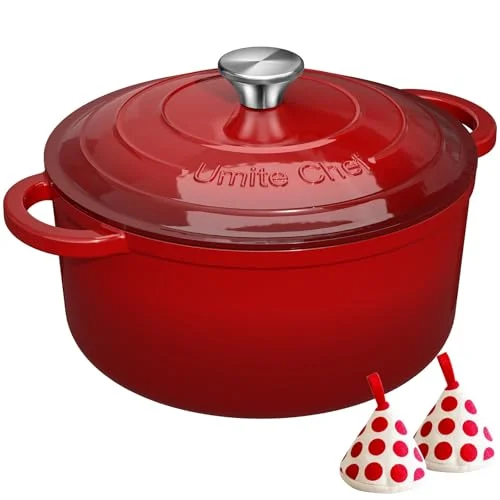
Umite Chef 5QT Enameled Cast Iron Dutch Oven, Red

Best for a stovetop that sees frequent splatter and drips

5 quarts·Deep saturated red·Cotton potholders included·$39.99

Of the three colors here, this is the one with the most contrast-masking depth. A fully saturated, dark-toned red absorbs scorch residue, oil splatter and the faint browning that collects around the rim far more effectively than a pale or mid-tone finish, simply because there's less brightness difference between the mark and the background it's sitting on. It won't stop the enamel from eventually showing wear the way any enamel does — it just means you'll see that wear later, visually, than you would on a lighter pot.

The least visible pot in this trio on a stovetop that gets used daily — which, for most households, is the whole point.

Umite Chef 5QT enameled cast iron Dutch oven, red
Price
$39.99
Check price →
02Safest neutral

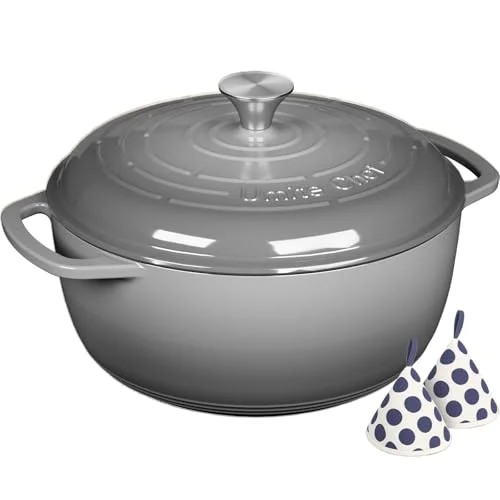
Umite Chef 6QT Enameled Cast Iron Dutch Oven, Grey

Best if resale, regifting, or matching an existing kitchen matters

6 quarts·Dual handles·Cotton potholders included·$39.99

Grey is the pick for anyone optimizing for broad appeal rather than personal statement. It's a mid-tone, so it still hides more than a bright white or cream would, and it reads as a neutral that fits almost any kitchen color scheme — the trait that matters most if there's any chance this pot gets resold, handed down, or regifted down the line. At the same $39.99 as the smaller red pot above, it's also simply more capacity for the same money, which is a separate reason to default here if color isn't the deciding factor for you.

Not the most distinctive option in the lineup. That's exactly why it's the safest one to buy for someone else's kitchen.

Umite Chef 6QT enameled cast iron Dutch oven, grey
Price
$39.99
Check price →
03Best for a crowd, and on-trend

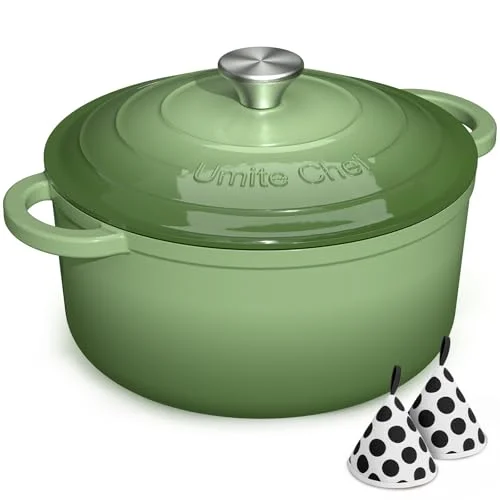
Umite Chef 7QT Enameled Cast Iron Dutch Oven, Sage Green

Best for feeding a larger household, in the color everyone's buying right now

7 quarts·Cookbook included·Cotton potholders included·$55.99

Sage green sits comfortably in the middle of the contrast scale between the red and the grey here — dark enough to hide most everyday splatter, light enough to still look fresh against a lighter interior. It also happens to be currently one of the most popular kitchenware colors, which is worth something if this pot is going to live somewhere visible, on a stovetop or counter rather than tucked in a cabinet. At 7 quarts it's also the largest of the three, sized for a household that regularly cooks for five or more rather than two.

The extra $16 over the smaller two pots buys a full extra quart of capacity, not a color surcharge — the pricing table above confirms that directly.

Umite Chef 7QT enameled cast iron Dutch oven, sage green
Price
$55.99
Check price →
The honest conclusion

When color is simply the whole decision, and that's fine

Once capacity, price and any published spec you actually care about — oven-safe temperature, included accessories, handle style — are equal across colorways, there is no remaining functional reason to pick one shade over another. At that point, choosing by color isn't a lapse in judgment; it's the only variable left that's genuinely yours to decide. A pot that matches your kitchen, or that you simply like looking at every time you lift it off the stove, has real value that has nothing to do with heat retention and doesn't need to pretend otherwise.

Where this gets people into trouble is reversing the order — picking the color first and quietly assuming the rest of the spec sheet will work out. It usually does, inside a single product line like the one in this guide, where every color ships in the same handful of sizes with the same accessories. It doesn't always hold once you're comparing across brands, where a color you love might only be offered in a size or a price tier that doesn't actually fit your kitchen. If you're building out more than one pot over time, this is also where a little planning pays off: choosing complementary colors across a small collection is a legitimate design decision, as long as each pot is still earning its place by size and use first.

So: confirm the capacity you need, confirm the price fits your budget, check any spec that's genuinely load-bearing for how you cook. Then pick the color you like. That's not a consolation step after the real decision is made — for most buyers comparing colorways within one product line, it's the final step precisely because everything that actually affects cooking was already settled by the time you got there.

Our method

How we compared

What we did

Same maker, same sizes, different colors and prices

We compared the published specifications and current Amazon prices for three Umite Chef enameled cast-iron Dutch ovens — the 5QT in red, the 6QT in grey, and the 7QT in sage green — specifically because they come from a single manufacturer, which isolates color and size as the two variables that actually move between listings. Every claim about enamel, pigment and pricing in this guide is limited to what's publicly documented about how porcelain enamel is manufactured and what these three listings themselves state, not to a spec no one has published.

What we didn’t

We don’t run a testing lab, and we don’t grade stain resistance

We do not physically test these pots, we do not own them, and we have no star ratings or review counts for these specific listings to report. The claims here about dark colors masking marks better than light ones rest on basic, well-established color-contrast principles that apply to any glazed surface, not on a side-by-side stain trial we ran ourselves — we say so plainly rather than imply otherwise. See more about our approach on the About page.

FAQ

Common questions

Does Dutch oven color affect how well it cooks?

No. The color lives in a thin, fused layer of porcelain enamel on the surface; the cast iron underneath, which does the actual work of holding and distributing heat, is identical regardless of which color enamel is applied over it. A red pot and a grey pot of the same size, from the same maker, perform the same way on the stove and in the oven.

Does a darker colored Dutch oven hide stains and scorch marks better?

Generally yes, for a simple reason: discoloration shows less contrast against an already dark, saturated surface than against a pale one. A deep red or dark-toned finish camouflages splatter and browning more effectively than white or cream. This is purely cosmetic visibility, though — it doesn't change how the enamel itself ages or resists chipping over time.

Does color affect resale value or how a Dutch oven is received as a gift?

We have no resale pricing data tied to specific listings, but neutral colors generally attract a wider pool of secondhand buyers, while a distinctive, currently fashionable color like sage green often reads as a more deliberate, considered gift. Neither effect relates to the pot's cooking performance or durability.

Is it okay to choose a Dutch oven based on color alone?

Yes, once capacity, price and any spec you actually care about are already equal across the colorways you're considering. Within a single product line like the Umite Chef pots in this guide, color carries no price premium and no performance difference, which makes it a legitimate final tiebreaker rather than a compromise.

Keep reading

More from Best Dutch Ovens