Best Dutch Ovens
Buying Guide · No Star Ratings

How to Judge a Dutch Oven When Amazon Shows No Star Rating

Open enough enameled cast-iron listings and you will notice the pattern: no stars, no review count, just a price, a photo gallery and a wall of bullet points. That is not a red flag specific to this category, and it is not something you can wait out. What follows is what we actually read instead — the spec line, the return window, the photos, and whether the brand stands behind the pot after the sale — using three unrated listings as the working example throughout.

By Ilane Tall · Updated October 30, 2026 · Research-based.

Affiliate disclosure: we may earn a commission if you buy through the Amazon links on this page, at no extra cost to you.

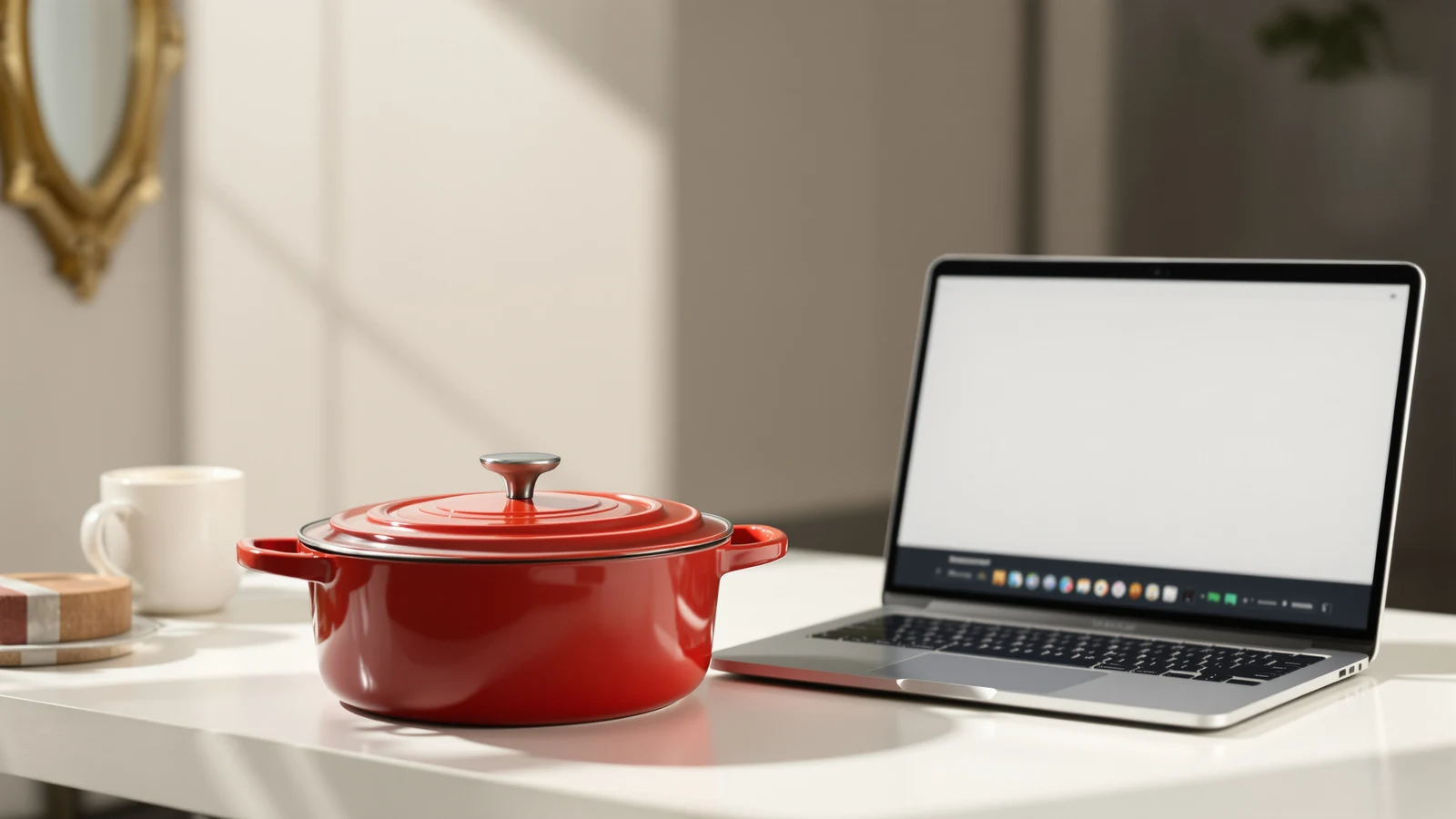
Enameled cast iron Dutch oven next to a laptop showing an Amazon product listing with no star rating displayed
Why this happens

Why this category is full of unrated listings

Amazon attaches star ratings and review counts to a specific ASIN, not to a brand or a product line. A cookware importer that lists the same basic pot in five colors and three sizes is, from Amazon's point of view, listing fifteen separate products, and each one starts at zero reviews until buyers of that exact color-and-size combination leave one. Enameled Dutch ovens are listed this way constantly — a 5-quart in green is a different ASIN from a 5-quart in cream, which is a different ASIN again from the 6-quart. The practical result is that a genuinely established pot can show no rating at all simply because you landed on a newer variant of it, while an identical-looking pot from the same factory under a different label might show four stars from a run of listings that happened to consolidate reviews early.

The three pots used as the working example in this guide — the Umite Chef 5QT in Green, the Mueller DuraCast 6 Quart and the Nuovva 6.4-Quart in Dark Blue — are exactly this kind of listing: real enameled cast-iron pots from brands that sell cookware as their business, with no visible star rating on the specific variant we checked. That is not evidence the pots are bad, and it is not evidence they are good; it is evidence the rating system measures something narrower than product quality, which is why the rest of this guide does not lean on it at all.

There is a second reason this shows up so often in cookware specifically: enameled Dutch ovens are a low-repurchase category. Someone who buys one does not buy another for years, so even a well-selling listing accumulates reviews slowly, and a new color variant can sell steadily for months before Amazon surfaces a rating for it publicly. None of that tells you whether the welds on the lid are even or whether the enamel will survive a metal spoon — the actual question, and the one the next four sections answer without inventing a score to answer it with.

Read this first

The spec line: capacity, oven-safe temperature, weight

Every one of these three listings publishes a capacity, and that single number is the most reliable thing on the page, because it is also the easiest claim for Amazon and for shoppers to catch if a seller got it wrong. The Umite Chef is 5 quarts, the Mueller DuraCast is 6 quarts round, and the Nuovva is 6.4 quarts, listed as 28cm. Capacity is also where most buying mistakes actually happen, unrated listing or not — a pot sized for a holiday roast sits unused most weeks if your household is really cooking for two, and the quart figure is the one spec you should treat as load-bearing even when nothing else on the page is verifiable.

Oven-safe temperature is where these three listings diverge, and the divergence is informative. The Nuovva's own listing states it is heavy-duty and oven safe up to 500°F — a specific, checkable figure stated by the seller, covering effectively every braise, roast or bread recipe a home cook runs. The Umite Chef and the Mueller DuraCast don't state an oven-safe figure in the specifications we have on file, which doesn't mean they can't handle oven heat — enameled cast iron generally can — but it does mean checking the current listing yourself rather than assuming it matches the Nuovva's rating. The detail that trips people up most is the lid knob, not the pot body: a plastic or phenolic knob is frequently rated lower than the cast iron underneath it, so a missing oven-safe figure is really a missing knob-material fact.

None of the three listings publish an empty weight, which is typical for this category rather than a flag specific to these sellers — weight is one of the least consistently published specs on enameled cookware generally, rated or unrated. Capacity itself is the honest proxy: more quarts means more cast iron around the cavity, so the Nuovva at 6.4 quarts will sit heavier in your hands, empty, than the Umite Chef at 5 — a relationship that holds regardless of brand, because it is a function of how the pot is cast, not how it is marketed.

What you can actually enforce

What the return and warranty terms tell you

A star rating is a secondhand opinion. A return window is a right you can exercise yourself, and it is worth reading before you buy rather than after something goes wrong. Amazon's standard return policy gives most buyers 30 days from delivery to return an eligible item for a refund, and that window applies independently of whether the listing has a rating attached — an unrated pot carries the same buyer protection as a five-star one, as long as it sells through Amazon's normal checkout rather than a third-party storefront with its own terms. Check the "Return & Refund Policy" section on the product page itself before buying; some sellers extend that window and a few narrow it for heavy items, and cast iron qualifies.

Warranty coverage is a separate question from the return window, and it is where brand size genuinely starts to matter, rating or no rating. Established cookware manufacturers typically publish a specific warranty term — a year, five years, a lifetime against manufacturing defects — in their own product documentation, not buried in an Amazon bullet point. If a listing says nothing about a warranty term at all, that silence tells you your recourse beyond the Amazon return window is whatever Amazon's own policies cover, probably nothing from the manufacturer directly. This matters even more if you are buying the pot as a gift, since a recipient discovering a chip three months in is relying entirely on whatever warranty exists in writing.

Practically: before you buy, open the listing's policy section and the seller's storefront page and look for a stated warranty period in writing. If you can't find one, treat the purchase as covered only by Amazon's return window and price that risk in — at $42.99 to $44.99 for the three pots named here, a very different calculation than it would be for a $300 pot with the same documentation gap.

Look closer

Reading the product photos for welds and finish

A listing's photo gallery is free information that a star rating cannot replace, and most shoppers scroll past it too quickly. Zoom into the rim where the lid meets the pot body: an evenly applied enamel line looks crisp and continuous all the way around, while a rushed production run often shows a visible seam or a spot where the enamel pulled away from the metal edge during firing. The same logic applies to the handle welds — look for a smooth, filled transition rather than a visible gap, since that junction is exactly where repeated oven-mitt lifting puts the most stress.

The interior finish matters as much as the exterior color. A light-colored interior enamel lets you actually see a sauce reduce, a real cooking advantage, not a styling choice; a photo that only shows outside angles, with no interior shot at all, is worth noticing for what it withholds. The Nuovva's listing describes its interior as non-stick in addition to oven safe — a checkable claim worth comparing against the interior photos rather than taking on faith.

The base is the other area worth a dedicated look, especially on induction: a flat, unglazed cooking ring on the underside is the visual tell for compatibility, and a listing with a clear base photo gives you the chance to check this yourself even when the bullet points stay silent on it. None of this requires owning the pot first — it requires scrolling past the hero shot to the fourth or fifth image, which is where sellers who cut corners tend to stop showing you anything at all.

The long-term tell

Checking whether the brand sells replacement parts

A brand that sells a replacement knob, lid or gasket for its own cookware line is a brand planning for the pot to still be in use years from now, a more honest signal of confidence than any star rating — a rating tells you what early buyers thought in the first few months; a spare-parts page tells you what the company expects to still be supporting later. Search the brand's own storefront, and the brand name directly, for "replacement knob," "replacement lid," or the model name followed by "parts." Larger, longer-established brands frequently sell a stainless steel replacement knob specifically because the stock plastic or phenolic knob has a lower temperature ceiling than the pot itself — which doubles as a second useful fact: a knob upgrade existing is evidence the stock knob has a real limit worth knowing.

For newer or smaller importers — the category all three pots named in this guide fall into — a dedicated parts page is less common, and its absence is not automatically disqualifying at this price point. What it does mean is that a cracked lid or a lost knob is more likely to mean replacing the whole pot than ordering a single part, worth factoring into the price comparison: a $42.99 pot with no parts availability and a $90 pot from a brand that sells spares aren't really $44 apart in total cost of ownership if the cheaper one fails at the lid.

The check itself takes two minutes and tells you something a rating never could: open the brand's Amazon storefront, search their name plus "dutch oven lid" or "dutch oven knob," and see what comes back. No results is not a reason to walk away from an otherwise well-specified pot in this price range. It is a reason to treat the pot itself, lid included, as the unit you are buying whole, rather than something you can incrementally repair later.

Side by side

The three, by what's actually published

No star ratings or review counts appear for any of these three listings, so none are shown below. Capacity and the seller's own stated specs are what we're comparing instead.

PotCapacityOven-safe tempMade byPriceGet it
Umite Chef 5QT, Green 5 qt Not published — check listing Umite Chef $42.99 Get it
Mueller DuraCast 6 Quart 6 qt Not published — check listing Mueller $49.27 Get it
Nuovva 6.4-Quart, Dark Blue 6.4 qt 500°F, stated on listing Nuovva $44.99 Get it
What convinced us

The picks, and what convinced us without a single star

Not a ranking by popularity — there isn't one to rank by here. This is what held up when we read the spec line, the policy section and the photos on each listing in turn.

01Clearest spec sheet

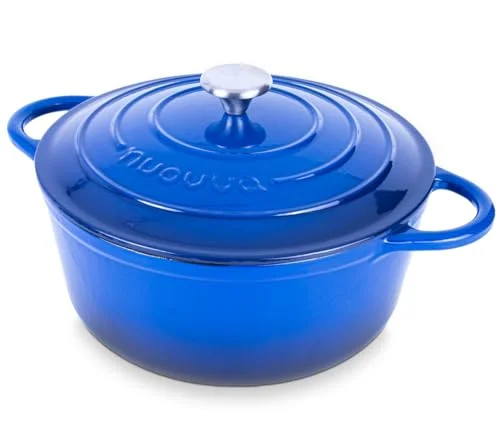
Nuovva Enamelled Cast Iron Dutch Oven, 6.4 Quart, Dark Blue

Best for buyers who want a number, not a guess

6.4 quarts·Oven safe to 500°F·Non-stick interior, per listing·28cm

This is the one listing of the three that states an oven-safe temperature outright, in its own title and bullet points, rather than leaving you to extrapolate from a similar-looking pot. That single published figure is worth more to us than a star rating would be, because a rating tells you how early buyers felt about the pot generically, while 500°F is a number you can hold the seller to directly. At 6.4 quarts it is also the largest of the three, which fits a household cooking for four to six rather than one or two.

The brand told us the one thing that actually matters before you put this in an oven. That is a better signal than a star we have no way to verify anyway.

Nuovva enamelled cast iron Dutch oven, 6.4 quart, dark blue
Price
$44.99
Check price →
02Lowest entry price

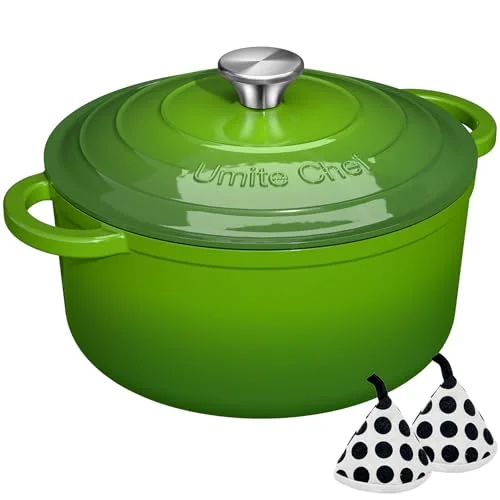
Umite Chef 5QT Enameled Cast Iron Dutch Oven, Green

Best if you're deciding whether you'll use a Dutch oven at all

5 quarts·Enameled cast iron·Heavy-duty, per listing·$42.99

At $42.99, this is the cheapest way into the category among the three pots here, and the price itself lowers the stakes of buying something unrated. The listing is specific about intended use — bread baking, braising, stews, roasting — and is explicitly marketed toward gift-giving occasions like wedding registries, which tells you the seller expects it to be given once and used for years, not treated as disposable. It does not publish an oven-safe figure or a weight, so we are not assigning either here; check the current listing before a long high-heat roast.

The spec gap here is real. At this price, with a 30-day Amazon return window behind it, it is a reasonable gap to accept.

Umite Chef 5QT enameled cast iron Dutch oven, green
Price
$42.99
Check price →
03Middle ground

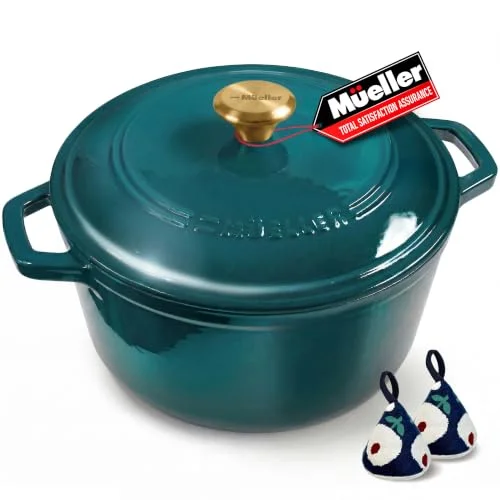
Mueller DuraCast 6 Quart Enameled Cast Iron Dutch Oven

Best for the household-default size at a mid-range price

6 quarts, round·Enameled cast iron·$49.27

Six quarts is the capacity most households actually reach for week to week — a whole chicken, a loaf, a stew for six — and Mueller sells cookware as its core business rather than as one listing among unrelated categories, which is itself a small point in favor of the brand sticking around to honor a return claim. Like the Umite Chef, this listing does not publish an oven-safe temperature or a weight, so treat both as unknowns to verify on the current page rather than specs we can repeat with confidence.

Nothing here is dramatic. A sensible size, a mid-range price, and two spec gaps worth checking before you buy — which is the honest state of most of this category.

Mueller DuraCast 6 quart enameled cast iron Dutch oven
Price
$49.27
Check price →
Our method

How we compared

What we did

Specs, policy pages and photos, read directly

We compared the published specifications, current Amazon prices, stated return and warranty terms, and the full photo gallery for the Umite Chef 5QT, the Mueller DuraCast 6 Quart and the Nuovva 6.4-Quart, limiting every claim in this guide to what each seller actually states on the listing or on their own storefront. Where a figure such as weight or oven-safe temperature is not published for a given pot, we say so directly rather than estimate it from a similar-looking product in the same category.

What we didn’t

We don’t run a testing lab, and we don’t invent ratings

We do not physically test these pots, we do not own them, and we have no star ratings or review counts for these specific listings to report — so none are shown anywhere on this page, and we do not paraphrase sentiment we don't have. What we can do honestly is read the spec line, the policy section and the product photography the same way any careful buyer would, and tell you plainly where a listing goes quiet. See more on the About page.

FAQ

Common questions

Does a Dutch oven need a star rating to be worth buying?

No. A star rating attaches to one specific ASIN, not to a brand or a product line, and enameled Dutch ovens are listed in enough color and size variants that a genuinely established pot can easily show zero reviews on the exact combination you're viewing. The rating measures how many buyers of that specific listing left feedback, not whether the pot itself is well made.

What should I check instead of star ratings?

Four things, in this order: the spec line (capacity, oven-safe temperature, weight, read plainly off the listing), the return window and any stated warranty, the product photos zoomed in on the rim, handle welds and interior finish, and whether the brand sells replacement parts like a knob or a lid. None of these require owning the pot first, and together they tell you more than a rating would.

Why do some Dutch oven listings on Amazon have zero reviews?

Usually because the listing is a newer color or size variant of an otherwise established product. Amazon tracks reviews per ASIN, and a seller offering five colors across three sizes is technically running fifteen separate listings, each starting at zero until buyers of that exact variant leave feedback. Dutch ovens are also a low-repurchase category, so even well-selling variants accumulate reviews slowly.

Do these brands sell replacement parts?

We checked and did not find a dedicated parts listing for the Umite Chef, Mueller DuraCast or Nuovva pots named in this guide, which is typical for smaller cookware importers at this price point. That means a damaged lid or knob is more likely to mean replacing the whole pot than ordering a single part — worth weighing against the lower upfront price of all three.

Keep reading

More from Best Dutch Ovens