Best Dutch Ovens
Roundup · A First Dutch Oven

The Best Dutch Ovens for Someone Who Has Never Owned One

A first Dutch oven should not come with homework. No seasoning ritual to learn before dinner, no printed temperature to guess at, no enamel so thin that one distracted scrub leaves a mark you'll see for years. We compared published specs and current prices for three enameled cast-iron pots sized and priced for exactly this moment — the first one — to find the ones that forgive what a first-time owner doesn't yet know.

By Ilane Tall · Updated November 2, 2026 · Research-based.

Affiliate disclosure: we may earn a commission if you buy through the Amazon links on this page, at no extra cost to you.

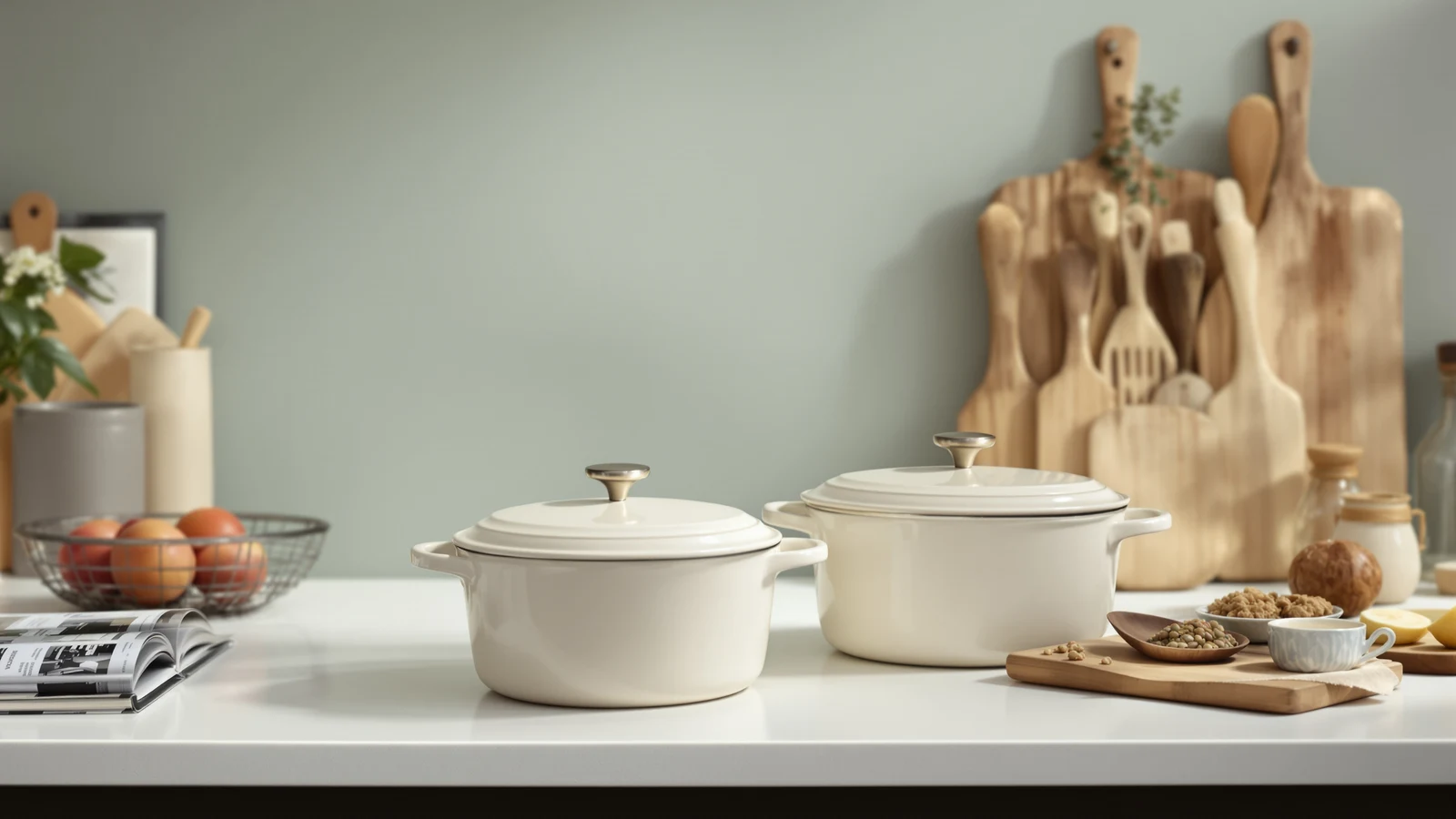
A white enameled cast iron Dutch oven with its lid resting beside it on a kitchen counter, set up for a first-time cook
Before you buy

What a first Dutch oven should not ask of you

If you have never owned one, a Dutch oven is not a tool you are evaluating — it is a bet you are placing on whether you will cook differently once you have a heavy, lidded pot in the cupboard. A good first pot should not raise the stakes on that bet. It should not require you to already know how to season metal or recognize the smell of a pan that has been left wet too long. Those are bare cast-iron skills, and nobody should need them to braise a chicken thigh on a Tuesday.

It should also not leave you guessing at a number nobody printed. None of the three pots in this guide — the Overmont 5.5QT, the Umite Chef 5QT or the Umite Chef 6QT — list a specific oven-safe temperature in the specifications available to us, which is common across this category at every price point. What they do give a first-time buyer instead is a lower bar to clear before the first use: the Overmont ships with a cookbook and cotton potholders, and the 5QT Umite Chef ships with potholders as well, so the accessories a beginner doesn't yet own are already in the box.

And it should not punish the mistakes that come with learning. Every new owner eventually walks away from a simmering pot a beat too long, scrubs harder than they should, or turns a burner up out of habit from a different pan. The right first Dutch oven is enameled specifically so that none of those ordinary mistakes are permanent — which is the whole case for the next section.

Material, not marketing

Why enameled, not bare iron, for a beginner

Bare cast iron and enameled cast iron hold heat the same way, because underneath the enamel is the same iron. The difference a first-time owner actually feels is everything bare iron demands before you can use it at all: a seasoning layer of baked-on oil built up in several rounds, a habit of drying it within minutes of washing so it doesn't flash rust, and a wariness around tomatoes and wine until the seasoning can tolerate acid. None of that is difficult once you know it. All of it is a reasonable thing to not know yet, which is exactly the position a first-time buyer is in.

Enamel removes that entire checklist. It is glass, fused onto the iron at high heat, and it arrives ready: no seasoning cycle before the first meal, no rust risk if a wet pot sits in the sink overnight, no need to think twice before reducing a tomato sauce for two hours. The Overmont 5.5QT, the Umite Chef 5QT and the Umite Chef 6QT are all enameled cast iron for exactly this reason — each is built and sold for braising, stews, roasting and bread, without asking the owner to maintain a seasoning layer to get there.

What enamel does not remove is the fact that it is glass. It will not rust, but it can chip if a metal spoon scrapes it hard enough or stain if a dark sauce sits too long before washing. Those are cosmetic risks, not functional ones — a chipped or stained pot still cooks the same braise. For a first pot, trading a demanding material for a forgiving one is the right trade, which is why every pot recommended here is enameled rather than bare.

Read this before the first use

The one setting mistake that ruins a first pot

If you take one piece of advice from this guide and skip the rest, take this one: never put an enameled Dutch oven on a stovetop burner set to high, especially when the pot is empty or nearly dry. Enamel is glass fused to iron, and glass does not tolerate a sudden jump from room temperature to the highest setting on a burner the way stainless steel does. The thermal shock can craze or discolor the interior enamel the very first time it happens, long before braising — slow, moist, and gentle on the pot — would ever cause a problem.

This mistake is specifically a first-timer's mistake because it is a habit imported from other cookware. Stainless and nonstick pans are often used on high heat to sear quickly, so a new owner reaches for the same knob out of muscle memory. Enameled cast iron is built around the opposite instinct: low to medium heat, more time, and let the thick walls hold and distribute that heat evenly. This is true across the enameled cast-iron category at every price — physics acting on glass over iron, not a brand-specific quirk of any one pot.

The same caution extends to the oven, and it matters more here because none of the three pots in this roundup publish a specific oven-safe temperature in the information available to us. Without a printed ceiling, the honest move is to check the current Amazon listing before pushing any of them past a moderate roasting temperature, remembering that the lid knob is very often the actual limiting part on a Dutch oven, not the pot body itself. If you're also weighing whether your stovetop is a fit for enameled cast iron — particularly a glass or induction surface — that's covered in our stovetop compatibility guide.

Side by side

The three, compared

PotBest forCapacityMade byNotablePriceGet it
Overmont Enameled Cast Iron Dutch Oven, 5.5QT A first pot, overall 5.5 qt Overmont Includes cookbook and cotton potholders $52.99 Get it
Umite Chef Enameled Cast Iron Dutch Oven, 5QT A smaller kitchen or a couple 5 qt Umite Chef Includes cotton potholders, red enamel $39.99 Get it
Umite Chef Enameled Cast Iron Dutch Oven, 6QT Carrying it confidently when full 6 qt Umite Chef Dual handles, grey enamel $39.99 Get it
The picks

Our picks, and who each one is for

01Best overall

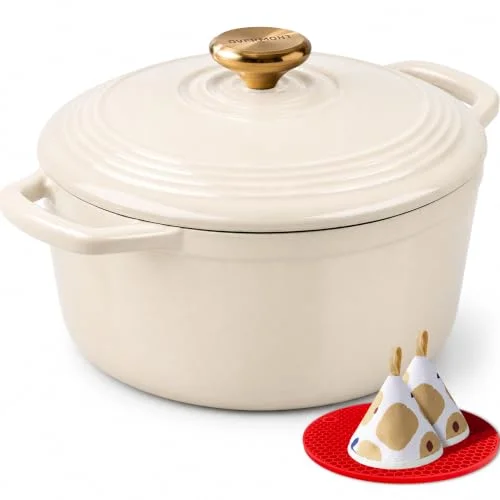
Overmont Enameled Cast Iron Dutch Oven, 5.5QT, White

Best for a first pot, full stop

5.5 quarts·White enamel·Cookbook included·Cotton potholders included

At $39.99, this is the pot that removes the most friction for someone starting from zero. Overmont sells it specifically for braising, stews, roasting and sourdough baking, and includes a cookbook in the box — which matters more for a first-time owner than it would for a fifth pot, because the question a beginner actually has isn't "is this good cookware," it's "what do I cook in it first." The cotton potholders solve the same problem from the other direction: a full enameled pot coming out of the oven is heavy, and a first-time owner may not yet own mitts rated for that job. 5.5 quarts is a forgiving size — large enough for a stew for four to six, small enough to fit comfortably on a standard oven shelf.

If you only want to buy one thing and start cooking tonight, this is the one with the fewest gaps.

Overmont enameled cast iron Dutch oven, 5.5 quart, white
Price
$52.99
Check price →
02Best smallest

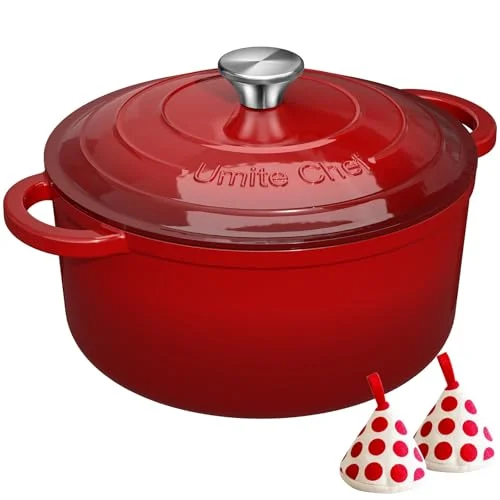
Umite Chef Enameled Cast Iron Dutch Oven, 5QT, Red

Best for a smaller kitchen or a household of two

5 quarts·Red enamel·Cotton potholders included·Made by Umite Chef

Also $39.99, but a half-quart smaller than the Overmont above it, which is the right trade if counter space and cupboard room are tight or if you are cooking for one or two rather than a full table. Umite Chef builds it for bread baking, braising, stews and roasting, and bundles cotton potholders the same way the Overmont does, so you are not short that one accessory on day one. Five quarts is still a real Dutch oven — enough for a weeknight braise or a loaf of bread — it is simply the lower-commitment size on this page.

The right choice if you'd rather start a size smaller than find out later you bought more pot than your kitchen or your household needs.

Umite Chef enameled cast iron Dutch oven, 5 quart, red
Price
$39.99
Check price →
03Best to carry full

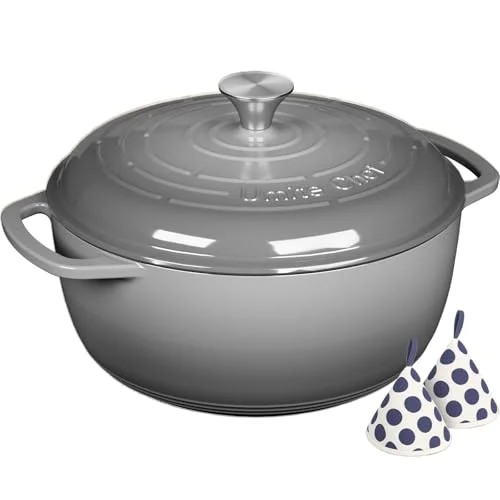
Umite Chef Enameled Cast Iron Dutch Oven, 6QT, Grey

Best if you're nervous about lifting a heavy pot one-handed

6 quarts·Dual handles·Grey enamel·Versatile, heavy-duty build

Same price again, $39.99, but the largest of the three at six quarts and the only one whose listing specifically calls out dual handles. That detail matters more for a first-time owner than it sounds: a six-quart pot full of stew is genuinely heavy, you'll be lifting it out of a hot oven in thick mitts rather than with bare hands, and a pot with two substantial, symmetrically placed handles is a safer object to carry than one you compensate for with an awkward grip. Umite Chef markets this size for bread baking, braising, stews and roasting, the same range as the smaller two, just with more room and a steadier carry.

The extra quart is nice. The two hands' worth of handle to hold it by is the actual reason to pick this one as a beginner.

Umite Chef enameled cast iron Dutch oven, 6 quart, grey, dual handles
Price
$39.99
Check price →
The first few weeks

Cleaning it the first ten times

The first ten uses are when a habit gets set, for better or worse, so it's worth being deliberate rather than improvising. Let the pot cool from cooking heat to merely warm before it touches water — plunging a hot enameled pot into a cold rinse is the same thermal-shock risk discussed above, just arriving through the sink instead of the stovetop. Wash by hand with warm water, a mild dish soap and a sponge or nylon brush, even if the listing says the pot is dishwasher-safe; establishing the gentler habit now costs nothing and avoids finding out the hard way what years of dishwasher detergent do to an enamel finish.

Skip metal scouring pads and steel wool entirely, on day one and every day after. Baked-on food releases with warm water and a little time far more reliably than it does with force, and force is exactly what puts the first chip in an enamel surface that would otherwise last years. If you're unsure how much handling a pot's enamel and handles were built to take over time, our guide on how much a Dutch oven actually weighs is a useful companion read, since a heavier full pot is also an easier one to bump against a sink edge while cleaning.

One more thing worth checking on your own pot, since it varies by manufacturer and isn't a spec any of the three listings here publish: many enameled Dutch ovens leave a narrow ring of bare, unglazed cast iron on the underside, around the base. That ring can rust if left wet, even though the enamel everywhere else cannot. Look at the bottom of your pot after the first wash, and if you find an unglazed ring, dry it promptly every time — it's the one spot on an otherwise rust-proof pot where the old bare-iron rules still apply.

Start here

What to learn to cook in it first

Start with a braise, not bread, even though two of these three pots are marketed with bread and sourdough baking in mind. A weeknight braise — chicken thighs with vegetables, a pot roast, a pot of beans simmered low for an hour — uses exactly the heat a Dutch oven is best at: moderate, moist, and sustained, with the lid on. It is also the gentlest way to learn how your specific pot distributes heat, since nothing here involves the high, dry heat that caused the problem above. For a first project with real guardrails, our guide to cooking a whole chicken or a pot roast walks through exactly that kind of forgiving dish.

Bread, by contrast, is usually the second or third thing to attempt, not the first. Baking a loaf typically means preheating the empty pot inside a very hot oven, often in the 450 to 500°F range, before the dough goes in — and none of the three pots here publish a specific oven-safe ceiling for us to confirm against that preheat. That doesn't mean it can't be done; the Overmont is sold with sourdough baking specifically in mind, cookbook included. It means it's worth getting comfortable with moderate, moist heat first, checking the current listing for oven-safe guidance, and treating your first loaf as the second project rather than the first night's dinner.

However you start, resist the urge to fill any of these pots to the absolute brim on the first attempt. A Dutch oven that's three-quarters full braises evenly and is easier to carry; one filled to the rim is more likely to spit hot liquid when the lid comes off, which is a bad first impression that has nothing to do with the pot itself.

Our method

How we compared

What we did

Specs and current prices, read for a first-time buyer

We compared the published specifications and current Amazon prices for the Overmont 5.5QT, the Umite Chef 5QT and the Umite Chef 6QT, reading each listing specifically for what it tells a total beginner: capacity, included accessories, handle design, and anything stated about care or oven temperature. Where a detail such as a specific oven-safe figure is not published for a given pot, we say so rather than borrow a number from a similar-looking listing. See more on how we approach every guide on this site, including the limits of what we can tell you without a star rating, in our guide to judging a Dutch oven without one.

What we didn’t

We don’t run a testing lab

We do not physically test these pots, we do not own them, and we have no verified star ratings or review counts for these three listings, so we have not invented any. What matters most to a first-time buyer — how forgiving a pot is of an early mistake — is a question about the category and the material, not something a few days with any single pot could answer honestly, by us or by anyone claiming otherwise. We've answered it instead from how enamel and cast iron behave generally, and been explicit everywhere a specific spec simply isn't published.

FAQ

Common questions

Which of these three is the right first Dutch oven?

The Overmont 5.5QT at $39.99 is the safest default: it includes a cookbook and potholders, and 5.5 quarts suits most households' weeknight cooking without being unwieldy. Choose the Umite Chef 5QT if your kitchen or household is smaller and you'd rather start a size down. Choose the Umite Chef 6QT if you want the most capacity and the reassurance of dual handles when the pot is full and heavy.

Do I need to season an enameled Dutch oven before using it?

No. Seasoning is a requirement of bare cast iron, not enameled cast iron. All three pots in this guide are enameled, which means they are ready to cook in straight out of the box, will not rust if left wet, and can handle acidic ingredients like tomatoes or wine without any special preparation.

What's the one mistake that ruins a lot of first Dutch ovens?

Putting it on a stovetop burner set to high, especially when it's empty. Enamel is glass fused to iron, and a sudden jump to high heat can craze or discolor it through thermal shock before a single meal is ever cooked in it. Enameled cast iron is designed to be used on low to medium heat, letting the thick walls hold and spread that heat slowly instead.

What should I cook in a Dutch oven for the first time?

A simple braise: chicken thighs, a pot roast, or a pot of beans, cooked low and slow with the lid on. That kind of moist, moderate heat is the safest way to learn how your specific pot behaves, and it avoids the high, dry heat that causes most early mistakes. Save bread and sourdough, which usually call for preheating an empty pot at a high oven temperature, for once you're comfortable with how the pot handles gentler cooking first.

Keep reading

More from Best Dutch Ovens